The alpha, twice a week
That was 4 min.
Get the best new moments in your inbox every Wednesday and Saturday. It's free.
Check your inbox
We sent a link to your address. Click it to finish signing up. Not there in a minute? Look in spam.
or
Unsupervised Learning · 4 min · Mar 17, 2025
Agent research depends on choosing the right environment
 Jack Rae
 says agents need useful interactive settings such as browsers or codebases, and designing those settings is a major research challenge.
In this episode
Full analysis- 19:34Inference is cheap enough to justify much more thinking6 min
- 25:29AI math progress depends on asking better questions6 min
- 31:48Research teams need both bottom-up and top-down bets8 min
- 9:39Qualitative tasks need broad reward criteria2 min
- 15:57Agent research depends on choosing the right environment4 min
- 42:03Use one model unless specialization earns its cost2 min
- 1:06:30Inference-heavy AI can use more distributed compute3 min
- 58:15Hallucinations made entertainment a natural early use2 min
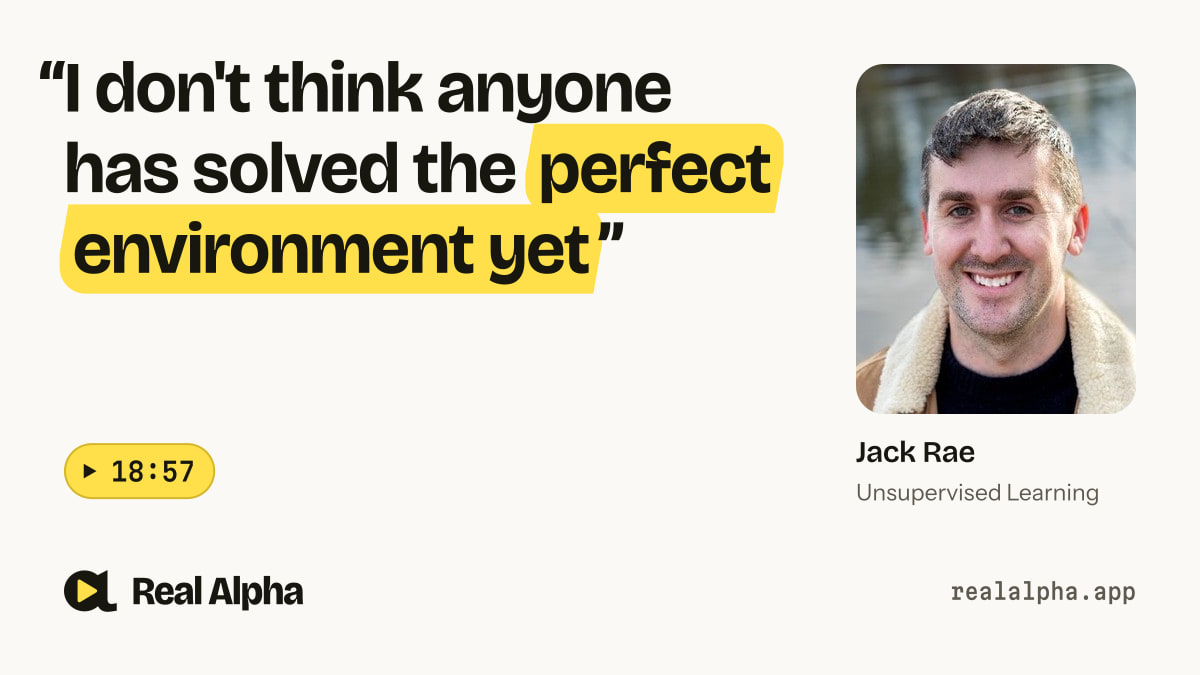
“I don't think anyone has solved the perfect environment yet”
 Jack Raeat 18:57 · Unsupervised Learning
Takeaways
- Web interfaces and codebases are candidate agent environments.
- Environment design is a research bottleneck, not just model quality.
- Changing training for interactive tasks carries substantial engineering cost.
About this segment
Jack Rae says agents need useful interactive settings such as browsers or codebases, and designing those settings is a major research challenge. The environment may matter as much as a new algorithm.

Research Director, DeepMind
Led Gemini Thinking, co-led Gemini pre-training, and contributed to Gopher and Chinchilla language-model scaling research.

Jacob Effron, Host · Partner, Redpoint
Growth investor in Abridge, Ramp and Physical Intelligence; ex-Flatiron Health.
From “Noam Shazeer and Jack Rae: Scaling Test-time Compute, Reactions to Ilya & AGI”, Mar 17, 2025. Watch the full episode
Thanks. We'll look at and fix what's off.
Transcript
Transcribed by machine (Whisper) from the episode’s audio, so a word may be off here and there.
- 16:02
I think you both talked before about, you know, to get really, you know, agents more widely used, you kind of need to solve both complexity of reasoning and then also reliability. How would you kind of characterize where we are today in terms of applying, you know, Gemini models toward these problems? and what is the actual path to getting better at a bunch of these things? I mean, there are a lot of answers.
- 16:20
I mean, one is just make the model smarter. That will always help. And, you know, most likely, you need very general solutions for... For, you know, for these control problems, you know, just like you need general solutions for the intelligence problems because, you know, people are going to use these things in so many unforeseen ways. You know, like you cannot, you can't anticipate it. The users are smarter than the developers in figuring out what the use cases are.
- 17:10
You know, no one envisioned like when they invented the internet, like what the internet was going to be for. No one envisioned when they invented computers, what computers are going to be for. And then, you know, AI is, you know, is getting so, so general these days that it's even more true. We're just building a product with billions and billions of use cases that are unanticipated. So we will need to build the general solutions for all of it.
- 17:47
How far away does it feel like we are from that kind of like next level of complexity and reliability? I don't want to give a precise like, is it six months? Is it 18 months? Is it 24 months? But I think a lot of really the time actually is not so much dependent on the, in my opinion, is like not really about like the core algorithmic AI development. There's part of it is just like there's a lot of even like engineering challenges to really changing the whole way you train to being in more complex agentic environments that that has like some like almost constant time but non-trivial cost to like switch how we do research.
- 18:29
So I feel like agentic research, it seems like a lot of the upfront challenges like it's no longer going to be very simple prompts and responses. we're now going to act in an environment so how you define those environments that kind of angle though has at the very least been something that DeepMind has been brought in on even since I joined in 2014 it's always been about there's part of building AGI which is like figuring out a really good agent and there's part which is figuring out a really good and general environment I don't think anyone has solved the perfect environment yet and you know there's some obvious ones there's a notion of like using like a web UI and being able to automate many web tasks.
- 19:14
There's a notion of having a code base and being able to work within that code base and do many useful things. But I think picking out those, if you can pick out a really good environment, then we can accelerate a lot of agentic research in that environment and build really good algorithms. And I feel like that's as big a part of the challenge as any given breakthrough in attention or in long context or reinforcement learning.
- 19:38
How high do you guys think the ceiling is for continuing on this like test time compute vector? I mean, obviously you've, you know, I think very publicly like Ilya's come out and said