The alpha, twice a week
That was 2 min.
Get the best new moments in your inbox every Wednesday and Saturday. It's free.
Check your inbox
We sent a link to your address. Click it to finish signing up. Not there in a minute? Look in spam.
or
Unsupervised Learning · 2 min · Mar 17, 2025
Hallucinations made entertainment a natural early use
 Noam Shazeer
 says Character AI began as a broad way to explore LLM uses, then saw entertainment emerge while models still hallucinated.
In this episode
Full analysis- 19:34Inference is cheap enough to justify much more thinking6 min
- 25:29AI math progress depends on asking better questions6 min
- 31:48Research teams need both bottom-up and top-down bets8 min
- 9:39Qualitative tasks need broad reward criteria2 min
- 15:57Agent research depends on choosing the right environment4 min
- 42:03Use one model unless specialization earns its cost2 min
- 1:06:30Inference-heavy AI can use more distributed compute3 min
- 58:15Hallucinations made entertainment a natural early use2 min
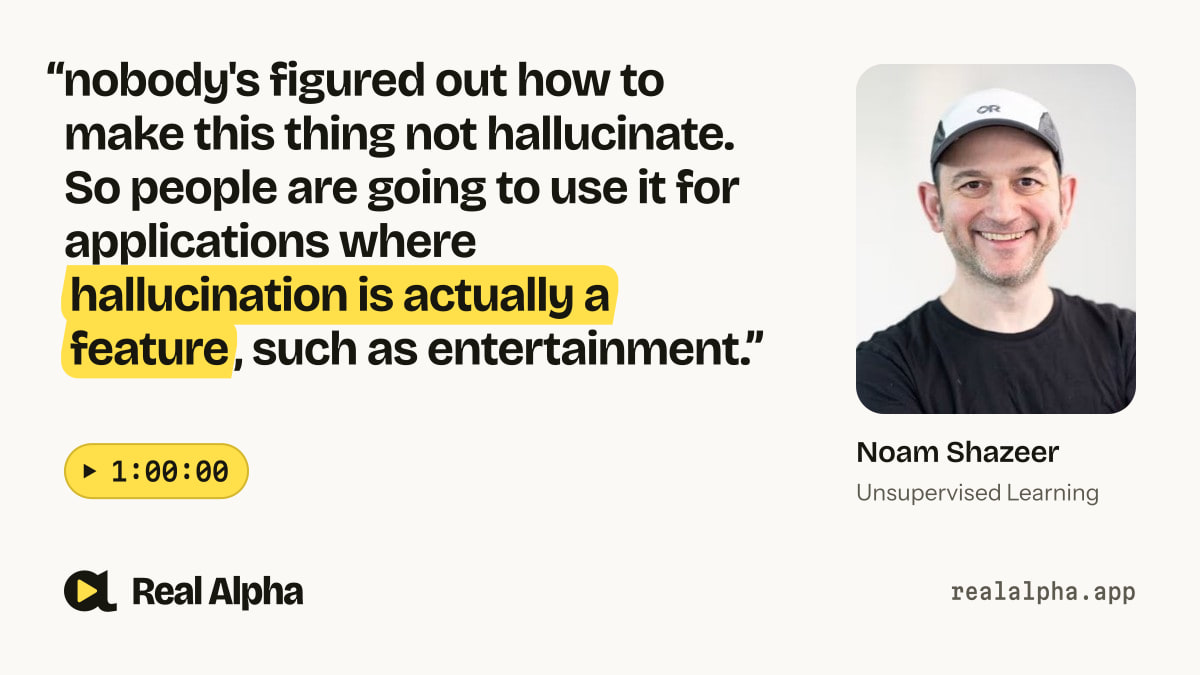
“nobody's figured out how to make this thing not hallucinate. So people are going to use it for applications where hallucination is actually a feature, such as entertainment.”
 Noam Shazeerat 1:00:00 · Unsupervised Learning
Takeaways
- Character AI began as a broad way to explore LLM uses.
- Users gravitated to entertainment while models still hallucinated.
- In some applications, unreliability can be part of the appeal.
About this segment
Noam Shazeer says Character AI began as a broad way to explore LLM uses, then saw entertainment emerge while models still hallucinated. Unreliability could fit role-play better than high-stakes tasks.

OpenAI; co-author of the Transformer
Designed multi-head attention in the Transformer, and worked on sparse Mixture of Experts, Mesh-TensorFlow and T5.

Jacob Effron, Host · Partner, Redpoint
Growth investor in Abridge, Ramp and Physical Intelligence; ex-Flatiron Health.
From “Noam Shazeer and Jack Rae: Scaling Test-time Compute, Reactions to Ilya & AGI”, Mar 17, 2025. Watch the full episode
Thanks. We'll look at and fix what's off.
Transcript
Transcribed by machine (Whisper) from the episode’s audio, so a word may be off here and there.
- 58:19
kind of building out character and yeah a lot about kind of that product space of what like you know uh ai companions and the ability for folks to to chat with all sorts of different kinds of people what do you you know what do you feel about where that space is today what kind of like problems, do you feel like we still need to solve there? Yeah, I mean, it's interesting because the main reason I left Google to start Character was I thought that the biggest thing that the LLM industry could use was an application where anybody can go and interact with LLMs and use them and discover use cases that were that were good for them.
- 59:00
And, you know, because this was before, you know, before ChatGPT launched, before Gemini launched. So, I mean, mission accomplished. Everyone's out there talking to OLMs now. But, which is kind of different from how things are now. I guess the other thing was, you know, going into character, we were not really focused on, hey, this is going to be uh an entertainment product or something or something else we kind of just went in with an open mind and we're like okay um you know we're going to just put this out there in a general way we're going to help um help people conceptualize this as you know okay this thing can um you know take on different personas meaning it's a you know it's a very very general technology see what you can make it do.
- 59:57
And definitely, we found a lot of people are using it for entertainment, I think partially because at that point in the technology, like, OK, nobody's figured out how to make this thing not hallucinate. So people are going to use it for applications where hallucination is actually a feature, such as entertainment. then, you know, that's, you know, I think that's worked pretty well. I know a lot of people like using character.