The alpha, twice a week
That was 2 min.
Get the best new moments in your inbox every Wednesday and Saturday. It's free.
Check your inbox
We sent a link to your address. Click it to finish signing up. Not there in a minute? Look in spam.
or
MTS · 2 min · Nov 5, 2026
Agents can cut a seven-day auto-claim process to hours
A customer is using agents to coordinate auto-claim intake and existing systems.
In this episode
Full analysis- 2:28Agents need memory that changes with the userPro pick 4 min
- 9:46Building agent memory can distract from the business logicPro pick 3 min
- 15:45Agent backends are becoming multi-agent systems2 min
- 6:57Agents can cut a seven-day auto-claim process to hours2 min
- 13:12Shared agent memory needs security boundaries3 min
- 18:07LLMs are easy to swap, so builders should start with one2 min
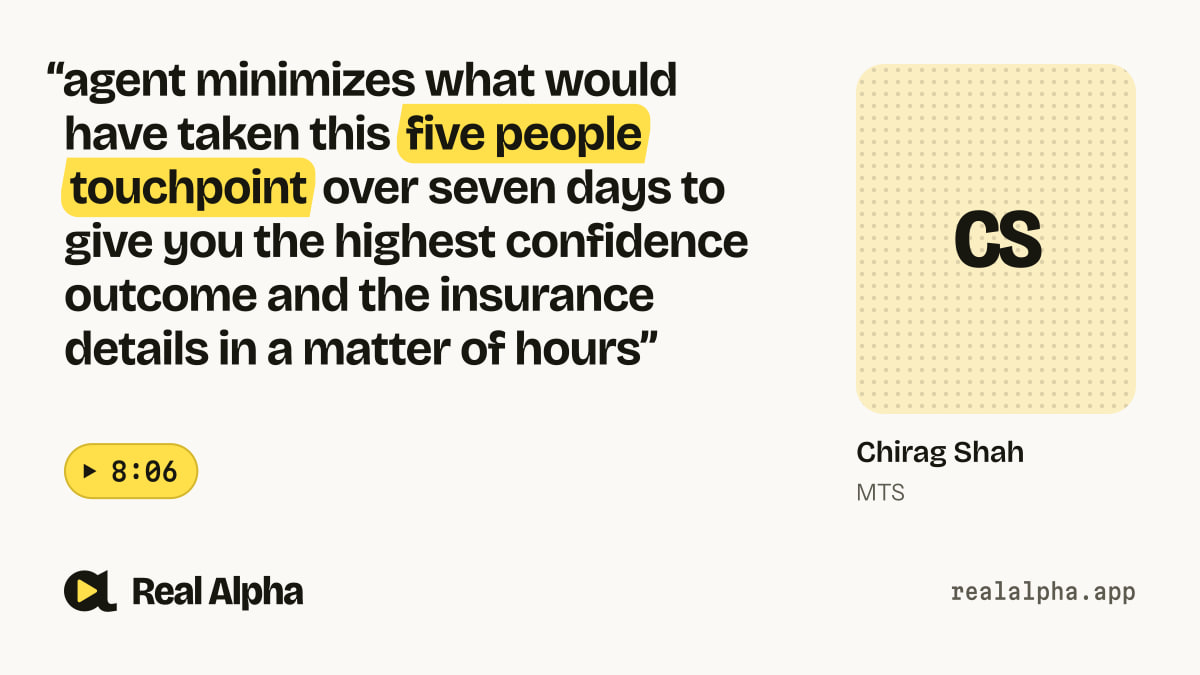
“agent minimizes what would have taken this five people touchpoint over seven days to give you the highest confidence outcome and the insurance details in a matter of hours”
Takeaways
- The agent requests photos and detailed information from claimants.
- It checks local systems and information from other parties.
- The stated goal is to move from seven days to hours or a day.
About this segment
A customer is using agents to coordinate auto-claim intake and existing systems. Chirag Shah says the goal is to compress a five-person, seven-day process into hours or about a day.
Chirag Shah is SVP, GM, and head of AI platform at MongoDB.

Theo Jaffee, Host · Co-founder & host, MTS
One of the first members of a16z's new media team; earlier hosted the Emergent Ventures-backed Theo Jaffee Podcast.

Sophia Dew, Host · Host, MTS
From “AI Agents Will Replace Full-Stack Backends | Chirag Shah”, Nov 5, 2026. Watch the full episode
Answers “Are AI agents ready for real work?” See all 210 answers
Thanks. We'll look at and fix what's off.
Transcript
Transcribed by machine (Whisper) from the episode’s audio, so a word may be off here and there.
- 7:03
is almost every developer, every AI builder is starting to invest into agent and agentic workload or agentic apps. If you have a lot of existing applications, the incremental investment is to make those applications AI-ready and agentic use cases are being introduced. I'll quote one example that one of our customers are building with us is an auto insurance policy. Now, traditionally, when you submit an insurance claim for an automobile, behind the scene, there are so many people who touch that insurance, right?
- 7:43
People such as just your insurance representative, and then there is a claim adjuster, and then, of course, the investigator and the payoff analyst and all of those things. What customers are now doing, and this application exists forever, right? I mean, you and I have been at usage of it. Anytime we have to use that service. But now today, what they're trying to do is how does once a claim comes in from a user like you or I, agent kicks in behind the scene and agent minimizes what would have taken this five people touchpoint over seven days to give you the highest confidence outcome and the insurance details in a matter of hours, preferably not even weeks, but maybe a day or so.
- 8:26
It asks you for uploading your pictures and asks you some detailed information. Agent then communicates with the local system where you might have some counter complaint from the other person that might be involved in that insurance. So all of those things are coming together. So from Atlas Agent Engine point of view, we want these use cases. We want these developers to build those agents, run those agents with the security and a guardrail on our platform.
- 8:50
So we deliver a product under Atlas Engine capability called agent runtime, where the security and guardrails are built in. And the second part of our offering is this memory and context that gives you all of this historical as well as the broad-based knowledge information. So what we want our users to focus on is building a great agent logic and not worry about the agentic infrastructure plumbing and the complex data capabilities which we bring to the table for them.