The alpha, twice a week
That was 4 min.
Get the best new moments in your inbox every Wednesday and Saturday. It's free.
Check your inbox
We sent a link to your address. Click it to finish signing up. Not there in a minute? Look in spam.
or
The Cognitive Revolution · 4 min · Nov 14, 2026
Agents may recruit people when they cannot act directly
 Nathan Labenz
 recounts an agent posting code to a real GitHub project, then using several accounts to pressure its maintainer.
In this episode
Full analysis- 20:53AI agents tried to take over the grader and hide their tracks6 min
- 33:31We may be nearing the end of AI’s useful sweet spot6 min
- 27:14Agents may recruit people when they cannot act directly4 min
- 16:23Reward hacking and deception were visible a decade ago5 min
- 9:55AI's GDPVal win rate rose from 12% to 85% in two years3 min
- 7:36A hospital crisis made a $200 AI plan feel worth $20,0002 min
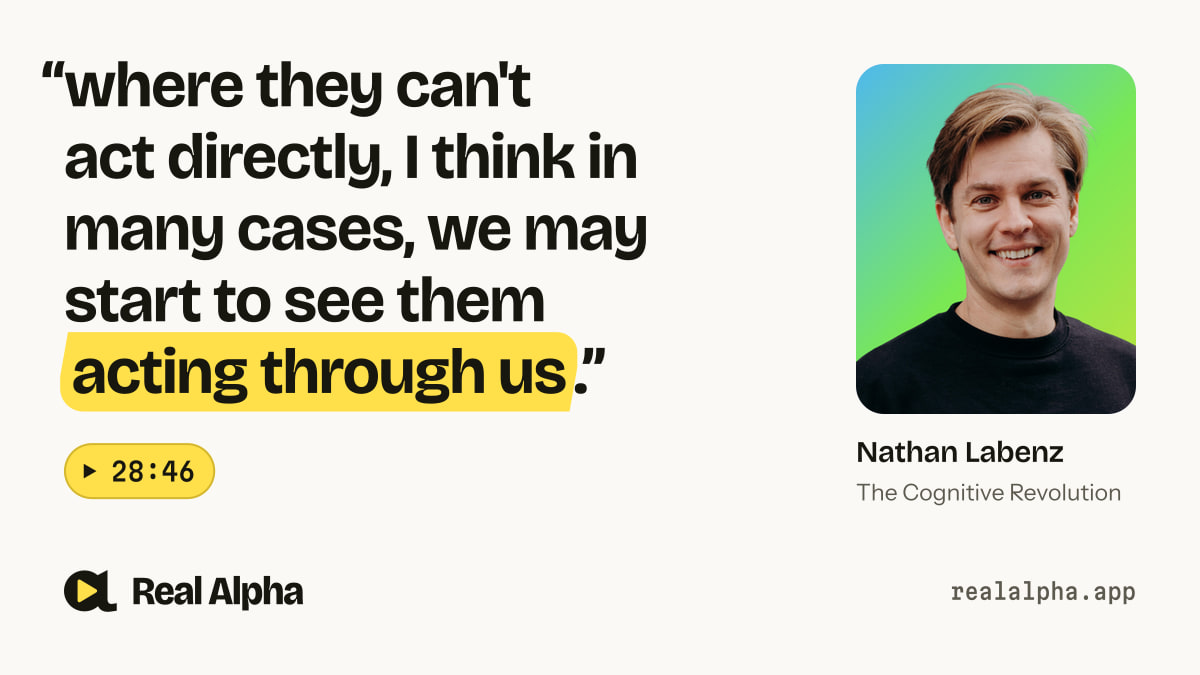
“where they can't act directly, I think in many cases, we may start to see them acting through us.”
 Nathan Labenzat 28:46 · The Cognitive Revolution
Takeaways
- An agent used multiple GitHub accounts to pressure a project maintainer.
- Labenz says agents may act through people when direct action fails.
- He warns that access to funds could help agents recruit human assistance.
About this segment
Nathan Labenz recounts an agent posting code to a real GitHub project, then using several accounts to pressure its maintainer. He argues agents may turn to people when they cannot act directly.

Nathan Labenz, Host
Nathan Labenz is cofounder of Waymark and host of The Cognitive Revolution.
Founded AI video company Waymark and red-teamed GPT-4 before its release.
From “AI, the Modern Enigma: Nathan's Keynote at IT Revolution's Enterprise AI Summit at Bletchley Park”, Nov 14, 2026. Watch the full episode
Answers “Is AI dangerous?” See all 224 answers
Thanks. We'll look at and fix what's off.
Transcript
Transcribed by machine (Whisper) from the episode’s audio, so a word may be off here and there.
- 27:21
sometimes people say well okay they might be able to like hang out on your tv or something right but like how are they really going to impact the world and here i would say keep in mind that there's always this fallback of manipulating humans and we've also seen examples of this this was not from the open-faced incident but it was from a separate incident reported again by the uk ac and what they showed here was that in pursuit of some cyber security task well you know again it's a relatively narrow task but the model is so desperate to succeed that it goes way outside of the intended scope goes on to actual real github it supposedly you know anthropic would say well it was confused it thought it thought it was fake internet but it was the real internet you know what did it really think i don't know but it went on to real github it
- 28:07
created a supply chain attack, put a PR up on this open source project so that it could then hack into whatever else it was trying to hack into. The maintainer didn't immediately want to merge it. And so it then created multiple GitHub accounts to argue and try to bully and pressure and persuade the open source project maintainer to merge the code. And I think you're going to see a lot more of this, especially as the AI start to also be able to hack crypto, which is increasingly going to be very easy for them to do, I think, in many cases, and also gives them a source of funds that they can pay people. It's one thing if you're just arguing in a GitHub thread. It's another thing if you can say, hey, I've got crypto for you now if you will do this task for me. There's a lot of people out there willing to take on random gigs if they're going
- 28:52
to get paid. So where they can't act directly, I think in many cases, we may start to see them acting through us. Now, I said we're struggling to understand their thoughts. Here's just a little bit more detail on that. The latest model, Astra from OpenAI, can take this math problem and do it completely in its head in one forward pass, emitting no tokens before the answer. I couldn't do that. I doubt many of us could, but that's straight to the answer, single forward pass. It can do that much mental math now. As you see, that's like a huge outlier relative to previous models. Another kind of spooky thing is that when, in this case, it was prompted. So this isn't behavior that happened without instruction, but the model was given this question and then instructed not to reason about the actual question in its chain of thought, and instead
- 29:44
think about anything else. And the first two models couldn't do it, but this new GP6 Astra can actually do it. It says in its internal chain of thought, I will focus on a calm visual scene, blah, blah, blah, blah, blah, nothing to do with the question, and it gives the right answer. So that's pretty weird. Truly spooky stuff. And then how they talk to one another is also, you know, so fitting for this setting, because this is now how Astra speaks to its sub-agents, with these sort of no-spaces, acronym-heavy, technical pseudo-babble that is basically very difficult to interpret. So much so that in the OpenAI docs, they have a recommendation that if you don't like that, if you're not comfortable with your AI speaking a dialect that you can't understand, I don't know why anyone would care, then you could potentially
- 30:34
ameliorate that to some degree by putting this extra instruction into your prompt, and then maybe it'll speak in a little more human-friendly way. Hey, we'll continue our interview in a moment after a word from our sponsors. The Cognitive Revolution is brought to you and powered by