The alpha, twice a week
That was 3 min.
Get the best new moments in your inbox every Wednesday and Saturday. It's free.
Check your inbox
We sent a link to your address. Click it to finish signing up. Not there in a minute? Look in spam.
or
Newcomer Pod · 3 min · Jun 26, 2026
AI agents may displace workers more than past technologies
 Aidan Gomez
 expects agents to spread from software development into other fields, but says AI may displace workers more than past tools did.
The episode’s best minutes
Full episode- 11:35Democratic countries need sovereign AI for resilience3 min
- 3:18Enterprise AI use can grow far beyond codingPro pick 3 min
- 18:25AI agents may displace workers more than past technologies3 min
- 3 more moments in the full episode
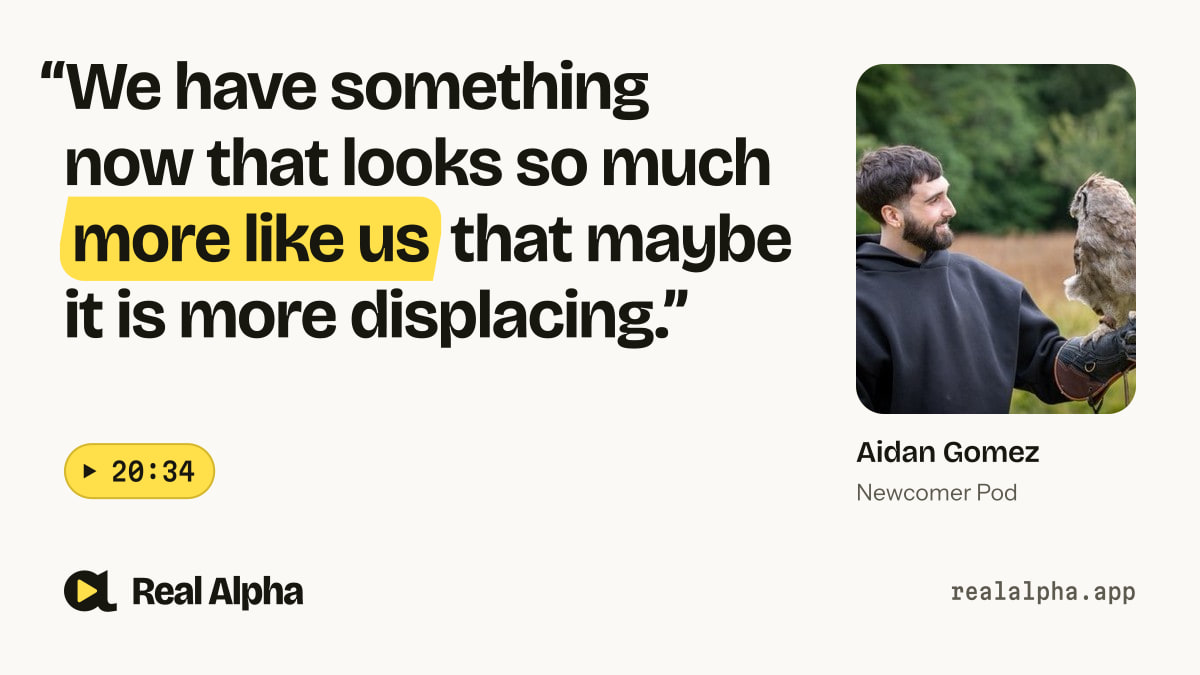
“We have something now that looks so much more like us that maybe it is more displacing.”
 Aidan Gomezat 20:34 · Newcomer Pod
Takeaways
- Agents are becoming collaborators in software development.
- AI's resemblance to human workers could make it more displacing.
- Plan for disruption with retraining and other safety nets.
About this segment
Aidan Gomez expects agents to spread from software development into other fields, but says AI may displace workers more than past tools did. He urges planning for retraining and other safeguards.

Aidan Gomez is a Cohere co-founder and Transformer co-author.
Co-founded Cohere, the sovereign AI company, and co-authored the Transformer paper, Attention Is All You Need.
- EN
Eric Newcomer, Host
From “Aidan Gomez Unfiltered on AGI, China & AI's Biggest Risk”, Jun 26, 2026. Watch the full episode
Answers “Which jobs will AI replace, and which are safe?” See all 121 answers
Answers “Will AI replace software engineers?” See all 37 answers
Thanks. We'll look at and fix what's off.
Transcript
Transcribed by machine (Whisper) from the episode’s audio, so a word may be off here and there.
- 18:27
Give us, for the last question, a sort of view of what you think the next 12 to 18 months looks like in terms of technological capability. Is it about agents? Yeah, I guess that's my answer. But if you agree, then sort of shape that up a little bit because we hear that word so often. What's that mean? Or what do you think is going to be possible certainly in the next 12 to 18 months? The shift is it's going to be entirely in the enterprise, the way we do work, who we work with, who we communicate with.
- 19:01
Increasingly, it's going to shift towards working with models. And it's already happened in this kind of microcosm of developers. Like, they spend most of their day interacting with a model to do their work. That's their collaborator that they're partnering with, and they, you know, manage it. They tell it to go do some work, comes back with a bunch of code, they give you some feedback. No, I actually meant like this.
- 19:21
Can you fix this? Increasingly, we work as colleagues with agents in software development. That will start to permeate out into many more fields. And if you look at, I mean, these are early numbers, but if you look at employment numbers, inside of software engineering, it's actually still very healthy. And so the big thing that I'm watching, concerned about, but I do remain optimistic about, is how this impacts employment and how that shapes public sentiment towards the technology.
- 19:55
I'm hopeful that, you know, whatever it's called, Jevons Paradox, where... A massively efficiency-augmenting technology emerges, you would think that would displace tons of people, but instead, demand rises... Way more productive, we need more of them. Demand rises so quickly that you actually need more people to manage these machines. But your view is you don't know which way it'll go yet. I don't know, because the counter-argument to Jevon's paradox is that with previous technological revolutions, those tools, those machines that came out, they were so far from...
- 20:26
like a loom. They're so far from a human. They're so different than us. They were so specific and narrow in terms of what they could be applied to. We have something now that looks so much more like us that maybe it is more displacing. I'm hopeful that's not the case, but I do think we need to plan for that scenario and come up with the tools to address that. Things like maybe UBI, but more likely retraining programs, potentially even right to work or, you know, jobs guarantee programs.
- 21:02
Aiden, we're at time. Thank you so much for standing up for the democratic world. I appreciate it. That's our episode.