The alpha, twice a week
That was 4 min.
Get the best new moments in your inbox every Wednesday and Saturday. It's free.
Check your inbox
We sent a link to your address. Click it to finish signing up. Not there in a minute? Look in spam.
or
a16z Podcast · 4 min · Nov 16, 2026
AI agents need coordination to outperform human organizations
 Alex Imas
 argues that AI agents are often just parallel-processing tasks, not coordinating like human teams.
The episode’s best minutes
Full analysis- 6:59AI lab valuations need productivity beyond the labsPro pick 3 min
- 11:00Double-digit growth requires ideas to compound without bottlenecks8 min
- 29:47AI agents need coordination to outperform human organizations4 min
- 4 more moments in the full episode
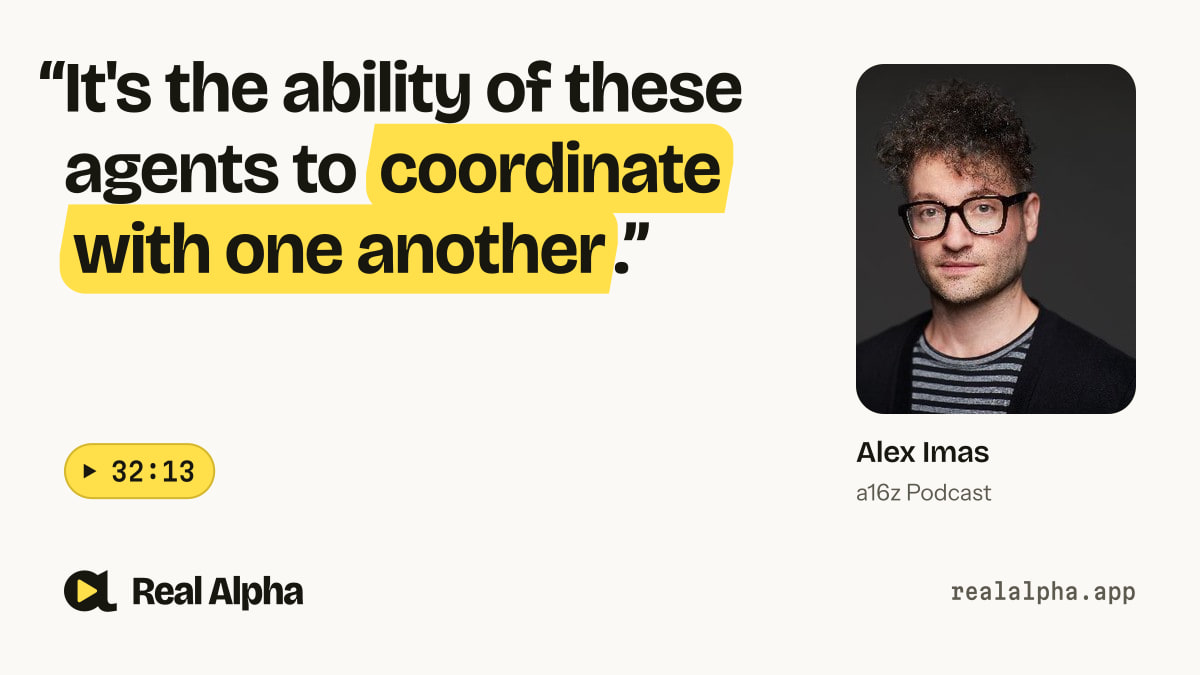
“It's the ability of these agents to coordinate with one another.”
 Alex Imasat 32:13 · a16z Podcast
Takeaways
- Organizations, not individual workers, are the relevant comparison.
- Current agent swarms often fail to coordinate effectively.
- Coordination breakthroughs could reshape firms and wages.
About this segment
Alex Imas argues that AI agents are often just parallel-processing tasks, not coordinating like human teams. Better coordination could change firm structures and drive more visible economic effects.

Economist, Google DeepMind
Studies how AI reshapes productivity, labor markets and organizations, and leads Google DeepMind’s AGI economics research.

Erik Torenberg, Host · General Partner, a16z
Helped build Product Hunt; founded On Deck, Village Global and Turpentine.
From “What History Tells Us About the AI Revolution | Tyler Cowen & Alex Imas”, Nov 16, 2026. Watch the full episode
Thanks. We'll look at and fix what's off.
Transcript
Transcribed by machine (Whisper) from the episode’s audio, so a word may be off here and there.
- 29:52
Yeah. Yeah. Alex, let's go deeper on your paper. Why don't you share some of the findings that you had and some of the questions that still ring? Yeah. So like the paper, I believe you're talking about the organizing intelligence paper. Yeah. With Andrew Coe and my colleague Shane Legg. And basically the idea of that paper is that it starts with this kind of puzzle that, you know, AI is becoming very capable on particular dimensions, but we don't see still see any like visible economic transformation.
- 30:26
And the first kind of thing that we start with is that there's been this focus on individual agent benchmarks without kind of thinking about what those agents are actually competing with in the economy where the thing that's the competitive, the relevant competitive unit is not the agent, it's the organization. And the organization historically has been referred to as a form of superintelligence because of this concept called Ricardian comparative advantage.
- 30:53
So basically, if you have a bunch of jobs, the person who does the job is not the average person, it's the person who's best suited for it. So like the envelope of the intelligence in an organization is way better than if you kind of average across the population. And so these the AI agents are basically competing against forms of human organizations or teams of humans. And so you shouldn't compare an individual level benchmark to how well a human does something. It should be across the entire kind of what we call mosaic intelligence. So then we kind of start layering on like what sort of how do capability improvements will actually affect the economy in equilibrium.
- 31:32
So this is a formal theoretical paper. And we look at different levels of intelligence. So we start with minimal AGI, where the AI models are as good as average human capability on every single dimension. So minimal AGI. And we show that even when you get to this point, you're not going to have a huge impact on the economy. Because again, because the organizations are not the average human ability.
- 31:59
They're better than that. And so what you're going to start seeing is actually wages change because, you know, production becomes cheaper and so that's going to affect human wages. And so what we show is that what you actually need for real economic transformation is not just competence, like ability on particular tasks to change. It's the ability of these agents to coordinate with one another. If you look at hugging face and even like how the solutions to the millennium problems, there's this idea of agentic swarms, right?
- 32:33
But if you unpack it, these agents are still very bad at coordinating. They're not coordinating. They're mostly just doing parallel processing. And if you have benchmarks specifically on coordination, you could actually show that one agent does better than two agents splitting the work, even if they can communicate. Whereas if you give the same thing to people, they actually have division of labor, they communicate, and they do way better than one person with double the resources.
- 33:02
So the agents are still pretty bad at coordinating, but if they get better at coordinating, you can basically break the cohesion ceiling on firm size, and you can get very, very different firms to emerge. So that's the basic premise is that once coordination becomes better, the economic space of possibilities of what firms look like, what happens to wages, what happens to employment, that's when the real kind of visible changes that are going to happen.
- 33:30
And what's the biggest bottleneck to figuring out coordination at the moment? To be honest, I don't know. I think it could be as simple as it's not being trained into the models. It's not part of post-training. I actually don't have any insight on that. Yeah.