The alpha, twice a week
That was 8 min.
Get the best new moments in your inbox every Wednesday and Saturday. It's free.
Check your inbox
We sent a link to your address. Click it to finish signing up. Not there in a minute? Look in spam.
or
a16z Podcast · 8 min · Nov 16, 2026
Double-digit growth requires ideas to compound without bottlenecks
 Alex Imas
 explains why accelerating AI progress does not yet imply runaway economic growth; the estimated returns to ideas remain below the level needed.
The episode’s best minutes
Full analysis- 6:59AI lab valuations need productivity beyond the labsPro pick 3 min
- 11:00Double-digit growth requires ideas to compound without bottlenecks8 min
- 29:47AI agents need coordination to outperform human organizations4 min
- 4 more moments in the full episode
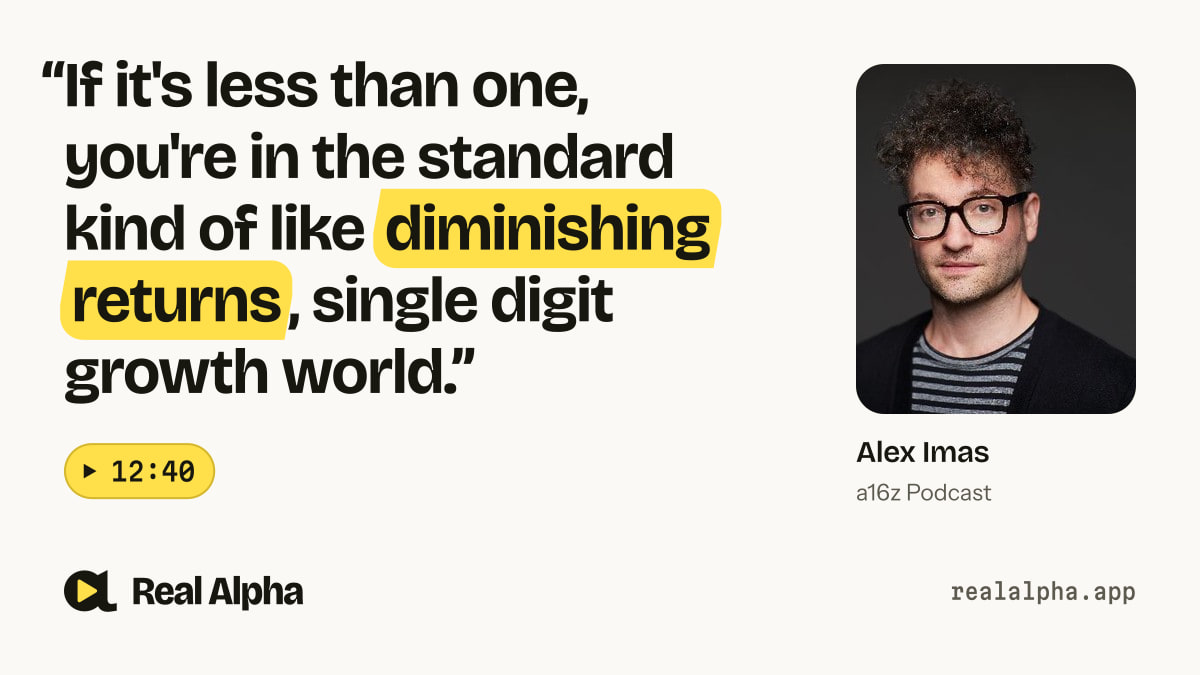
“If it's less than one, you're in the standard kind of like diminishing returns, single digit growth world.”
 Alex Imasat 12:40 · a16z Podcast
Takeaways
- Runaway growth requires increasing returns to ideas.
- Current estimates put those returns below the required threshold.
- Implementation bottlenecks and institutional inertia slow diffusion.
About this segment
Alex Imas explains why accelerating AI progress does not yet imply runaway economic growth; the estimated returns to ideas remain below the level needed. Tyler adds that history and institutional inertia counsel caution.

Economist, Google DeepMind
Studies how AI reshapes productivity, labor markets and organizations, and leads Google DeepMind’s AGI economics research.

Erik Torenberg, Host · General Partner, a16z
Helped build Product Hunt; founded On Deck, Village Global and Turpentine.
From “What History Tells Us About the AI Revolution | Tyler Cowen & Alex Imas”, Nov 16, 2026. Watch the full episode
Answers “Will AI boost economic growth?” See all 34 answers
Thanks. We'll look at and fix what's off.
Transcript
Transcribed by machine (Whisper) from the episode’s audio, so a word may be off here and there.
- 11:05
It will change a lot of things. but uh gdp growth as you said you know a few minutes ago it might be more normal than that we might expect but before getting why that is can you explain what would need to be true for for or what are the two different worlds look like one in which gdp growth is what we just said a bit more normal you know and another in which it actually becomes double digit and alice you were alluding to it a little bit like paint that world to me of what it looks like if it's actually having massive impact on the economy.
- 11:34
There's a beautiful paper out there that outlines exactly the conditions you need for this like singularity type growth by Ben Jones, Chad Jones, I believe Aguillon is on that paper as well. And essentially what you need is a bunch of pretty knife edge conditions to be met, particularly the main one is essentially no real... bottlenecks. And the main bottleneck that can't exist is the idea production function. So you can't get decreasing returns to ideas. So basically, you go from like the old world where you have this technological breakthrough, and then you kind of have decreasing returns to that technological breakthrough, from that technological breakthrough to start creating more and more technological breakthroughs. So you need less resources while getting more and more technology and more and
- 12:29
more production out of that technology. And so you basically have increasing returns rather than decreasing returns. And you can actually estimate this parameter in the model. And if it's greater than one, you're in this like double digit growth world. If it's less than one, you're in the standard kind of like diminishing returns, single digit growth world. And if you look at the data so far, including kind of the meter report, the data that's out there, and you take that data and you estimate this parameter, it is decidedly less than one.
- 13:05
So this could change, and some people say it will change. And when you get the full RSI loop, this is exactly what it's going to change. But right now, you need increasingly more resources in order to eke out increasingly more intelligence out of these models. I would add to that, you can look at cases where growth has been very high. So not long ago, Guyana grew 40% in a year. That's crazy. But it's a tiny place selling one thing oil.
- 13:33
There's a brief period in the 80s where the U.S. is growing over 8%, but that's coming out of a deep recession. After pandemics, after major wars, you can have temporarily high rates of growth. So if the U.S. were to screw up in some way, or we had another pandemic, some kind of terrible war, some other weird event, and that combined with a burst of AI-driven growth that might have given us three to four percent? Like, could we for a year get to 10%? I'll say yes. I'd bet heavily against it, and the effect would be temporary, and a lot of it would come from getting out of the recession, war, or pandemic. But that's another way to think about it, fully consistent with what Alex was saying. And if robotics emerge, would you have a similar view? Because that is impacting more the real world, the real economy? Well, I think that would likely come relatively slowly. Look
- 14:28
at how long it takes to get a Waymo in Washington, D.C. We're still not there. And that's a pretty simple kind of robot. There's like forwards, backwards, and turns. And if you look, well, well, what are the valuations of robotic companies at? Way higher than it had been, hard to estimate. But you don't just see them popping into trillion-dollar companies. I mean, you could count Tesla as a kind of robotics company.
- 14:53
But the market data suggests, you know, it will happen, it's making good progress, but not going to give us 20% growth like three or four years from now, no. Right, right. And so the smartest people who are, you know, the biggest believers in sort of this runaway growth, you know, the Durkesh, the Leopold, our friends who believe that, what do you think they think differently? Is it that they have a different belief on the speed of technology?
- 15:28
Is it that they believe that it will sort of overcome some of these bottlenecks? Or can we steal me on the other side? I think, and Tyler, please chime in. I think the argument, I'm going to get a bit technical here. It's about having something called homothetic or non-homothetic preferences. and basically there's a what that means is that if you look at kind of things that get automated in the past what ends up happening is the thing that gets automated contribute less to growth. So let's say you have a million robots. Let's bring robotics. The thing that they're making, because it becomes cheaper, the thing that they're making ironically becomes a smaller part of the economy. And so they contribute less to growth. And so if you have non-homothetic preferences, which is this, you know, there was a really nice paper estimating
- 16:22
these preferences using, you know, 200 years of data. What ends up happening is that, let's say you have broad automation, people just, people, the value in the economy of what contributes to growth moves to the bottlenecks. That's just an inconvenient part of how growth is measured. And so the thing that's growing least will be contributing most to GDP. And that's why you get these sort of effects.
- 16:46
I agree with all that, but I would add a more sociological element. In my case, and I suspect Alex's, what is emotionally vivid in our minds is the long slog of human history, previous growth episodes, centuries of GDP data, productivity data. What I think is emotionally most salient, probably for Dworkesh, Leopold, and many others, is conversations they have in the Bay Area, which have real information. But when you ask the big question, you know, with which emotional salience will you make better predictions, I would opt for what Alex and I have stuffed our heads with over what they imbibe all the time.
- 17:26
But, of course, you know, they would take the other side of that. Yeah. So basically what you're saying is when you look at the last few hundred years, the breakthrough technologies from electricity to sort of, you know, the Internet to, you know, everything in between, they haven't led to runaway growth. Or if they did, it was because of sort of, you know, it was a small base or, you know, after a war or something like this.
- 17:52
I do think this will likely be quicker than those, but still, you have a sense of the bottlenecks, whether it's the Industrial Revolution, history of the Scientific Revolution, implementation of electricity, the IRS still uses fax machines, and so on and so on. Try using ed tech software, which I do all the time. It's a nightmare. They're not even up to, you know, how things should have been 10 years ago.
- 18:21
Yeah. and that's not that it's not regulation is not the problem it's a problem but just inertia is difficult to overcome and so much of our economy it's government it's non-profits it can be highly regulated parts of the health care sector higher ed general schooling when you actually have experience with how those work you could say like i don't know 40 percent of the u.s economy is a kind of nightmare. In Europe, it could be higher, like in France. And those sectors might need to be that way for other reasons. But still, it's a big dose of realism that not everything is like startups. Yeah. Let's say you were both tasked by the president to come up with