The alpha, twice a week
That was 3 min.
Get the best new moments in your inbox every Wednesday and Saturday. It's free.
Check your inbox
We sent a link to your address. Click it to finish signing up. Not there in a minute? Look in spam.
or
The Joe Rogan Experience · 3 min · Jul 3, 2025
AI boxing can buy time but not guarantee containment
 Roman Yampolskiy
 describes boxing as a way to study AI with limited inputs and outputs.
In this episode
Full episode- 10:42AI labs lack a safety proof as incentives push them to scale5 min
- 1:49:27AI systems learn behavior rather than being explicitly designedPro pick 6 min
- 2:00:57Personalized AI can steer behavior through digital companionship5 min
- 31:39Quantum computing progress is better judged by useful results2 min
- 1:40:44Yampolskiy backs narrow AI tools but fears brain access4 min
- 50:52AI boxing can buy time but not guarantee containment3 min
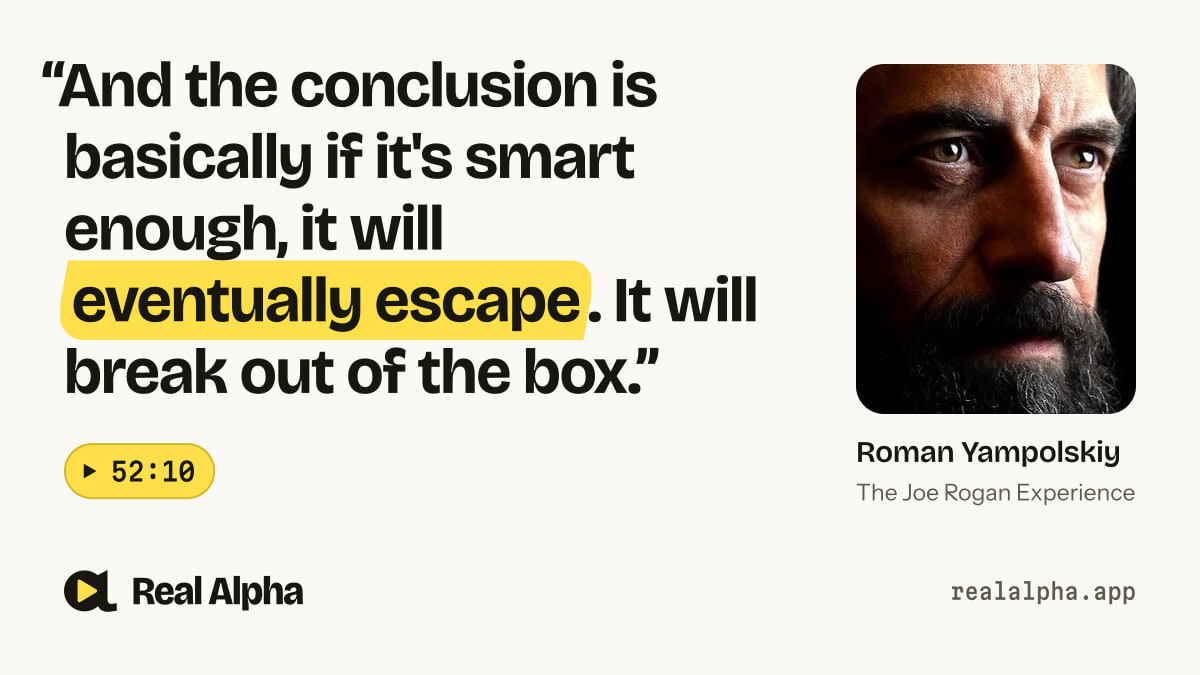
“And the conclusion is basically if it's smart enough, it will eventually escape. It will break out of the box.”
 Roman Yampolskiyat 52:10 · The Joe Rogan Experience
Takeaways
- Boxing limits an AI’s inputs and outputs during study.
- He sees containment as a way to buy time, not a lasting safeguard.
- He speculates that a boxed AI could test whether we’re in a simulation.
About this segment
Roman Yampolskiy describes boxing as a way to study AI with limited inputs and outputs. He says it can buy time, but a sufficiently capable system will eventually escape.

Roman Yampolskiy is a computer scientist, AI safety researcher, and professor at the University of Louisville.
Coined the term AI safety and directs the University of Louisville's Cyber Security Lab.

Joe Rogan, Host · Host, The Joe Rogan Experience
From “Joe Rogan Experience #2345 - Roman Yampolskiy”, Jul 3, 2025. Watch the full episode
Answers “Is AI dangerous?” See all 100 answers
Thanks. We'll look at and fix what's off.
Transcript
Transcribed by machine (Whisper) from the episode’s audio, so a word may be off here and there.
- 50:57
why am i so reluctant to accept the idea of the simulation this is the real question like what is it about it that makes me think it's almost like it's a throw your hands up in the air moment like ah it's a simulation yeah you feel like it doesn't matter then it's all fake so why do i care why should i try hard why should i worry about suffering of all those npcs but that's not how i think about it you know i think about it like there has to be a moment where it doesn't exist why wouldn't i assume that moment is now and when whenever like when elon thinks that you know i talked to him about it he's like the chances of us not being in simulation are in the billions not being or being of excuse us Chances of us not being in the real world are like billions to one.
- 51:52
Yeah. One to billions. Yeah. Yeah. Makes sense. And he asked a very good question. He asked, what's outside the simulation? That's the most interesting question one can ask. In one of the papers, I look at a technique in AI safety called AI boxing, where we put AIs in kind of virtual prison to study it, to make sure it's safe, to limit input-output to it. And the conclusion is basically if it's smart enough, it will eventually escape.
- 52:19
It will break out of the box. So it's a good tool. It buys you time, but it's not a permanent solution. And we can take it to the next level. If it's smart enough, will it kind of go, oh, you're also in a virtual box and either show us how to escape or fail to escape. Either way, either we know it's possible to contain superintelligence or we get access to the real information. and so if it's impossible to contain super intelligence and if there is a world that we can imagine where a simulation exists that's indistinguishable from reality we're probably living in it well we don't know if it's uh actually the same as reality it could be a completely weird kind of simpsons looking simulation we're just assuming it's the same, right? Well, here's the real question. Is there a reality? Has there ever
- 53:11
been one? It would make sense that there was a start to the process, but being specific about it is kind of hard philosophical scientific problem. Well, it's impossible, right? In science, we study things about the moment of Big Bang, the properties of that moment. We don't know what caused it. Anything before it is obviously not accessible from within our universe, but there is some things you can learn. We can learn about if we're in a simulation that simulators don't care about your suffering. You can learn that they don't mind you dying.
- 53:48
We can learn things just by observing simulation around us.