The alpha, twice a week
That was 4 min.
Get the best new moments in your inbox every Wednesday and Saturday. It's free.
Check your inbox
We sent a link to your address. Click it to finish signing up. Not there in a minute? Look in spam.
or
The Joe Rogan Experience · 4 min · Jul 3, 2025
Yampolskiy backs narrow AI tools but fears brain access
 Roman Yampolskiy
He warns that brain interfaces could expose thoughts and pain centers, but supports AI built for specific tasks.
In this episode
Full episode- 10:42AI labs lack a safety proof as incentives push them to scale5 min
- 1:49:27AI systems learn behavior rather than being explicitly designedPro pick 6 min
- 2:00:57Personalized AI can steer behavior through digital companionship5 min
- 31:39Quantum computing progress is better judged by useful results2 min
- 1:40:44Yampolskiy backs narrow AI tools but fears brain access4 min
- 50:52AI boxing can buy time but not guarantee containment3 min
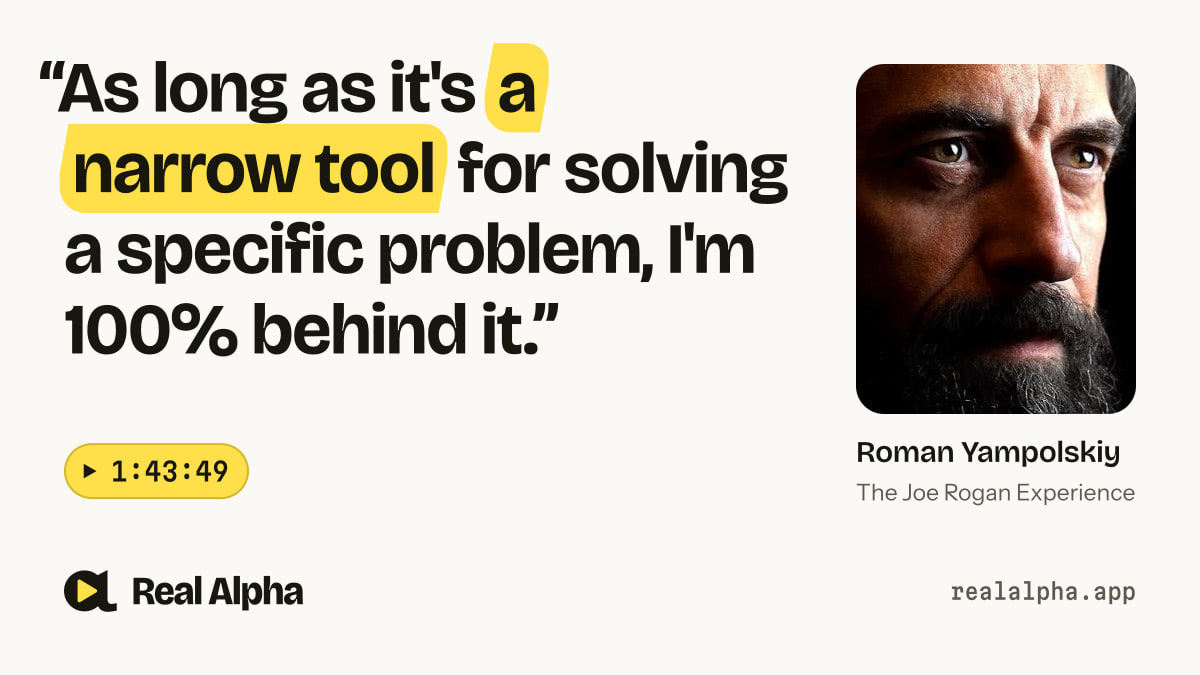
“As long as it's a narrow tool for solving a specific problem, I'm 100% behind it.”
 Roman Yampolskiyat 1:43:49 · The Joe Rogan Experience
Takeaways
- Direct brain access could expose thoughts and pain centers.
- He supports AI tools for bounded tasks like cancer and energy.
- He’d consider a non-surgical memory aid despite the integration risk.
About this segment
He warns that brain interfaces could expose thoughts and pain centers, but supports AI built for specific tasks. He’d consider a non-surgical memory aid while recognizing that integration could become a slippery slope.

Roman Yampolskiy is a computer scientist, AI safety researcher, and professor at the University of Louisville.
Coined the term AI safety and directs the University of Louisville's Cyber Security Lab.

Joe Rogan, Host · Host, The Joe Rogan Experience
From “Joe Rogan Experience #2345 - Roman Yampolskiy”, Jul 3, 2025. Watch the full episode
Thanks. We'll look at and fix what's off.
Transcript
Transcribed by machine (Whisper) from the episode’s audio, so a word may be off here and there.
- 1:40:49
Do you worry about that kind of stuff? I worry about giving direct access to human brain to AI. I feel like it's a backdoor to our consciousness, to our pain and suffering centers. So I don't recommend doing that. Somebody hacks it, it's pretty bad. But if AI itself wants that access. But why would it be motivated to give us pain and suffering? Pain and suffering is like a theme that you bring up a lot.
- 1:41:14
Because it's really the worst outcome and it's the only thing that matters. The only thing that matters to us. But why would it matter to AI if it could just integrate with us and communicate with us and have harmony? Why would it want pain and suffering? So short term, it's not AI. It's a hacker who got access to your brain. short term right so another so right now somebody hacks your neural link and starts doing things to your brain that's long term again unpredictable effects maybe it does something else and the side effect of it is unpleasant for you maybe it's retraining you for something controlling you uh it just it seems like we always worry about privacy but this is like the ultimate violation of privacy can read directly what you're thinking it's thought crime at its worst like it immediately
- 1:42:05
knows that you like don't like the dictator right and then there's also this sort of compliance by virtue of like understanding that you're vulnerable so you just comply because there is no privacy because it does have access to your thoughts so you tailor your thoughts in order for you to be safe and so that you don't feel the pain and suffering we don't have any experimental evidence and how it changes you, you may start thinking in certain ways to avoid being punished or modified. And we know that that's the case with social media. We know that attacks on people through social media will change your behavior and change the way you communicate.
- 1:42:44
Absolutely. I mean, most people look at their post before posting and go like, should I be posting this? Not because it's illegal or inappropriate, but just like every conceivable misinterpretation of what I want to say, like in some bizarre language, That means something else. Let's make sure Google doesn't think that. Right. Right. Of course. And then there's also no matter what you say, people are going to find the least charitable version of what you're saying and try to take it out of context or try to misinterpret it purposely.
- 1:43:16
so what what does the person like yourself do when use of neural link becomes ubiquitous when it's everywhere what do you do do you integrate or do you just hang back and watch it all crash so in general i love technology i'm a computer scientist i'm an engineer i use ai all the time do you use a regular phone do you have one of those de-googled phones i have a normal phone instead of... Android or...
- 1:43:40
Apple. Apple. My privacy is by flooding social network with everything. I'm in Austin today. I'm doing this, so you're not going to learn much more about me by hacking my device. As long as it's a narrow tool for solving a specific problem, I'm 100% behind it. It's awesome. We're going to cure cancer. We're going to solve energy problems, whatnot. I support it 100%. Let's do it. What we should not be doing is general superintelligence.
- 1:44:09
That's not going to end well. So if there is a narrow implant, ideally not a surgery-based one, but like an attachment to your head, like those headphones, and it gives me more memory, perfect recollection, things like that, I would probably engage with. Yeah, but isn't that a slippery slope? It is, but again, we are in a situation where we have very little choice. Become irrelevant or participate.
- 1:44:33
I think we saw it with Dylan just now.