The alpha, twice a week
That was 4 min.
Get the best new moments in your inbox every Wednesday and Saturday. It's free.
Check your inbox
We sent a link to your address. Click it to finish signing up. Not there in a minute? Look in spam.
or
Latent Space · 4 min · Nov 19, 2026
AI budgets speed buying, but may not stay open
 Cristina Cordova
New AI budgets let buyers try tools, though Cristina Cordova expects the spending environment to change.
In this episode
Full analysis- 12:08Linear proved it could win growth companies before going enterprise4 min
- 19:56Agents create half of Linear issues, but the app still mattersPro pick 3 min
- 50:08Linear tests AI pricing before charging customers6 min
- 57:04Linear traded planned enterprise features for agent infrastructure2 min
- 46:42AI budgets speed buying, but may not stay open4 min
- 42:19Linear avoids forward-deployed engineers by keeping setup simple3 min
- 34:37Linear gives AEs outbound rather than hiring SDRs2 min
- 36:57Linear uses AI to draft support replies, with humans making the call4 min
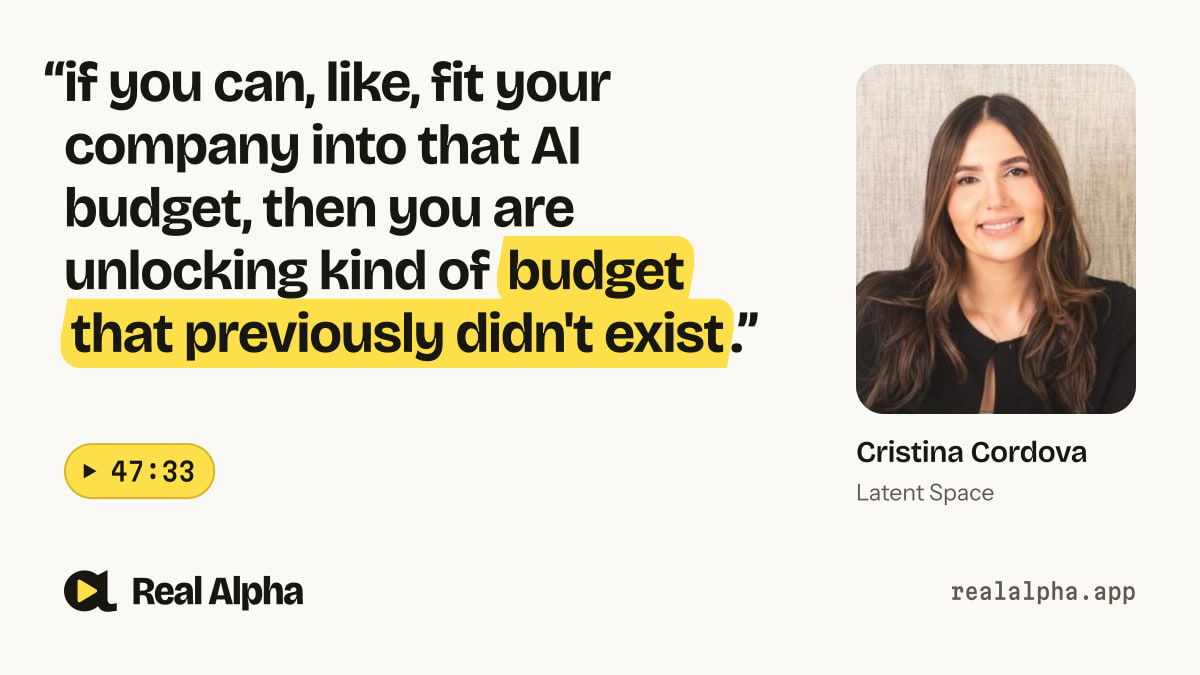
“if you can, like, fit your company into that AI budget, then you are unlocking kind of budget that previously didn't exist.”
 Cristina Cordovaat 47:33 · Latent Space
Takeaways
- AI budgets can unlock spending that buyers didn't previously have.
- Companies may choose pilots or one-year deals while tools change quickly.
- A few $30–40 million deals can produce rapid ARR growth.
About this segment
New AI budgets let buyers try tools, though Cristina Cordova expects the spending environment to change. She contrasts Linear's 40,000 paying customers with vendors reaching $100M through a handful of huge deals.

Cristina Cordova is COO of Linear.
Built Stripe’s partnerships team, led Notion platform and growth, and now leads Linear’s go-to-market and operations.

Shawn Wang (swyx), Host · Co-founder, AI Engineer
Wrote “The Rise of the AI Engineer” and founded Smol AI, maker of AI News.

Alessio Fanelli, Host · Founder, Kernel Labs
Partner at Decibel, backing technical founders who build developer tools.
From “Scaling Linear's GTM to $100M+ ARR — Cristina Cordova, COO”, Nov 19, 2026. Watch the full episode
Thanks. We'll look at and fix what's off.
Transcript
From the transcript Latent Space publishes with the episode.
- 46:45
And so- Are you seeing that, like, they're now operating, like, a lot faster because of the way, like, things are changing so fast now or not really still? Um- Maybe, like, these more legacy companies. Yeah. I don't think they operate any faster, honestly, at least with decisions like this. Yeah. I would say for a lot of these companies, the things th- the thing that's helping them move faster is that, like, AI tools have effectively been, like, unblocked, right?
- 47:10
So if they believe that, like, the engineering team in particular believes that, like, this tool is going to make them better, and it fits in, like, the AI budget- Yeah... for some companies, you know, that m- is maybe not infinite, but [laughs] it is very high- Yeah... whatever that budget is. And it was like, you know, add-on budget that kind of had to come out of nowhere, right? I think that's going to change. [laughs] Yeah. Um, it's starting to change- Mm-hmm...
- 47:34
for companies, but in a lot of ways, if you can, like, fit your company into that AI budget, then you are unlocking kind of budget that previously didn't exist. Mm. Right? And so that makes it far easier, I think, for companies to make a decision because, like, oh, there is budget. We found, we've- Yeah... magically found budget that didn't previously exist before. Yeah. You know? Okay. So you think, like, a lot of this, like, AI companies are, you know, getting to $100 million of revenue within, like, three months, that's because of this basically.
- 48:01
It's like a lot of companies that previously didn't have budget for, like, experimenting with new tools are just kinda like, "Oh my God, our company's gonna die if we don't try any of these tools." [laughs] "So, like, let's just experiment." And then, you know, at some point, maybe a year from now, two years from now, that's gonna stop. Um- Like, they're experimenting right now, and then, you know, they're gonna figure out what actually works, what doesn't, and- I think, I think a lot of companies- Yeah... are experimenting. Yeah.
- 48:20
And, you know, you're signing, like, one-year deals maybe with companies, or you're signing, like, pilot agreements with companies that have costs associated with them still. Um, but you're not signing, like, a three-year deal with a company- Mm... 'cause you're like, "I don't know if I'm gonna like this- Yeah... [laughs] you know, in two years." Yeah. Like, things are changing so rapidly, right? Is it normal for a company to sign a three-year deal? Um, if you're trusted. Yeah. Like, we s- we sometimes sign- Wow... very long-term deals- That's pretty cool. [laughs]...
- 48:47
for that reason. It has trade-offs, right? Like, we can't move up our prices- Ah. [laughs] Yeah, yeah... uh, in that three-year period of time unless you have, like, step-ups built into- Yeah... the agreement. But you know that you have that committed revenue, right? Yeah. So, you know, uh, like, and for the business, the same is true. They feel like maybe they're getting a discount- Yeah... for, you know, three years that they wouldn't have otherwise been getting. But, but I would say, like, to the example you, you had, I mean, I think, um, a lot of those businesses are, are very concentrated.
- 49:16
In the customers- Okay... that we have, right? So it's very different, I think, to be like a business like Linear that is, you know, 40,000 paying customers, right? And like historically up until June was like an entirely seat-based business, right? Um, much harder to like grow revenue to like from zero to 100 [laughs] Yeah... million overnight, right? Um, and then, you know, you see companies where, I don't know, you sell to like the defense industry or you sell to like gigantic law firms or, you know, something like that. Yeah.
- 49:50
And, you know, you sign a few deals that are like 30 to $40 million in ARR, and then okay, great, we got to 100 million in ARR. Yeah. Right? So, um, you know, certain kinds of businesses, um, do have like more of that profile. So you're usage-based now? Uh, we have some features that are usage-based in terms of how we charge for them, yeah.