The alpha, twice a week
That was 4 min.
Get the best new moments in your inbox every Wednesday and Saturday. It's free.
Check your inbox
We sent a link to your address. Click it to finish signing up. Not there in a minute? Look in spam.
or
Upstarts · 4 min · Jun 25, 2026
AI buyers should be held accountable for results
 May Habib
 argues that AI spending without measurable results should have consequences, and explains why thoughtful product, implementation and rollout matter.
The episode’s best minutes
Full episode- 40:15AI buyers should be held accountable for results4 min
- 35:09Writer's moat grows as enterprise AI gets more capable5 min
- 22:06May Habib describes bias in her VC fundraising5 min
- 5 more moments in the full episode
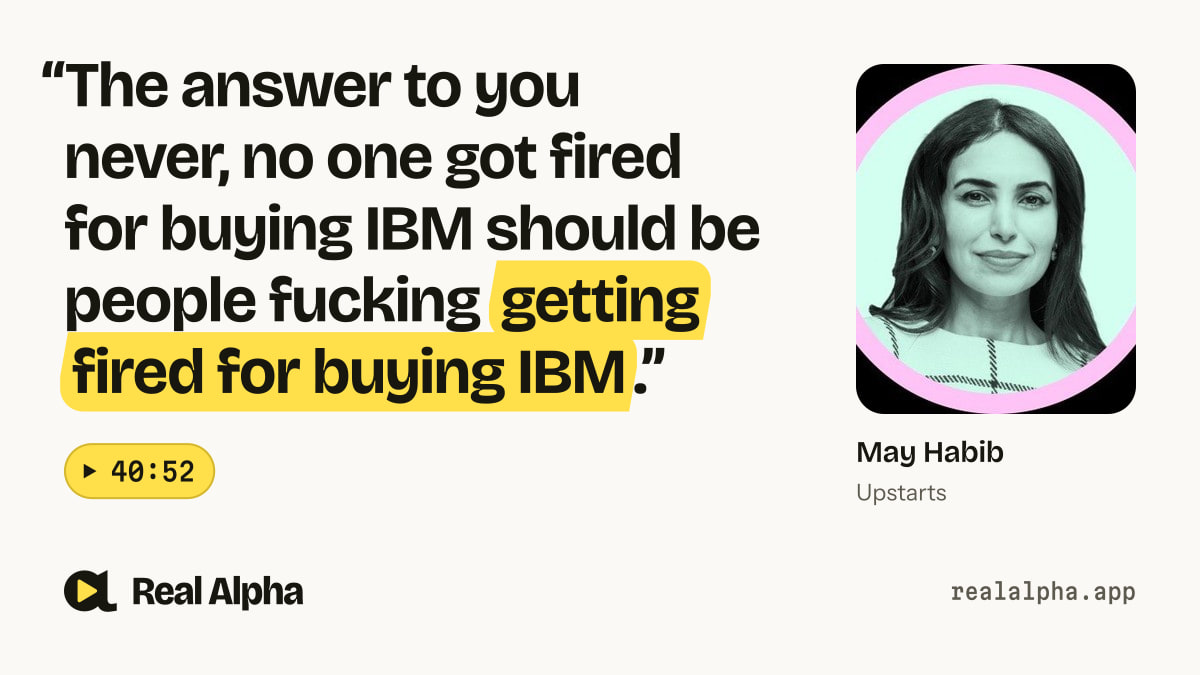
“The answer to you never, no one got fired for buying IBM should be people fucking getting fired for buying IBM.”
 May Habibat 40:52 · Upstarts
Takeaways
- Buying AI is not a result; measure what it delivers.
- A few million in token overages can have zero ROI.
- Scaling agents requires trusted workflows and human oversight.
About this segment
May Habib argues that AI spending without measurable results should have consequences, and explains why thoughtful product, implementation and rollout matter. The point is to replace token spending for its own sake with accountable adoption.

May Habib is cofounder and CEO of Writer.
Co-founded and leads Writer, an enterprise agentic AI platform serving Accenture, Mars, Uber and hundreds more.

Alex Konrad, Host · Founder & editor, Upstarts Media
Ran Forbes' Midas List for ten years and co-created its Cloud 100 list; founded Upstarts in 2025.
From “Writer's May Habib: Building The Enterprise AI That Anthropic And OpenAI Sell — Then ‘Leave’ Behind”, Jun 25, 2026. Watch the full episode
Thanks. We'll look at and fix what's off.
Transcript
Transcribed by machine (Whisper) from the episode’s audio, so a word may be off here and there.
- 40:27
There is a narrative popping up more and more now of companies spending for these tokens without necessarily feeling great about an ROI yet. I think Uber and Uber executives sort of famously said earlier this year they'd already blown through the whole annual budget. It's happened to dozens of people now. Is there justifiable concern or sort of soul searching that should be happening from that? Do you think spending those budgets earlier is a good thing in a way?
- 40:57
Like, what would be your response as customers say, hey, May, what's going on with everybody, you know, spending so much here? Should we feel good about it? The answer to you never, no one got fired for buying IBM should be people fucking getting fired for buying IBM. So, like, that's the best way, right, to get and infuse some sanity into this market. Almost every one of our customers has everything under the sun and they don't get results.
- 41:23
And our ability to come in and help them get results is just about thoughtful product meets thoughtful implementation meets thoughtful rollout. And the token maxing across all aspects of the business, I think on the coding side, you know, Cursor and others have built in the actual, like, budget constraints, right, and that functionality. Anthropic hasn't, right? Right. And so I'll meet people where it's three mil of overage on two weeks of like the plug in in Excel.
- 41:56
Like, what's the ROI on that? Zero. Right. Excitement, maybe. But if you're not learning the right lessons, then that is not money that is well spent. And CEOs are just having to get involved. I think CFOs will have to get involved. I almost wonder if Ryder and your peers get punished by being more mature companies for good and bad here. Like, you can't claim maybe the runaway spend with customers that might create that record ARR number, right?
- 42:26
Like, you know, and at the same time, you know, you guys were last valued, I think, at $1.9 billion. That would be amazing 10 years ago when we first met. And now we do see these pre-launch AI companies with no product raising it even more than that. It's almost like... It's a negative premium for having a real company. Or like in Silicon Valley, the show, you know, when the VC is like, no, never have revenue.
- 42:47
You know, you always want to say free revenue. Yeah, I think the, you know, the answer is the terminal value is the only thing that matters, right? And, you know, for us in a lot of ways, the runaway market hasn't materialized yet. Why? We have a process that is really well structured to be able to turn human and AI collaboration into working code, right? Does that happen in sales? Does that happen in marketing?
- 43:12
Does that happen in HR? We don't have the scaffolding to be able to take agents and get them into production with human oversight that is well-known, well-established, easy to audit. And that's the scaffolding that we are building for these teams. And that's the difference between production and scale. The explosion happens when teams and organizations trust the agent as much as they trust the people and trust the new people managing these agents just as much as they trust the old way of doing things.
- 43:44
And that explosion is incredibly latent, right? We haven't announced these things. So we've met a lot of the milestones that people, you know, brag about. I think for us, the thing that we will be bragging about is when we have the same kind of agentic autonomy in the enterprise that we all have in engineering and coding domains. And we're not there yet because the customer is not there yet. The trust is not there yet.
- 44:07
One question we ask everyone on the show is about their upstart moment.