The alpha, twice a week
That was 5 min.
Get the best new moments in your inbox every Wednesday and Saturday. It's free.
Check your inbox
We sent a link to your address. Click it to finish signing up. Not there in a minute? Look in spam.
or
Upstarts · 5 min · Jun 25, 2026
Writer's moat grows as enterprise AI gets more capable
 May Habib
 says more capable models increase the need for an enterprise preferences layer, then argues that customers want to build AI capability in-house rather than rely on consultants.
The episode’s best minutes
Full episode- 40:15AI buyers should be held accountable for results4 min
- 35:09Writer's moat grows as enterprise AI gets more capable5 min
- 22:06May Habib describes bias in her VC fundraising5 min
- 5 more moments in the full episode
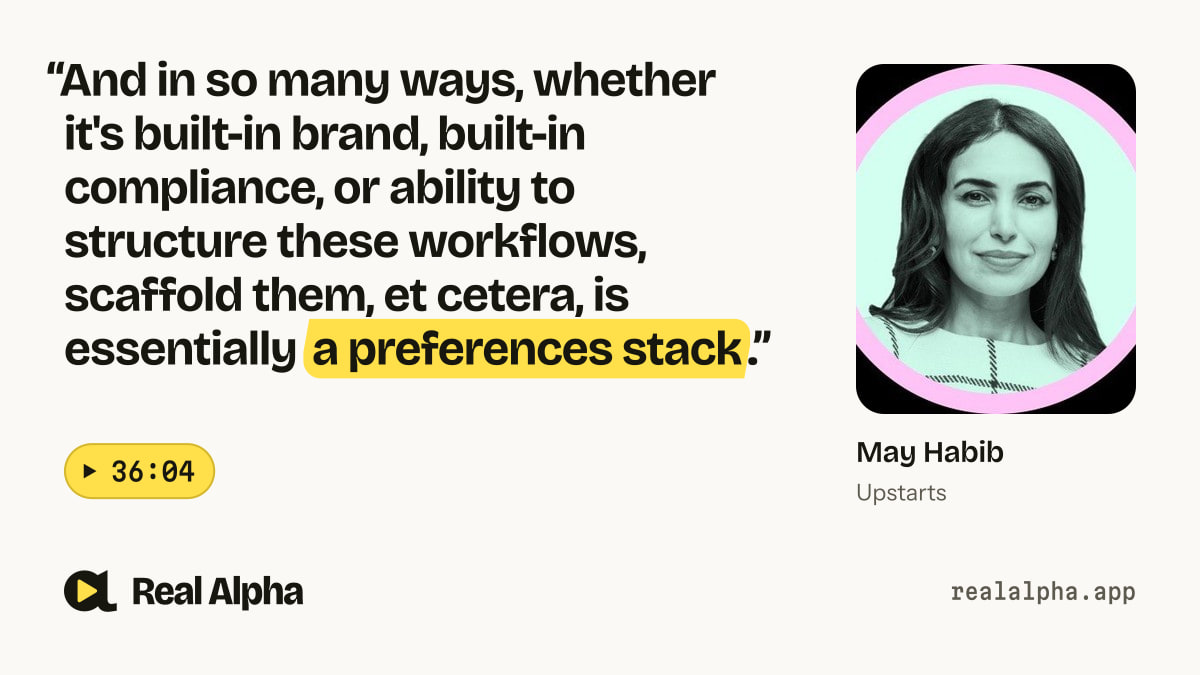
“And in so many ways, whether it's built-in brand, built-in compliance, or ability to structure these workflows, scaffold them, et cetera, is essentially a preferences stack.”
 May Habibat 36:04 · Upstarts
Takeaways
- Models don't know a company's own preferences.
- Agentic AI expands the need to manage those preferences.
- Enterprises want leverage over consultants, not more of them.
About this segment
May Habib says more capable models increase the need for an enterprise preferences layer, then argues that customers want to build AI capability in-house rather than rely on consultants. That combination shapes how Writer competes with the labs.

May Habib is cofounder and CEO of Writer.
Co-founded and leads Writer, an enterprise agentic AI platform serving Accenture, Mars, Uber and hundreds more.

Alex Konrad, Host · Founder & editor, Upstarts Media
Ran Forbes' Midas List for ten years and co-created its Cloud 100 list; founded Upstarts in 2025.
From “Writer's May Habib: Building The Enterprise AI That Anthropic And OpenAI Sell — Then ‘Leave’ Behind”, Jun 25, 2026. Watch the full episode
Answers “Are AI wrappers a real business?” See all 13 answers
Thanks. We'll look at and fix what's off.
Transcript
Transcribed by machine (Whisper) from the episode’s audio, so a word may be off here and there.
- 35:21
do the general advancements from the labs or from anywhere in AI help a company because they build on top of it, or do they innately compete? You were a little spicy earlier about OpenAI and Anthropic maybe not delivering in some of these places. They will continue to develop Cloud Cowork or some of these white-collar uses of their tools. Will Ryder be able to just sort of continue to stay above and build on top of any advances they might have?
- 35:47
Or do you have to stay faster, better, deliver better results in a head-to-head? Yeah, that's a good question. You know, a lot of people have this misconception that, you know, the capabilities of the models improving reduce the TAM for companies like us. And, you know, the history of this space is that that's not the case. And if you think about it from a preferences perspective, you'll get to understand why.
- 36:13
No matter how good the model is, it doesn't understand a customer's own preferences. And in so many ways, whether it's built-in brand, built-in compliance, or ability to structure these workflows, scaffold them, et cetera, is essentially a preferences stack. And actually, your need for that as an enterprise increases the more the LLM capabilities increase, right? That surface area of preferences increases a lot more with agentic, right?
- 36:40
It explodes exponentially. And the customer's own ability to manage that or rebuild it with co-work, right, is actually just too complex. And our moat is being able to aggregate everything that we have seen pharma need in marketing or CPG need in sales or, you know, wealth and asset management need in front office and help productize that. So, not only that nth customer benefits, but that, like, why team in the same organization that's onboarding benefits?
- 37:13
And it's that really tight productization cycle on top of the increasing LLM capabilities. And so, you know, very little of what the LLM companies productize actually impacts us structurally. Certainly, the hype and the headlines and the indecision that it forces the customer to make, right? I think it was just last week where Anthropik's giving away $10 million per organization, right, to a product that has no mold.
- 37:41
It's absolute insanity. And I think the enterprises that understand why that is not in their interest, right, are the ones that become our target market. Well, you mentioned that they might also sell something and then leave, but we have seen these companies invest heavily in services. And I guess I'm curious, you know, with Rider, do you hope that the Rider agent can basically get someone who maybe doesn't feel AI native, not a power user, to become an effective user? Or do you also need to have services people training to kind of get those, you know, late adopters to feel good?
- 38:17
Two reactions. I think it tells you how little they speak to enterprises, the fact that they launched services companies. Enterprise hates service companies, right? You talk to any CIO after a drink and they'll be like, fuck me if I help seed the next Palantir, right? And like seed that power, right? They don't want SIs. They want leverage over the SIs. And so the idea that somehow DeployCo, right, is going to be more successful in the team that built the product, right, because there is such a tight feedback loop between us knowing how the models work and the product work and helping the customer to make it work internally and have their own people be the reason why it works, right?
- 39:00
This is a teach you how to fish, not fish for you, and being able to help build that capability internally is what the customer actually wants, right? They don't want their place crawling with consultants. It's been crawling with consultants, and, you know, the results haven't been there. And so, you know, this idea that deploycos, you know, generically solve the problem is no one that I have talked to is going out excited about that, right, in the enterprise.
- 39:25
I think the second thing is, you know, what we are doing, I haven't seen anyone else do, is really help the product onboard people, right, in a natural language, very conversationally driven way. And enterprise brain helps a lot, right? This is the functionality that creates kind of proactive shared context. So, you know, if I'm asking how many salespeople does Blue Shield of California have because I'm getting on the phone with the CRO and CMO and it helps tell me like all of the other sessions related to that account, right?
- 40:00
So not just what's in my CRM, but what are people actually agentically doing, right? What are the agents doing for that account helps me understand much better how I can help these folks I'm about to talk. That doesn't exist anywhere else. You don't get that with service people, right? You only get that agentifying your own people and helping them use each other's context. So I'm a lot less concerned about folks who outsource their own implementation.