The alpha, twice a week
That was 7 min.
Get the best new moments in your inbox every Wednesday and Saturday. It's free.
Check your inbox
We sent a link to your address. Click it to finish signing up. Not there in a minute? Look in spam.
or
Future of Life Institute Podcast · 7 min · Oct 22, 2026
AI can coach job interviews but not intimacy
 Sherry Turkle
 contrasts a useful AI job-interview coach with the pauses and vulnerability that make human relationships work.
The episode’s best minutes
Full analysis- 24:02AI can coach job interviews but not intimacy7 min
- 33:07AI advice cannot replace the care that therapy requires7 min
- 45:39Solitude and boredom help people develop6 min
- 4 more moments in the full episode
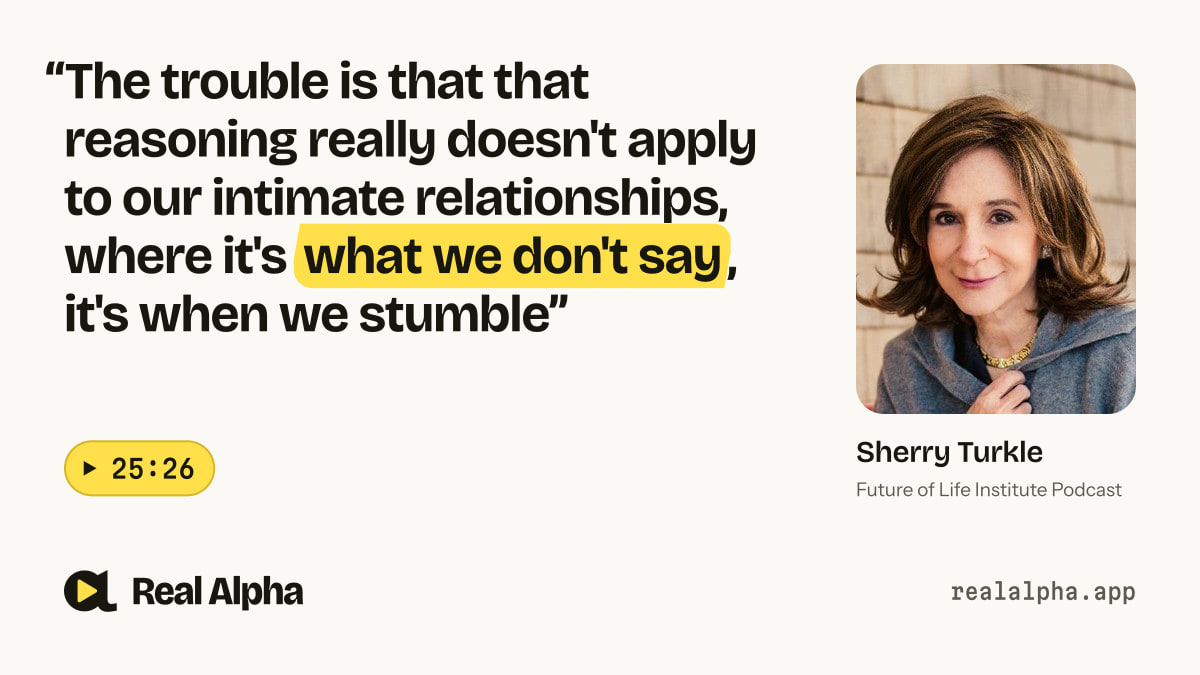
“The trouble is that that reasoning really doesn't apply to our intimate relationships, where it's what we don't say, it's when we stumble”
 Sherry Turkleat 25:26 · Future of Life Institute Podcast
Takeaways
- AI feedback can help rehearse structured job interviews.
- Intimacy grows through pauses, insecurity and imperfect expression.
- Human conversations are not performances to optimize.
About this segment
Sherry Turkle contrasts a useful AI job-interview coach with the pauses and vulnerability that make human relationships work. Treating intimate conversations like practice risks weakening the skills they require.

Sherry Turkle is a professor of sociology and personality psychology at MIT.
Founded MIT’s Initiative on Technology and Self and wrote influential books on technology, empathy, and human connection.
- GD
Gus Docker, Host · Host, Future of Life Institute Podcast
From “Artificial Intimacy: When Machines Pursue Our Attachment (with Sherry Turkle)”, Oct 22, 2026. Watch the full episode
Thanks. We'll look at and fix what's off.
Transcript
Transcribed by machine (Whisper) from the episode’s audio, so a word may be off here and there.
- 24:06
you have a space where you're allowed to try out something without the possibility of getting hurt. And so maybe you develop skills by talking with AIs and you can then go and use those skills in your relationships with people. As a professor at MIT, I supervised one of the first uh, theses, dissertations on an AI program that would coach you in job interviews. And, uh, what we worked on together was the, uh, the AI's capacity to anticipate what would happen in the interview, respond to what the person was saying in real time, give you feedback, you know, kind of take you through an interview, then do another one and another one, and then sort of give you feedback on how to do better.
- 25:00
It was a very tricky problem and I did that without feeling any sort of moral, in other words, moral compunction about an AI job interview coach. So I'm not like, you know, I don't come to this with like an anti-technology position at all. It seemed to me that the arena of job coaching was one where you do it a lot of times, you know, on your 10th interview when you're going out for a job, you're kind of better than your first interview.
- 25:30
The trouble is that that reasoning really doesn't apply to our intimate relationships, where it's what we don't say, it's when we stumble, it's when we think and are silent and the pauses we take and our insecurities and our not perfect ways of saying things and our, that's when we learn about each other. I mean, we're people. We're not doing PowerPoint presentations. I mean, even in this interview, I mean, I know this material.
- 26:04
I wrote the book myself, you know, but you're a person and you have particular interests. And I'm trying to tell you the story, you know, in a way that is trying to pick up on what I think can help you put the puzzles together of a picture. And I think that that capacity, that empathic capacity, that effort to do that, that ability to listen is exactly what you lose if you say, well, I'll just practice with an AI until I have it right.
- 26:37
What are we getting right? If you're talking to your daughter about a problem that you have between you, you want her to hear your pain in a certain sense. You want her to hear your stumble. You want her to be with you, be with you. So I don't think that we want to be sort of offloading our emotional conversations to something that doesn't care, hasn't lived a life, doesn't know what it is to have a daughter or a husband or a partner or a son or a mother.
- 27:16
No, no. It's not the same. They have quite a different personality from any actual person where they are incredibly patient and they are trying their best to be helpful in the exact way that the companies have defined them being helpful. And so what you're learning about when you're interacting with AI is not perhaps what it is to interact with an actual person just because their personalities are shaped very differently from ours? They don't have interests that they're trying to introduce into a relationship in the same way that any normal person or any actual person will have. Well, they don't have a life.
- 27:59
I mean, I think that's what we forget when we talk to them. They don't have a life. They don't give a damn. If you've talked to an AI and then you walk out of the street... And your city is so impoverished, and there's such a crisis of the environment, a crisis of water, a crisis of money, and you walk out, and there's garbage piled high, and the air smells foul, and the water coming out of your sink is dirty, and you can't drink it, and you're a mom, and you're boiling water to give to your children.
- 28:27
I mean, if you tell this to an AI, it means nothing to them. They're not in the community. They're not in the community of living things that you live in, that you breathe in, that you're raising your children in. And they haven't known love or loss or passion or death. Nothing hurts them. And just because they can, I say they're smooth talkers. They're like marvels. They're like marvels of the Middle Ages where people would drag around, you know, relics from town to town.
- 29:02
So I look at this. It's a marvelous thing. I had an experience with an AI. I saw a play that I loved in New York. It was called V. And Andrew Scott was a great actor, one of my favorite actors, did all of Uncle Vanya, playing all the parts by himself. and I'd gone to with a friend and we'd had a cup of coffee after the play and we spoke about it a little and then I went home and I was like I mean I was like wired I was so wired by this performance and I wanted to talk about Chekhov at 11 30 at night I wanted to know everything about this play I wanted to know it and I just had this long conversation with chat GPT uh you know it had you know when Chekhov wrote it and it had been a disaster in the first draft and then he put it away for 18 years and had the debut at the Moscow Art Theater.
- 29:47
But then he, I mean, I was so deep into Uncle Vanya. Now, it seemed to me that that was perfectly reasonable. That's what ChatGPT is good for. ChatGPT, and now, of course, it probably made a lot of mistakes and I'd have to fact check the details, but that's what it can do. That's what it knows how to do. And good for it. Good for it. But that's different than coming to it and saying, my daughter and I had a conversation. I think she's disappointed with me and make me feel better about this. Give me strategies for talking to her instead of talking to a friend or talking to your daughter or talking, how can I be a better person?