The alpha, twice a week
That was 6 min.
Get the best new moments in your inbox every Wednesday and Saturday. It's free.
Check your inbox
We sent a link to your address. Click it to finish signing up. Not there in a minute? Look in spam.
or
Future of Life Institute Podcast · 6 min · Oct 22, 2026
Solitude and boredom help people develop
 Sherry Turkle
 explains how solitude helps people form a sense of self, while boredom gives the mind room to wander.
The episode’s best minutes
Full analysis- 24:02AI can coach job interviews but not intimacy7 min
- 33:07AI advice cannot replace the care that therapy requires7 min
- 45:39Solitude and boredom help people develop6 min
- 4 more moments in the full episode
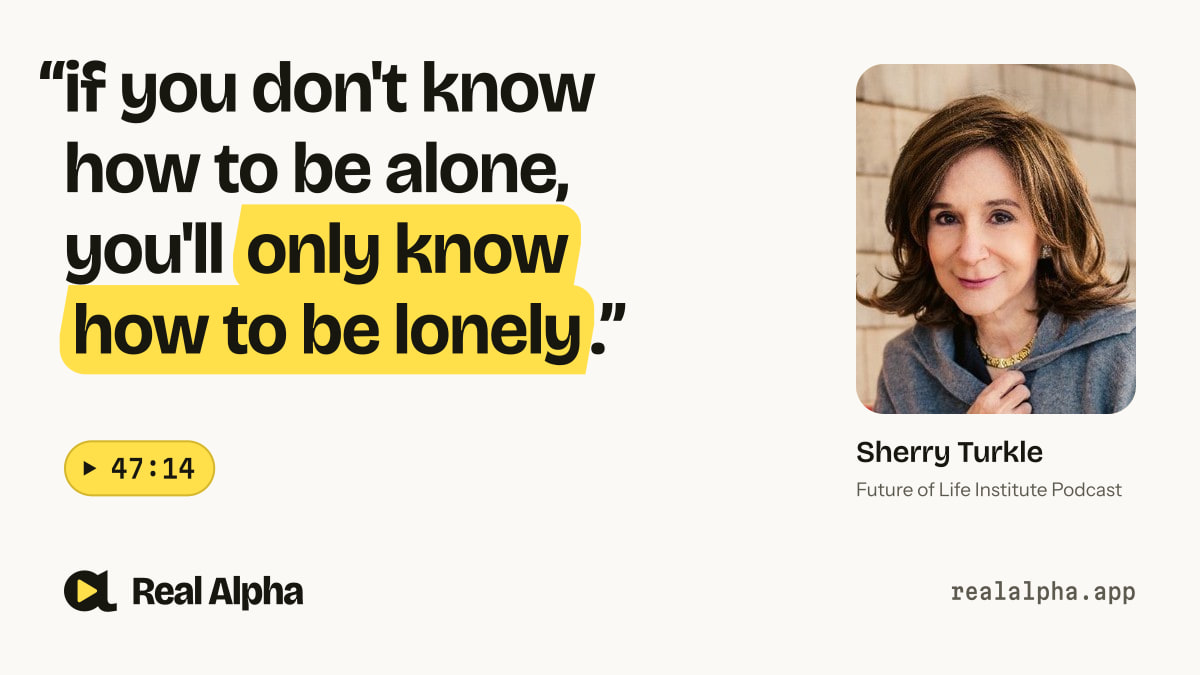
“if you don't know how to be alone, you'll only know how to be lonely.”
 Sherry Turkleat 47:14 · Future of Life Institute Podcast
Takeaways
- Being alone without feeling lonely builds self-knowledge.
- Boredom and mind wandering support a sense of self.
- Parents can make quiet walks part of children’s lives.
About this segment
Sherry Turkle explains how solitude helps people form a sense of self, while boredom gives the mind room to wander. Constantly filling those moments can undermine both development and relationships.

Sherry Turkle is a professor of sociology and personality psychology at MIT.
Founded MIT’s Initiative on Technology and Self and wrote influential books on technology, empathy, and human connection.
- GD
Gus Docker, Host · Host, Future of Life Institute Podcast
From “Artificial Intimacy: When Machines Pursue Our Attachment (with Sherry Turkle)”, Oct 22, 2026. Watch the full episode
Thanks. We'll look at and fix what's off.
Transcript
Transcribed by machine (Whisper) from the episode’s audio, so a word may be off here and there.
- 45:42
So that I found chilling. It sounds to me like we might be headed to a world in which it's very easy to avoid being bored and very easy to avoid feeling lonely. If that's the world we're headed towards, what would that do to us? I'm trained as a developmental psychologist and as a psychoanalytic training, a clinician. And one of the things you learn in studying lives is the importance of boredom and the importance of solitude, both as kids grow up and also to really have a life as a fully functioning adult.
- 46:21
And this for a couple of reasons. I mean, to take solitude first. It's when you're alone, but not lonely. It's when you can be there and feel content with yourself and knowing yourself and with yourself that you can then turn to another person and say, who are you? Who are you? Um, and, uh, if you don't. have that capacity to know who you are and what your boundaries are. When you meet another person, you ask them, who am I? You ask another person to define you rather than coming to another person and being able to have a relationship. And so the capacity for solitude is one of the signal developments of childhood. Great psychoanalyst DW Winnicott said that if you don't know how to be alone, you'll only know how to be lonely. If you don't know how to be alone, you'll only know how to be lonely. So solitude is very important. And of course, where I'm getting to, I mean,
- 47:33
this big buildup is to say that the idea that at any moment you can kind of get on the web, get on, you know, talk to your avatar, talk to Replica, talk to Claude, you're never feeling alone. And you never have, and so you're always going to be lonely because you're never really developing that ability to really be alone and not lonely. You're bombarded with the possibility of kind of curing that moment of solitude as though we're a problem. And then the second thing you mentioned was the boredom. Similarly, people think, oh, boredom, I want to not be bored.
- 48:12
It turns out that boredom and that feeling of boredom, that feeling of, oh, I'm just kind of staring out the window or in the back of a cab and before phones. And I just kind of have a, you know, I just kind of have a moment of nothing going on. Some people call it mind wandering, where you just kind of are thinking about nothing and that moment. And maybe it's a little bit uncomfortable, but maybe if you think of it as mind wandering, you can make it not feel uncomfortable. Is the moment when our nervous system lays down certain neural pathways that are crucial for our sense of ourselves as a kind of sort of our autobiographical sense of being one person moving through life. So there too, boredom, like solitude, turn out to be things that we shouldn't be saved from. We need to have those experiences and we need to not run from
- 49:08
them and um uh it's very dangerous that chatbots you know try to cure these things that not only don't they need a cure but we really need them in order to develop the way we should and so what happens if we if we do not have a boredom and and loneliness how do we then develop what happens to our minds well if you don't have solitude you really risk not being able to have relationships because you risk not developing a sense of who who i am without input so that then you can present yourself to somebody else as who you are if you're constantly looking for external uh validation external telling you who you are um you you're not really in relationships of reciprocity of of kind of mutual connection because you're using other people just to tell you who you are and in in psychoanalytic terms
- 50:14
people talk about self-objects people talk about about about people or narcissistic personalities they're trying to come to a language that says the person doesn't know who they are is not a kind of contained person is always looking almost like as though they were porous to be told who they are from other people. Now, obviously, you just can't take anybody and put them in a solitary confinement and say you're going to develop this great thing. I'm talking about as you're growing up, moments of solitude and moments of mind wandering and moments of boredom need to be part of a child's and then a young adult's experience. So one of the most powerful things that a parent can do for a child is to take a child on a walk in nature, let the child walk a little bit ahead, hold their hand, be quiet. The child starts to understand that being quiet and
- 51:09
alone and reflective and just gathering oneself is a very important part and a crucial part of being a person. It's not to be sort of run from as though it were a terrible thing.