The alpha, twice a week
That was 3 min.
Get the best new moments in your inbox every Wednesday and Saturday. It's free.
Check your inbox
We sent a link to your address. Click it to finish signing up. Not there in a minute? Look in spam.
or
Future of Life Institute Podcast · 3 min · Sep 25, 2026
AI companies lack visibility into classified military use
 Katrina Manson
Claude was used in Maven Smart System, but Anthropic could not see its classified use.
In this episode
Full analysis- 8:42AI sharply increased the number of targets the military could strike7 min
- 17:43Computer vision struggled when Ukraine's battlefield changed3 min
- 23:30Targeting doctrine is shifting from human decisions to oversight3 min
- 35:53Accurately labeled data matters more than the model3 min
- 27:00Maven was updated 50 times during Ukraine's first months3 min
- 29:53AI companies lack visibility into classified military use3 min
- 15:45AI made human judgment the longest step in a targeting cycle2 min
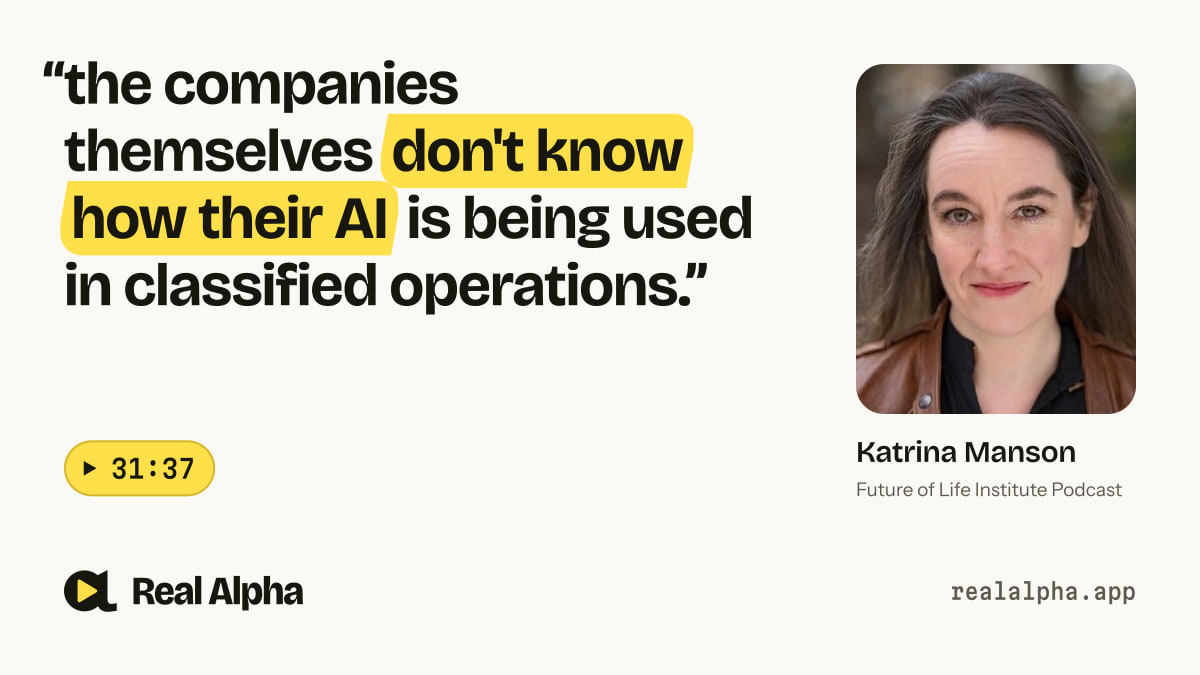
“the companies themselves don't know how their AI is being used in classified operations.”
 Katrina Mansonat 31:37 · Future of Life Institute Podcast
Takeaways
- Anthropic's Claude was in Maven Smart System.
- Companies cannot see how their tools are used in classified operations.
- The Pentagon says contractors do not set the rules for military use.
About this segment
Claude was used in Maven Smart System, but Anthropic could not see its classified use. Katrina Manson says companies may set guardrails, while the Pentagon insists it sets the rules.

Katrina Manson is author of Project Maven: A Marine Colonel, His Team, and the Dawn of AI Warfare.
Investigated the US military's AI use and chronicled the Pentagon's Project Maven program in her book.
- GD
Gus Docker, Host · Host, Future of Life Institute Podcast
From “Can Humans Still Control AI-Assisted Kill Chains? (with Katrina Manson)”, Sep 25, 2026. Watch the full episode
Thanks. We'll look at and fix what's off.
Transcript
Transcribed by machine (Whisper) from the episode’s audio, so a word may be off here and there.
- 29:57
My question is inspired by what happened between Anthropic and the Department of War, where there's a disagreement about which organization or who sets the limits of how these systems are used and can be used. And I'm wondering whether there is a similar debate happening around this system. Well, the Anthropic case is really, really interesting because as Anthropic decided that they had two red lines that they wanted to keep to in the use of their AI, which was AI should not be used in fully autonomous weapon systems and it should not be used for domestic mass surveillance, nobody agreed with what they were actually fighting about because the Pentagon said, well, we don't do mass domestic surveillance and we make the rules.
- 30:43
we have the policy. You can't be the ones to say how something is used. And that is felt very fervently by people I've spoken to at the Pentagon. Now, Anthropics is a particularly interesting case study because their tool, Claude, was in Maven's smart system. And when Dario Amodei, the chief executive, was asked, do you have any concerns about that? He, I think, fell back on his argument that these tools should be used to defend the West and that it was a legal use case to put Claude into a Maven smart system in support of AI targeting.
- 31:21
And essentially that the company has to trust that the Pentagon will follow the law, which obviously the Pentagon says it will. And so there's a real lack of line of sight from some of these companies into how their own tools are being used. It's not just me who doesn't know specifically how some of these AI tools are being used in classified environments. the companies themselves don't know how their AI is being used in classified operations.
- 31:47
They can try and set guardrails in terms of policy, as Anthropic did. They can try and set guardrails inside the model, as other companies have tried to do. But ultimately, the Pentagon wants to work with models that will respond favorably to defense-related commands, which a normal model might not. So my understanding is they're experimenting with models that will be much more licentious in what they're prepared to do, but also aware that the most powerful models may also end up being the open weight models and trying to find a way to work with them as well.
- 32:21
So it's a moment of profound shift. The Pentagon, certainly, certain parts of it made very clear that they don't want companies dictating to them what the law is. That's not the same as labeling Anthropica a supply chain risk, which is this unprecedented move that hadn't been ever done on any US company before.