The alpha, twice a week
That was 3 min.
Get the best new moments in your inbox every Wednesday and Saturday. It's free.
Check your inbox
We sent a link to your address. Click it to finish signing up. Not there in a minute? Look in spam.
or
Future of Life Institute Podcast · 3 min · Sep 25, 2026
Maven was updated 50 times during Ukraine's first months
 Katrina Manson
Operators and vendors worked closely enough to update the system 50 times in Ukraine's first months.
In this episode
Full analysis- 8:42AI sharply increased the number of targets the military could strike7 min
- 17:43Computer vision struggled when Ukraine's battlefield changed3 min
- 23:30Targeting doctrine is shifting from human decisions to oversight3 min
- 35:53Accurately labeled data matters more than the model3 min
- 27:00Maven was updated 50 times during Ukraine's first months3 min
- 29:53AI companies lack visibility into classified military use3 min
- 15:45AI made human judgment the longest step in a targeting cycle2 min
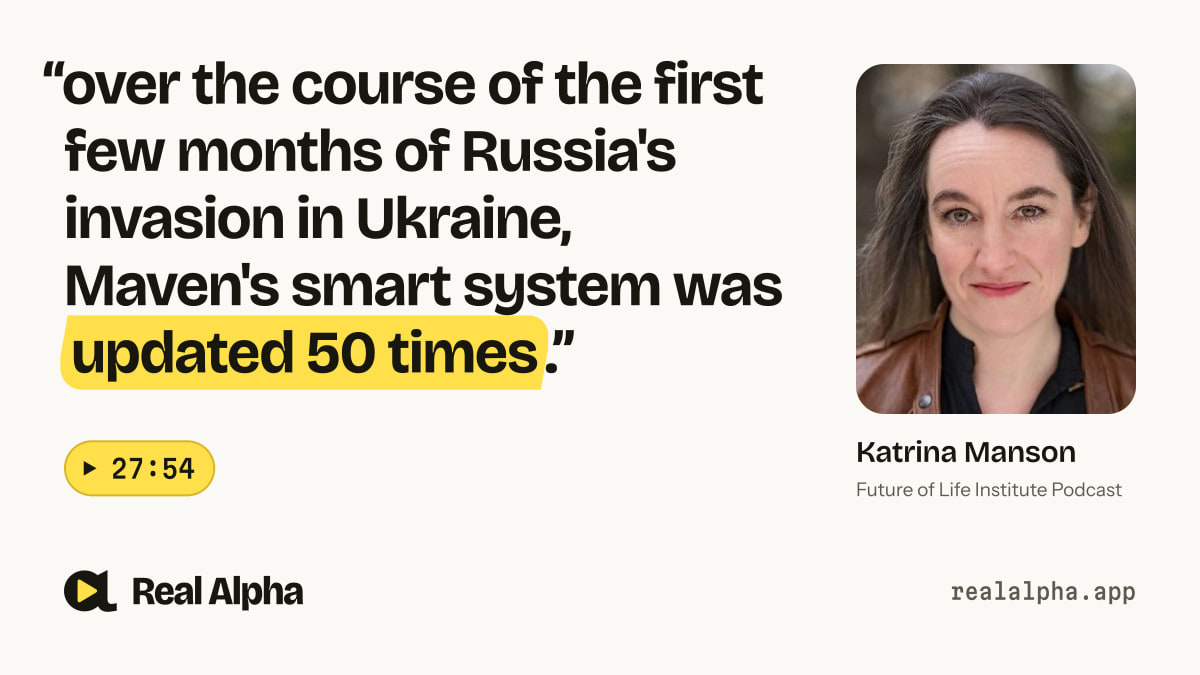
“over the course of the first few months of Russia's invasion in Ukraine, Maven's smart system was updated 50 times.”
 Katrina Mansonat 27:54 · Future of Life Institute Podcast
Takeaways
- Maven Smart System changed 50 times in Ukraine's first few months.
- Close operator-vendor work enabled frequent updates.
- CENTCOM officials gave it a C-plus in 2024; Palantir's CEO later called it targeting's backbone.
About this segment
Operators and vendors worked closely enough to update the system 50 times in Ukraine's first months. A public C-plus grade preceded Palantir's CEO calling it targeting's backbone.

Katrina Manson is author of Project Maven: A Marine Colonel, His Team, and the Dawn of AI Warfare.
Investigated the US military's AI use and chronicled the Pentagon's Project Maven program in her book.
- GD
Gus Docker, Host · Host, Future of Life Institute Podcast
From “Can Humans Still Control AI-Assisted Kill Chains? (with Katrina Manson)”, Sep 25, 2026. Watch the full episode
Thanks. We'll look at and fix what's off.
Transcript
Transcribed by machine (Whisper) from the episode’s audio, so a word may be off here and there.
- 27:03
is developed in a partnership between the US government and US tech companies and how they share responsibility and ultimately share power in the system. Are there any tensions between them and how are those tensions resolved? Well, the department contracts with different commercial companies and sets them the requirements and then the companies deliver. So that's the traditional way of doing it. I think what's been so interesting about the way Palantir in particular has worked on Maven Smart System, because they really are the key vendor here is that they have sat with the operators. That has given them tremendous insight into how the workflow actually goes when you are at the edge making these decisions. My understanding is that it's enabled them to tailor the way their software works around the actual process that is
- 27:54
used and to make updates. For example, in the book, I report that over the course of the first few months of Russia's invasion in Ukraine, Maven's smart system was updated 50 times. Now, that is because operators and vendors were sitting close, were understanding each other. And each time the system wasn't good enough, it could be updated or molded to the new reality. And this is a system where even senior officials at US Central Command have graded Maven Smart System publicly a C plus.
- 28:26
That was in 2024. And so in 2026, Maven Smart System is now what Alex Karp at Palantir calls the backbone of targeting. So there's been tremendous acceleration into this system, even though there are issues still, obviously, to be ironed out with it and the way it's implemented. In terms of power, I think it's an interesting idea you raise. The Pentagon, as far as I understand it, at one point was really quite desperate for anyone to build this technology for them. Project Maven was really controversial. So in 2018, Google workers found out that they were working on this system without their understanding. And several of them protested. There was a multi-thousand signature letter saying, we don't want to work on the business of war. And Google decided not to renew its contract with the Pentagon. And so at that
- 29:19
point, the Pentagon went to Palantir and said, will you help us out? And Palantir said, yes. So for many years now, Palantir has been in this position where they have been able to argue that they, to some extent, saved this effort to deliver AI targeting within the department. And Palantir as a whole is doing very well in this second Trump administration. Funding has become very important for US defense funding to the company and is on the rise.
- 29:48
And so certainly you have this interesting relationship between the Pentagon and Palantir.