The alpha, twice a week
That was 3 min.
Get the best new moments in your inbox every Wednesday and Saturday. It's free.
Check your inbox
We sent a link to your address. Click it to finish signing up. Not there in a minute? Look in spam.
or
MD MEETS · 3 min · Sep 24, 2026
AI could end decades of technological stagnation
 Peter Thiel
 says progress had slowed since the 1970s, especially in physical engineering, while the internet was not enough to lift the whole economy.
The episode’s best minutes
Full analysis- 0:14AI could end decades of technological stagnationPro pick 3 min
- 3:01Slowing AI could leave societies stagnant and empower ChinaPro pick 7 min
- 39:30Europe’s AI gap reflects a deeper weakness in company building7 min
- One more moment in the full episode
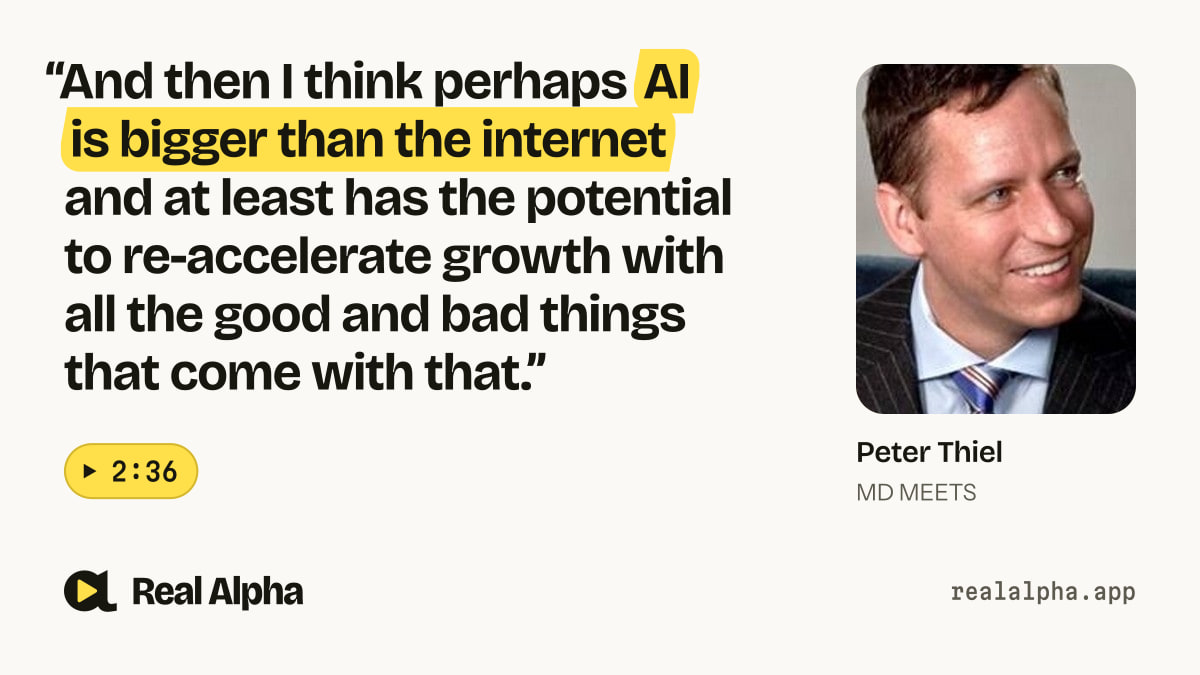
“And then I think perhaps AI is bigger than the internet and at least has the potential to re-accelerate growth with all the good and bad things that come with that.”
 Peter Thielat 2:36 · MD MEETS
Takeaways Pro pick
- Progress in software outpaced progress in fields tied to the physical world.
- The internet helped drive growth but may not have been enough on its own.
- Thiel thinks AI could reaccelerate growth, with both benefits and risks.
One of Pro's picks, open to you here. Try Pro free for 7 days
One of Pro's picks. The rest of the summary and the 3 takeaways are in Real Alpha Pro; the video, the quote and the transcript stay free.
Read it with Pro, 7 days freeAbout this segment
Peter Thiel says progress had slowed since the 1970s, especially in physical engineering, while the internet was not enough to lift the whole economy. He sees AI as a potential new growth engine.

Peter Thiel is a Silicon Valley investor and PayPal cofounder.
Co-founded PayPal and Palantir, was Facebook's first outside investor, and co-founded Founders Fund.
- MD
Mathias Döpfner, Host
From “Peter Thiel: The AI Crisis, Europe’s Decline & the Battle for America”, Sep 24, 2026. Watch the full episode
Answers “Will AI boost economic growth?” See all 19 answers
Thanks. We'll look at and fix what's off.
Transcript
Transcribed by machine (Whisper) from the episode’s audio, so a word may be off here and there.
- 0:18
Peter, you have discussed a lot over the last years the problem that, in your view, the West did not deliver enough progress, enough change in technology. You even spoke about stagnation. That is a topic and a term that almost nobody would use these days. It's pretty much the opposite. People are discussing, is there too much acceleration? Is AI progressing too fast? So what's your take? Did you change your mind or is it still not enough?
- 0:54
I've changed my mind to some extent. Let me first articulate the stagnation thesis, which I started articulating 20 years ago or so, and is that it's always very hard to measure these things because there's so many different dimensions of progress, so many different areas of technology and science. And the basic thesis was that since the 1970s, there had been a slowdown. There'd been progress in the world of bits, you know, computers, internet, mobile internet, software, but not so much in the world of atoms.
- 1:27
And most of the engineering fields that were related to atoms were not even successful fields for people to study. Mechanical engineering, chemical engineering, you know, aero-astro, nuclear engineering was already a bad idea by the 1980s. And that for a variety of reasons there had been this slowdown. I believed that this, not total stagnation, but this broad slowdown in progress was an important factor driving a lot of things that were going wrong in our society.
- 2:03
A lot of the politics have become more polarized because when there's a loser for every winner, it becomes this very zero-sum game and you sort of get a much worse society. And of course, there were some very deep reasons why I speculated this had happened. But a big picture was that for decades, we had something like stagnation. There was a way that the internet was an important growth driver in the late 90s. It was bigger than anything else, perhaps not big enough to take our whole civilization to the next level.
- 2:40
And then I think perhaps AI is bigger than the internet and at least has the potential to re-accelerate growth with all the good and bad things that come with that. But yes, the way I would defend the stagnation thesis is that now that we have AI, nobody disagrees with me that we were in stagnation for decades before.