The alpha, twice a week
That was 7 min.
Get the best new moments in your inbox every Wednesday and Saturday. It's free.
Check your inbox
We sent a link to your address. Click it to finish signing up. Not there in a minute? Look in spam.
or
MD MEETS · 7 min · Sep 24, 2026
Slowing AI could leave societies stagnant and empower China
 Peter Thiel
 accepts that AI risks may be real, but argues that stopping progress carries its own costs and that global restraints could be worse than the risk.
The episode’s best minutes
Full analysis- 0:14AI could end decades of technological stagnationPro pick 3 min
- 3:01Slowing AI could leave societies stagnant and empower ChinaPro pick 7 min
- 39:30Europe’s AI gap reflects a deeper weakness in company building7 min
- One more moment in the full episode
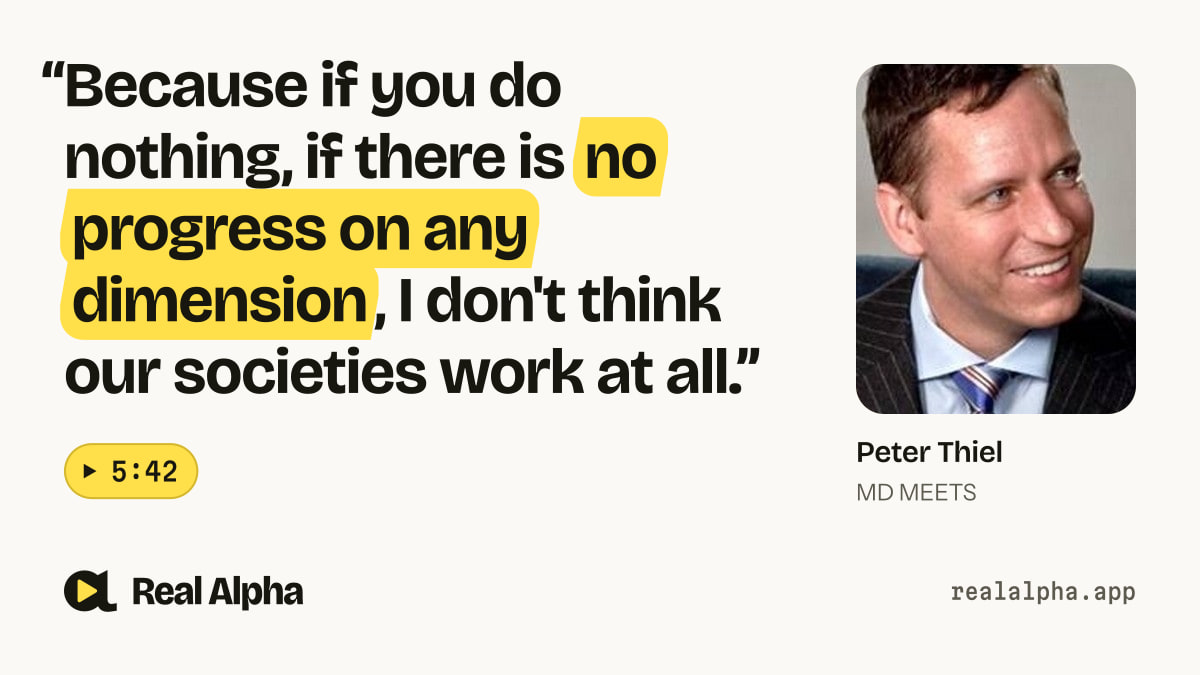
“Because if you do nothing, if there is no progress on any dimension, I don't think our societies work at all.”
 Peter Thielat 5:42 · MD MEETS
Takeaways Pro pick
- Even a small probability of catastrophe deserves attention.
- A zero-growth alternative could worsen social and political problems.
- Global AI limits could slow the West without slowing China.
One of Pro's picks, open to you here. Try Pro free for 7 days
One of Pro's picks. The rest of the summary and the 3 takeaways are in Real Alpha Pro; the video, the quote and the transcript stay free.
Read it with Pro, 7 days freeAbout this segment
Peter Thiel accepts that AI risks may be real, but argues that stopping progress carries its own costs and that global restraints could be worse than the risk. He also warns that Western limits may not apply in China.

Peter Thiel is a Silicon Valley investor and PayPal cofounder.
Co-founded PayPal and Palantir, was Facebook's first outside investor, and co-founded Founders Fund.
- MD
Mathias Döpfner, Host
From “Peter Thiel: The AI Crisis, Europe’s Decline & the Battle for America”, Sep 24, 2026. Watch the full episode
Answers “Is AI dangerous?” See all 112 answers
Answers “Should AI be regulated?” See all 51 answers
Thanks. We'll look at and fix what's off.
Transcript
Transcribed by machine (Whisper) from the episode’s audio, so a word may be off here and there.
- 3:05
Yeah, it has been proven in retrospect, definitely. So these days, the perception of AI is swinging pretty much between euphoria and dystopia. And there was a lot of discussion over the last weeks about the collective warning that Dario Amodei, Sam Altman, and Elon Musk presented. and that was the monster could get out of control. What's your take on that? Is it, as some people are saying, mainly a tactical move, a marketing move, or a move in order to drive the expectations down with regard to big multi-trillion IPOs?
- 3:51
Or is it truly the fear that AI could get out of control and could overrule human intelligence and banks? Well, there are many, many different dimensions to the AI debates and the problems. And yes, there are these scenarios that are maybe science fiction, science fiction fantasy. Maybe they're somewhat more realistic where if you have something that in some sense is way smarter than any human being? Is there some way it can escape control? And we have, of course, all kinds of dystopian science fiction movies, Matrix, Terminator, things like that.
- 4:36
And I don't even know how you speak about probabilities of things like that happen. I don't think the probabilities are very high. On the other hand, if the probability is even 5% or 10%. That seems pretty bad. So, there's something about the conversation that ends up pushing people very hard in a sort of defensive, precautionary way. If it's about probabilities, there was recently an experiment to ask the six biggest LLMs, is there an extinction risk with regard to AI? And the predicted percentage was between 1% and 10%.
- 5:11
Do you think it's just because the LLMs are based on human fears, human pessimism, or is it a real point? Let us, for the sake of argument, say that it is a real point. I think it's hard to argue that probabilities are 0% something. I do think, but you shouldn't, it doesn't necessarily follow that you should always go slower and always go in the precautionary direction. Because if you do nothing, if there is no progress on any dimension, I don't think our societies work at all.
- 5:54
And, you know, I've often said, you know, the middle class in the U.S., Europe, they're the people who expect their children to do better than themselves. and the sort of intergenerational progressive compact in our society was that there was, you know, progress from one generation to the next, maybe economic progress, material progress, progress in health progress, you know, all sorts of softer social kinds of dimensions.
- 6:23
And when that breaks down, yeah, I think the whole society starts to derange in very, very strange ways. And so, yes, so there's a, There's a picture that people implicitly have that the alternative to AI, let's say, a zero-growth world where there's no progress at all, will somehow be this peaceful, social-democratic society. And I don't think that's true. So I think the alternative is also far from neutral.
- 6:57
I also think there's some degree to which you can never just turn the clock back. But then slowing it down is just unrealistic, or how could it work? I mean, I don't get it. If America is slowing down and China is accelerating, we are just strengthening China, but it's not just solving anything. It's all, yeah. In theory, you could slow it down if you had genuine, you know, deep cooperation across the whole world. But I think that would require like a one world government with real teeth, real force. And the sort of classical liberal part of me thinks that's almost, you know, that's a frying pan into fire. It's a cure that's worse than the disease.
- 7:44
And then, of course, you can have fake global government where we have a lot of conferences to discuss it, a lot of somewhat empty statements that get put out. So, of course, a risk that it ends up being slowed down in the West and, you know, not in China. You know, the Pope recently issued this AI encyclical, or I would characterize it as an anti-AI encyclical. And again, this is, you know, maybe it was too harsh, but the rhetorical point I have on it is that people, you know, the Communist Party of China is not going to listen to the Pope.
- 8:25
There's a chance people in the U.S. will. And so, in effect, the Pope's encyclical was working for the Communist Party. I'm not saying he was an agent of the communists, but he was at least acting as a useful idiot for the CCP. I spoke to two founders of big AI platforms and both said that they have evidence that the Chinese are spreading anti-AI content, particularly through American social media platforms, but also elsewhere, in order to turn around the American sentiment towards more AI skepticism in order to increase their advantage.
- 9:06
Do you see similar things? Is there any evidence for that? Do you believe that? What's your take? I haven't studied it that carefully. I'm inclined to believe it. I'm also inclined to think that that's not the main factor driving it, that this is mainly what we're doing to ourselves. You know, there's a way I'm tempted to say that, you know, Greta is working for the Chinese communists. And maybe she is, but she's more of a problem we've created for ourselves in the West.
- 9:39
But is Greta's influence on the American sentiment that big? I mean, I'm surprised. I think she's passed her primes. But yeah, I think there are so many of these things that we're doing to ourselves. I'm a very tough critic of China's. I think we need to take the competition, the rivalry with China very seriously. And then also, it's often somewhat