The alpha, twice a week
That was 3 min.
Get the best new moments in your inbox every Wednesday and Saturday. It's free.
Check your inbox
We sent a link to your address. Click it to finish signing up. Not there in a minute? Look in spam.
or
MTS · 3 min · Nov 17, 2026
AI could make existing research funding go much further
 James Sinka
 argues that AI-native scientists could reach breakthroughs sooner and with less money, making current research capital more productive.
The episode’s best minutes
Full analysis- 5:43AI narrowed 43 quintillion lung-rejuvenation options to candidates3 min
- 9:19Scientists can use AI as a co-scientist, not just an automation tool3 min
- 22:07AI could make existing research funding go much furtherPro pick 3 min
- One more moment in the full episode
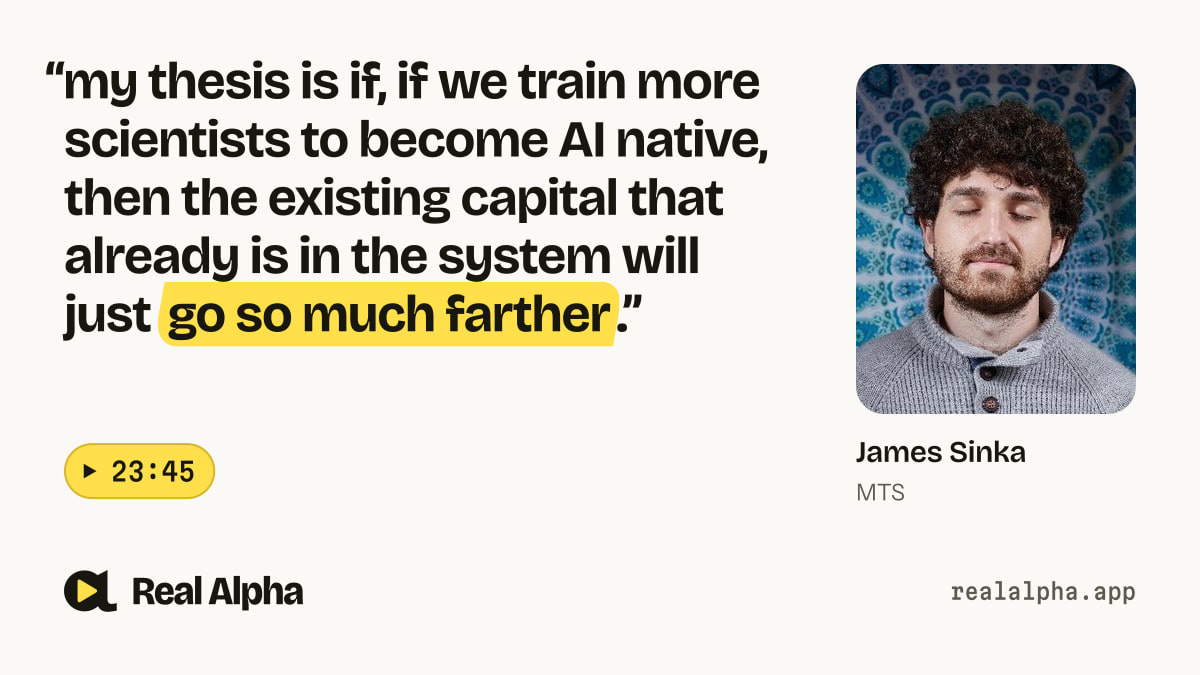
“my thesis is if, if we train more scientists to become AI native, then the existing capital that already is in the system will just go so much farther.”
 James Sinkaat 23:45 · MTS
Takeaways Pro pick
- Motivated researchers can find funding for genuinely novel work.
- AI can help teams do more without increasing headcount.
- Cheaper lab validation could make science accessible to more people.
One of Pro's picks, open to you here. Try Pro free for 7 days
One of Pro's picks. The rest of the summary and the 3 takeaways are in Real Alpha Pro; the video, the quote and the transcript stay free.
Read it with Pro, 7 days freeAbout this segment
James Sinka argues that AI-native scientists could reach breakthroughs sooner and with less money, making current research capital more productive. Lower costs for real-world validation could further broaden who can do science.

Co-founder, Reactorfield
Commercialized scientific research across biotech, materials science and ML, and built deep-tech ventures and a science fellowship.

Sophia Dew, Host · Host, MTS
From “James Sinka & Berk Ozer Reactorfield w Sophia Dew”, Nov 17, 2026. Watch the full episode
Thanks. We'll look at and fix what's off.
Transcript
Transcribed by machine (Whisper) from the episode’s audio, so a word may be off here and there.
- 22:12
wanted to get your take on if you see any innovation happening on the funding landscape for how science gets funded. Totally. So I'll answer that in kind of a bit of a counterintuitive way. I used to think that science funding was the limiting factor. I built a bunch of stuff in that space. I got my own research funding at 19 while an undergrad because I really believed in a research thesis on novel solar materials. So I've literally gone through that process myself.
- 22:39
And what I think is if someone is really motivated enough and has something that's truly unique and novel, they can make an argument for themselves for why that thing needs to get funded. And I think there are enough capital pathways out there. Granted, we need 10 times, 100 times more. But the thought experiment that I have for folks is like, let's imagine, you know, you have some amazing researcher that is proposing something like really audacious, like a teleporter, let's say, something crazy.
- 23:03
And that person was like, okay, it will take me, you know, $10 million and 10 years to kind of do this research project. I would argue like how much more capital efficient and how much sooner could they do that research if they first became AI native? And everyone I talked to is like, well, obviously they would do it way faster with less money, right? In fact, there's a company in our current cohort, I can't share who, that raised some money and was basically like, we're not increasing headcount at all because of how AI native we've become.
- 23:32
Like we can basically just hire a digital scientists to do a lot more work and, and, you know, they will end up hiring a few folks, but the idea is, is like you can tap into all of this additional horsepower on demand. And so you can achieve those breakthroughs years sooner with a lot less money. So, um, my thesis is if, if we train more scientists to become AI native, then the existing capital that already is in the system will just go so much farther.
- 24:00
And so we may not need 10 times more money if everyone can do 10 times more work with AI. Do you also see a trend where existing startups can now start doing science because the bar for scientific discovery is a lot lower? Totally. The ultimate thing here is actual validation in the real world, right? Like you cannot cheat nature. Everything works in simulation. Everything works like, you know, in theory.
- 24:23
And ultimately, that's one of the most expensive limiting factors. And so that's why I'm very excited to see all the, like, lab automation, robotics, so on and so forth that's coming online. But there's a lot of really talented people doing great work here. And I can recommend a bunch of folks you can chat with. And so over time, as the cost of validation plummets, then the full stack, fully baked cost of doing science completely evaporates.
- 24:44
And that's a world I'm super excited for because everyone is curious. Everyone is a scientist.