The alpha, twice a week
That was 3 min.
Get the best new moments in your inbox every Wednesday and Saturday. It's free.
Check your inbox
We sent a link to your address. Click it to finish signing up. Not there in a minute? Look in spam.
or
MTS · 3 min · Nov 17, 2026
Scientists can use AI as a co-scientist, not just an automation tool
 Berk Ozer
A fellow cut a data-analysis workflow from 25 minutes to 25 seconds, but the bigger surprise was AI producing new science.
The episode’s best minutes
Full analysis- 5:43AI narrowed 43 quintillion lung-rejuvenation options to candidates3 min
- 9:19Scientists can use AI as a co-scientist, not just an automation tool3 min
- 22:07AI could make existing research funding go much furtherPro pick 3 min
- One more moment in the full episode
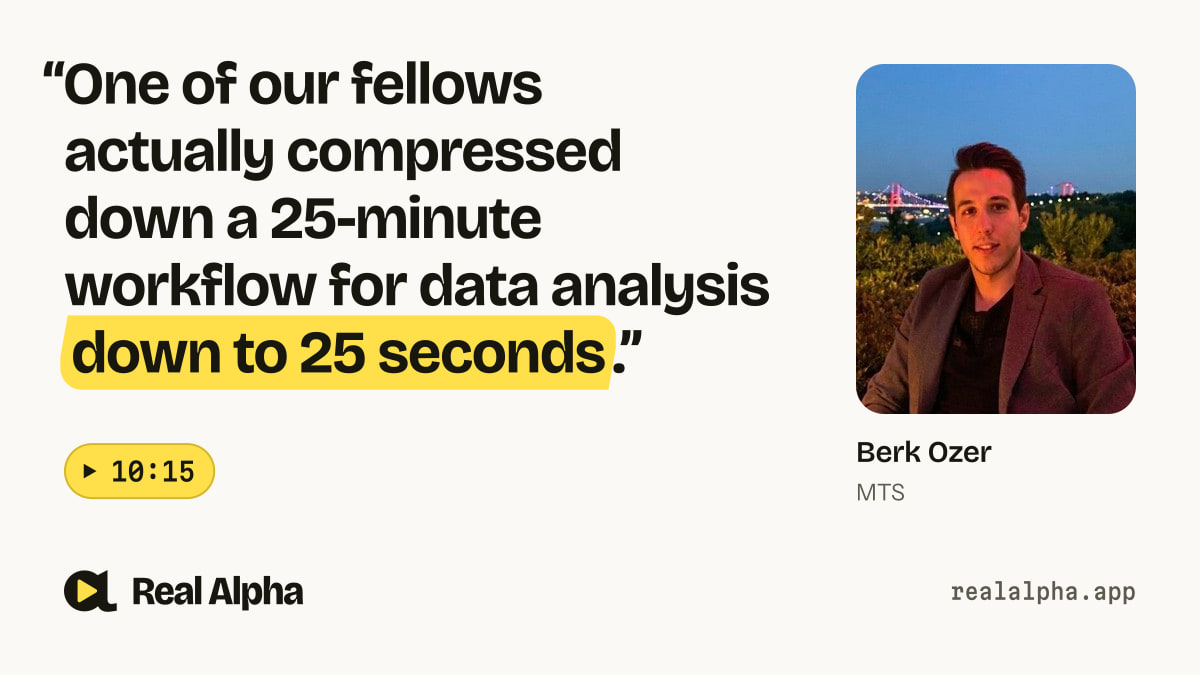
“One of our fellows actually compressed down a 25-minute workflow for data analysis down to 25 seconds.”
 Berk Ozerat 10:15 · MTS
Takeaways
- A data-analysis workflow shrank from 25 minutes to 25 seconds.
- AI use can move beyond automating tasks to producing new science.
- A dedicated community can help scientists build better AI habits.
About this segment
A fellow cut a data-analysis workflow from 25 minutes to 25 seconds, but the bigger surprise was AI producing new science. The founders say training and community help scientists adopt that approach.

Co-founder, Reactorfield
Shipped AI agents used by millions before ChatGPT, and invested in 150+ startups through Orange DAO.

Sophia Dew, Host · Host, MTS
From “James Sinka & Berk Ozer Reactorfield w Sophia Dew”, Nov 17, 2026. Watch the full episode
Thanks. We'll look at and fix what's off.
Transcript
Transcribed by machine (Whisper) from the episode’s audio, so a word may be off here and there.
- 9:24
Say, in theory, you're able to have people, scientists, individuals, use the methods that you're teaching, cohort one, to be able to use AI way more effectively. Do you see schools, research labs, PhD students all adopting this framework as well? Yeah. Yes, but it will take a little bit of time. So referring back to what I told, this is a little bit like changing our habits and using AI as a co-peer that you try to integrate everything rather than just asking a few questions here and there.
- 10:04
Let me give you a few examples. Even us, when we first started our cohort one in June, our primary idea was to help scientists to use AI so that they can automate stuff. They can automate literature search, writing some boring stuff so that they can spend more time. One of our fellows actually compressed down a 25-minute workflow for data analysis down to 25 seconds. Oh, wow. Yeah, so this is what we expected would happen.
- 10:29
Yes, and everyone is trying to use AI in this way, right, like for automation. But what we ended up with, as James mentioned, AI actually realized some pathways that we can produce some isotopes. AI actually created net new science. That's right. That's right. That's right. That's right. Yeah. And it takes a while for people to use AI this way. Yes. Ask the right questions, give the right context window, spend some time rather than just automation.
- 10:59
Yeah. There's two pieces here. So one, you were saying about like how does society adopt this? Ultimately, I think that there's so many like YouTube videos or guides or blog posts out there for how to use AI better in science. But we, having done YC, have seen that actually the community energy, the accountability, that ecosystem, that spark that it lights underneath you is the key differentiator.
- 11:20
And, you know, there's been a lot of new accelerators in Silicon Valley that have popped up around a similar thesis, understanding that you can do a ton of work in a very compressed period of time with the right, you know, starting conditions, with the right kind of environment. And that's what we uniquely create for the fellowship program. but our long-term vision is to build the tuxedo park or the chatham house uh for these ai native einsteins right there's no community there's no home where these people can go to and share what the crazy things that they've tried doing what's worked what hasn't worked what their new methods are um where they're going to be perceived as like insiders right like like this is like you're whiteboarding and kind of exploring and jamming on these things as opposed to if you
- 11:56
currently go to academia your average professor gets slapped for you use. AI, right? And so what we want to do is create that home base, that new environment, that tuxedo park where these AI native scientists can go, find their collaborators, and jam out and discover net new possibilities by cross-pollinating ideas across disciplines. And we think that that result will kind of take care of the rest. Once society understands what these models can do, then it'll become sort of negligent for not using it. We saw, for example, that this year we were able to deliver the Navier-Stokes results.
- 12:31
Our goal for cohort two is to deliver that same kind of a result, but for physics, chemistry, or biology, right? Like that's what we want to do. That's what we think we can do here.