The alpha, twice a week
That was 3 min.
Get the best new moments in your inbox every Wednesday and Saturday. It's free.
Check your inbox
We sent a link to your address. Click it to finish signing up. Not there in a minute? Look in spam.
or
Founders · 3 min · Jun 28, 2026
AI could make one-off software economical
 Scott Wu
 argues agents can create software for tasks used only once, where hiring engineers never made economic sense.
In this episode
Full analysis- 37:12Cognition found its first enterprise fit in repetitive migrations5 min
- 20:30AI progress calls for first-principles thinking2 min
- 52:14Focused startups can beat companies with far more resourcesPro pick 5 min
- 30:13One real task convinced Wu that Devin’s approach could work7 min
- 42:41Cognition put its whole team on its first enterprise customer5 min
- 48:31Measure AI spend by output, not token counts4 min
- 15:37AI could make one-off software economical3 min
- 23:01Long-running agents could pursue missions, not just tasks6 min
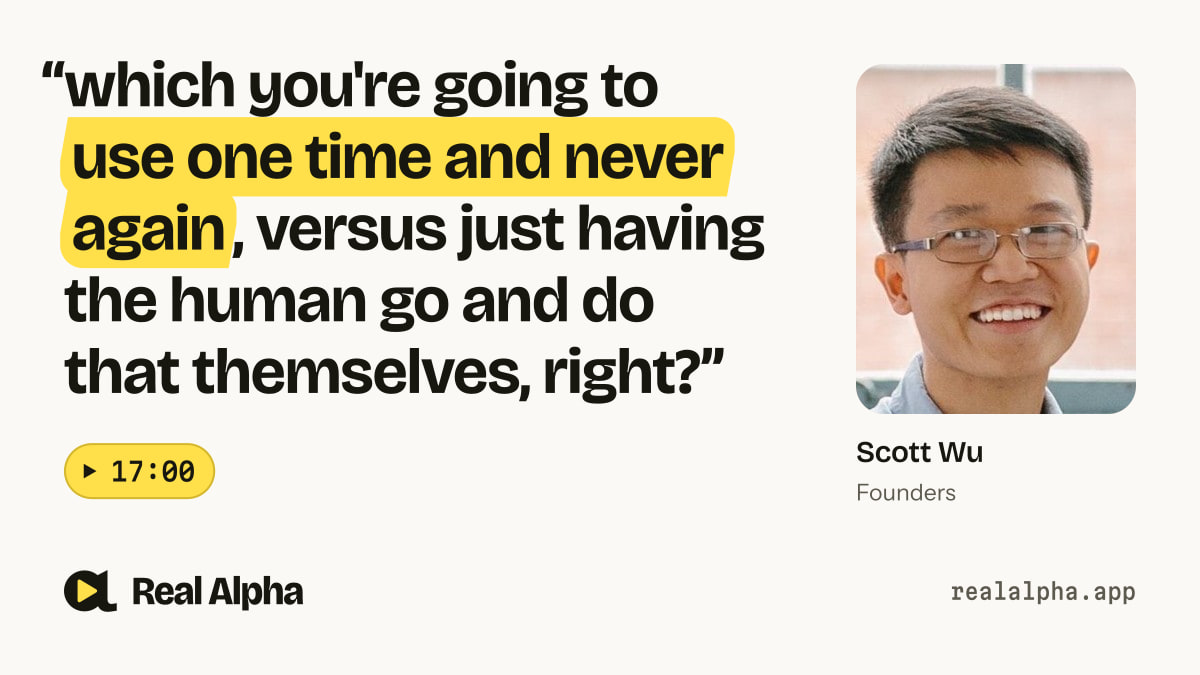
“which you're going to use one time and never again, versus just having the human go and do that themselves, right?”
 Scott Wuat 17:00 · Founders
Takeaways
- Teams avoid building software for tasks used only a few times.
- Agents could produce task-specific software on demand.
- That could make custom tools viable for one-off white-collar work.
About this segment
Scott Wu argues agents can create software for tasks used only once, where hiring engineers never made economic sense. That could extend software from mass-market products to ad hoc white-collar work.

Scott Wu is co-founder and CEO of Cognition.
Co-founded Cognition, the company behind Devin, an autonomous software engineer; three-time IOI gold medalist.

David Senra, Host · Host, Founders
Has read an entrepreneur's biography every week for Founders since 2016.
From “The Future of Software & AI | Cognition’s Scott Wu”, Jun 28, 2026. Watch the full episode
Thanks. We'll look at and fix what's off.
Transcript
Transcribed by machine (Whisper) from the episode’s audio, so a word may be off here and there.
- 15:42
One important kind of like distinction I'd make, which is, you know, I think what we'll see a lot more of in the near future is software today, that the math only really works out to create software if it's going to be used at least like a million times or something. You know, I'm giving a, maybe it's 10,000 times or whatever. And my point is like, if you want to go build a product today, you need a whole team of engineers.
- 16:04
Engineers are expensive. You got to pay salaries. You got to go build all this out and you got to go and do that, right? You need that software to be used enough times or to create enough value for that to be worth it, right? And, you know, something like YouTube passes that test because obviously so many, so many hours have been spent on building YouTube, but way more hours have been spent on using YouTube.
- 16:23
and that's what's made that work out and made it feasible, right? But there are so many things out there which only, you know, very specific things that only need to be used a few times or even like only need to be used once, right? And so like all the white collar work that we talk about today even is very, all right, you know, wake up in the morning. All right, I'm gonna go look through these like 15 LinkedIn profiles.
- 16:45
I'm gonna look for this and that or whatever or I'm gonna go fill out these forms or I'm gonna do this data analysis and put this Excel sheet together with this research that I found, right? All of these things are things that could be done with software. It's just, it obviously doesn't make sense to hire a whole team of people to go make you that piece of software, which you're going to use one time and never again, versus just having the human go and do that themselves, right?
- 17:10
I think what we're going to get to is we're going to get to a point where you are just giving your instructions to that agent. And the agent on the back end, you know, you don't even have to look at this, but on the back end, the agent is going to figure out, okay, here's, I'm going to write this code that's going to go do this. I'm going to put a script that automates this part. I'm going to do this and do this.
- 17:27
And that's what's going to allow it to actually go and do it. all these things. But what you start to get to, you know, as we're kind of saying, it's like, this is really just how you control your computer and how you do what you want to go do, right? And you wake up in the morning and it's like, here's what I want to go do. You talk to your agent about it. You figure out the task together. Once it has it, it can do the part of the literal, like, all right, put the pen to the paper on writing code. But that task is like, you know, you're the one that's deciding what to do. So this ideal future that's in your mind, right? How far away do you think we are to that?
- 18:00
Yeah. I mean, we've made a lot of steps toward it. I would say we still have got a ways to go. You can use Devon today. You can use all the different kind of coding tools today. And you can do a lot more than you could have done, you know, 10 years ago. But certainly, or even one year ago or six months ago. But certainly, you know, it's not at the level that we're talking about of you are neural linked into the AI and you can tell it exactly what you want it to do and what you want to see in the world and just have the AI go and do that.
- 18:27
When do we get there? It's hard to say, but I honestly, I mean, I think we'll have solved most of that over the next five years or so. In AI terms, five years is like a century. You know, in the rest of the world terms, obviously, it's like, it's kind of crazy to imagine that things can change that much in five years, but I really think it will.