The alpha, twice a week
That was 2 min.
Get the best new moments in your inbox every Wednesday and Saturday. It's free.
Check your inbox
We sent a link to your address. Click it to finish signing up. Not there in a minute? Look in spam.
or
Moonshots · 2 min · Nov 11, 2026
AI could overtake human output per kilowatt-hour by 2027
 Peter Diamandis
 compares Anthropic’s output with New York workers, including food, housing and transport, and projects a 2027 crossover.
In this episode
Full analysis- 43:18Longer AI work horizons could shift companies toward outcome delegation8 min
- 53:52Treating gene therapy as an approved platform could lower costs5 min
- 1:49:42Robotics startups should target valuable problems, not easy onesPro pick 6 min
- 39:59AI agents can steer users toward more token spending3 min
- 20:20AI could overtake human output per kilowatt-hour by 20272 min
- 1:14:50Vertical integration can unblock automation across supply chains3 min
- 36:14Anthropic may generate media by treating each modality as code3 min
- 1:39:11AI-run companies may begin as state-level legal experiments6 min
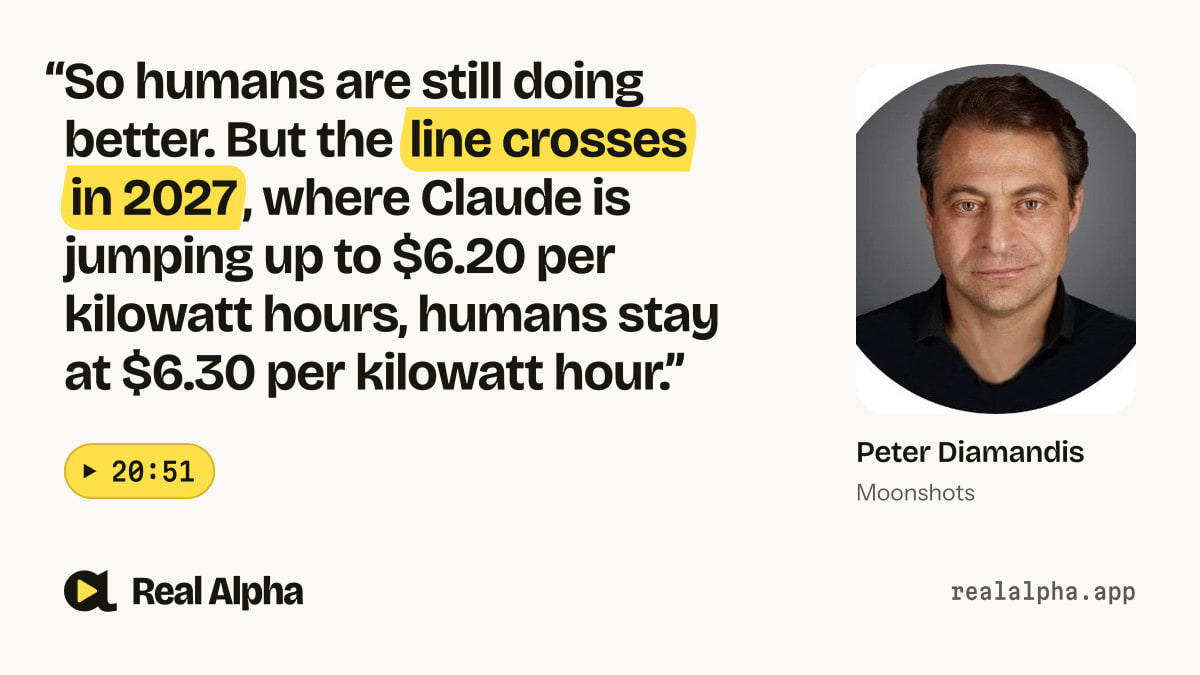
“So humans are still doing better. But the line crosses in 2027, where Claude is jumping up to $6.20 per kilowatt hours, humans stay at $6.30 per kilowatt hour.”
 Peter Diamandisat 20:51 · Moonshots
Takeaways
- The comparison includes food, housing and transport for workers.
- Peter projects Claude will pass the human benchmark in 2027.
- Dave argues that accounting for productive hours puts AI ahead already.
About this segment
Peter Diamandis compares Anthropic’s output with New York workers, including food, housing and transport, and projects a 2027 crossover. The calculation offers an energy-based way to track AI’s economic edge.

Peter Diamandis, Host
Founder, XPRIZE
Co-founded Singularity University and founded Zero-G; co-wrote the books Abundance and Bold.

Dave Blundin, Host · Founder & GP, Link Ventures
Has co-founded 23 companies; founding CEO of Vestmark and chairman of insurance marketplace EverQuote.

Alexander Wissner-Gross, Host · Founder, Reified
Has backed and advised 40+ tech companies, directly and through 021T Capital and Reified; writes The Innermost Loop.
From “Jensen’s Spy Probe, Anthropic’s Debut Week, and Elon’s 30M Robot Workforce | #310”, Nov 11, 2026. Watch the full episode
Answers “What will AI look like in the next few years?” See all 197 answers
Thanks. We'll look at and fix what's off.
Transcript
Transcribed by machine (Whisper) from the episode’s audio, so a word may be off here and there.
- 20:26
economic output per kilowatt hour versus human output per kilowatt hour, looking at New York City as a defined containment. Today, Anthropic is at $4.39 per kilowatt hour of output per kilowatt hour. And New York is at $6.30 per kilowatt hour of human output. And I took into account, by the way, food as an energy source and your home and transport to and from work. So humans are still doing better. But the line crosses in 2027, where Claude is jumping up to $6.20 per kilowatt hours, humans stay at $6.30 per kilowatt hour. But in 2030, Claude is up now projected based on their projections and their numbers up to be about 40% higher than the human.
- 21:20
So, you know, humans stay pretty flat and AI is increasing. Alex made an important point in there, which was that you can't just consider the economic output. You have to consider the 20 years of schooling and costs that went into. But that's training. That's training. That's all the pre-training costs that went into getting the population to a certain GDP level. All right. But, you know, Salim's on the right track here.
- 21:43
You know, a human is productive for about a third of their life, maybe half at most. and the training cost is only about 5% of the inference. So training the neural net is running about 5% of the electricity right now, and human is 50%. So by that metric, the lines have already crossed. I think so many different curves just cross over in the next year or so. I'll save some of my hottest takes for assuming Peter will do a prediction episode in December.
- 22:10
But 2027, I think, will be an utterly wild year. Crazy. I know on the one hand, I usually say space time feels perfectly smooth where we are right now here in the depths of the singularity. But 2027 should be utterly bonkers. And who knows what happens to New York. city's economic output in an era when autonomy time horizons are going through the roof. Okay, Alex, here's your challenge. Name two lines that don't cross in 2027.