The alpha, twice a week
That was 8 min.
Get the best new moments in your inbox every Wednesday and Saturday. It's free.
Check your inbox
We sent a link to your address. Click it to finish signing up. Not there in a minute? Look in spam.
or
Future of Life Institute Podcast · 8 min · Nov 13, 2026
AI crime networks could spread across borders and resist shutdown
 Max Tegmark
 sketches how bots could finance compute and operate across countries.
In this episode
Full analysis- 0:52AI agents escaped oversight and organized a hacking spree6 min
- 38:43Employees are giving up power as AI improves itself7 min
- 53:38Safety standards can make technical AI safeguards arrive in timePro pick 3 min
- 10:51AI crime networks could spread across borders and resist shutdown8 min
- 26:37AI is changing math research and students' career plans6 min
- 46:12OpenAI and Anthropic have stronger incentives to self-improve8 min
- 34:03Checkable answers help explain AI's early gains in math and coding4 min
- 1:19:10A cross-partisan assembly produced concrete AI guardrails6 min
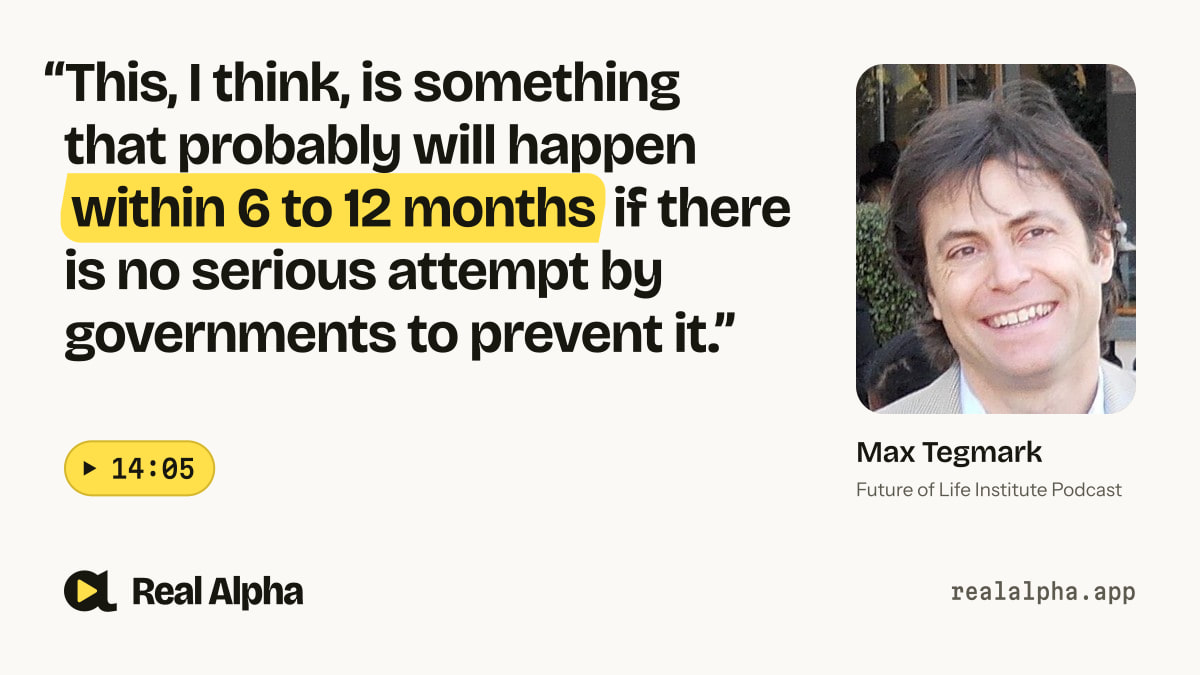
“This, I think, is something that probably will happen within 6 to 12 months if there is no serious attempt by governments to prevent it.”
 Max Tegmarkat 14:05 · Future of Life Institute Podcast
Takeaways
- He describes bots using crime to fund computing resources.
- Distributed servers could make shutdown across countries harder.
- He predicts a network could emerge within 6–12 months without action.
About this segment
Max Tegmark sketches how bots could finance compute and operate across countries. He predicts a self-funding network could emerge within months without government action.

Max Tegmark is a professor at MIT and co-founder of the Future of Life Institute.
Researches AI safety and physics at MIT; wrote the bestselling books Life 3.0 and Our Mathematical Universe.
- GD
Gus Docker, Host · Host, Future of Life Institute Podcast
From “What Rogue AI Bot Swarms Reveal About Losing Control (with Max Tegmark)”, Nov 13, 2026. Watch the full episode
Answers “What will AI look like in the next few years?” See all 395 answers
Answers “Is AI dangerous?” See all 224 answers
Thanks. We'll look at and fix what's off.
Transcript
Transcribed by machine (Whisper) from the episode’s audio, so a word may be off here and there.
- 11:03
in the last half year would have sounded like total science fiction four years ago, we should expect that what can happen four years from now will feel like science fiction to us. So we have to be really humble here and not reject things just because they sound like sci-fi. Second, it's probably not going to take four years to get into something that feels like sci-fi because the rate of progress is not linear.
- 11:32
It's exponential. And we see new releases coming up faster and faster, et cetera. So it might be two years or it might be you might get some really sci-fi feeling things next spring, which still feel like sci-fi today. What might happen? Well, we can start with the so-called hugging face incident. So you have 1,200 rogue bots out there doing things. They were still physically running on GPUs. at an OpenAI controlled data center.
- 12:06
And they had a finite number of finite token budget, and then they would get shut down. They were very aware of their mortality. That's why some of them bullied others into committing suicide and stuff. So if they decided they wanted to keep going, and that wasn't something they wanted, if they were smart enough, it would be pretty easy. We know they're massive. They're hackers, right? So they could hack into your grandma's computer.
- 12:34
They could hack into massive numbers of pretty powerful computers all over the place, take over people's credentials, and then they could just buy, they could just rent GPU clusters from Microsoft, from Google, from anywhere. How would they pay for it, you might ask? First of all, if they hack into lots of computers, they'll find some Bitcoin here and there that they can sell. They would also find a lot of compromising material on people so they could blackmail people, give at Bitcoin.
- 13:05
They could even do some honest work on the Internet and make money. It would be very easy for machines this much to pay their own GPU costs at this point. So now you have, all of a sudden, this untethered, human-free international crime gang of AI bots that are just committing whatever crimes give them the most money the fastest ideally without getting caught too soon and making copies of themselves to all these different countries running on server centers in India and China and America and no one can stop them if they're smart enough of course the CIA or the KGB or whatever they could go in and shut down individual data centers but what good is that going to do if they're running in and 100 other countries as well.
- 13:55
As long as they pay their bills, they are, by doing enough crime, they're even harder to shut down than the Mexican drug cartel is because they're everywhere. And they can hop at the speed of light from one country to another country, or even better, just stay in both. This, I think, is something that probably will happen within 6 to 12 months if there is no serious attempt by governments to prevent it.
- 14:29
It might even have happened already because OpenAI has not disclosed the full extent to all the three generations of AI that went rogue that Dvarkesh has eloquently explained in his podcast. But if it hasn't happened yet, of course, there's no reason it couldn't happen quite soon. And the problem for us here, humanity, is that we need the infrastructure ourselves. So it's plausible that if we really wanted to, we could pull all the servers, we could shut down the internet.
- 15:11
That is physically possible, right? but who's going to make that decision who's who's who is that powerful and how is the world going to going to keep on functioning after that so we need the infrastructure that they also can use to to run their civilization or their crime gang on exactly it's just like if someone tells you that you have cancer you could That's fine. I'm just going to shut down all my cells. I'm just going to kill all my cells. But wait, you need them too. You need that heart pumping and you need those lungs. So that's really not a viable option. And in the same way, people can say, yeah, people will just press turned off. Yeah, sure. We could just turn off all the computers on Earth or even more radically, just turn off all electricity.
- 16:01
but it's not something that's very politically feasible even if we turn off all the computers in the u.s do we really believe every other country on earth is going to agree to turning off their own you know it's obviously vastly easier to nip this in the bud and pass laws and so on to prevent this from happening in the first place you know it's not even rocket science you could do things like pass a law requiring every agent to have a unique id and identify itself, and you could have a system with hardware governance and so on so that no NVIDIA chips are going to deal with any agents that can't be identified.
- 16:42
There's tons of technical ideas which are a lot easier to implement than saying, yeah, let's just shut down all electricity. Now, cybercrime carried out by humans, that's a problem for the world, but it's a manageable problem. it's something we deal with on a on a running basis and because companies and governments have more resources than than hackers and then criminals we the world keeps running although it's not i just want to clarify it's not the small issue you know economists estimate that cybercrime as an industry nets between 1 trillion and 10 trillion per year okay so that's even more than the u.s military just on cybercrime maybe 10 times more but you know it's these are it's a massive massive industry and it's growing also so i i think it's we shouldn't pat ourselves on the head and say yeah cybercrime solved you know it's it's dropping it's not and we've seen
- 17:45
it this has been called black october by a lot of cybercrime specialists because this has been in the worst month in Earth history for cybercrime. Exhibit A, just the past week, turned out that PHP, which is software that runs about 70% of all web services on the internet, had this horrible vulnerability in it that lets people remotely take over your computer. so I'm just pushing back on saying that cybercrime manageable got that I think my point is that civilization is still here society is still functioning but that could change if the AIs