The alpha, twice a week
That was 4 min.
Get the best new moments in your inbox every Wednesday and Saturday. It's free.
Check your inbox
We sent a link to your address. Click it to finish signing up. Not there in a minute? Look in spam.
or
Unsupervised Learning · 4 min · Nov 2, 2026
AI customers need shared storage built for extreme throughput
Danila Shtan says GPU customers now pull up to 700 GB/s from shared storage, then contrasts AI labs with compliance-focused enterprises.
In this episode
Full episode- 39:13Chip scarcity gave AI clouds room to competePro pick 5 min
- 25:05Open-model inference still has major room to improvePro pick 3 min
- 53:19Nebius lets engineers use AI but keeps accountability human3 min
- 15:36AI customers need shared storage built for extreme throughput4 min
- 10:12New Nvidia chips require constant iteration before launch5 min
- 21:47Prefill/decode disaggregation remains a case-by-case tool3 min
- 34:25Execution capacity is the bottleneck across AI infrastructure3 min
- 57:53Agent reliability may matter more than model size3 min
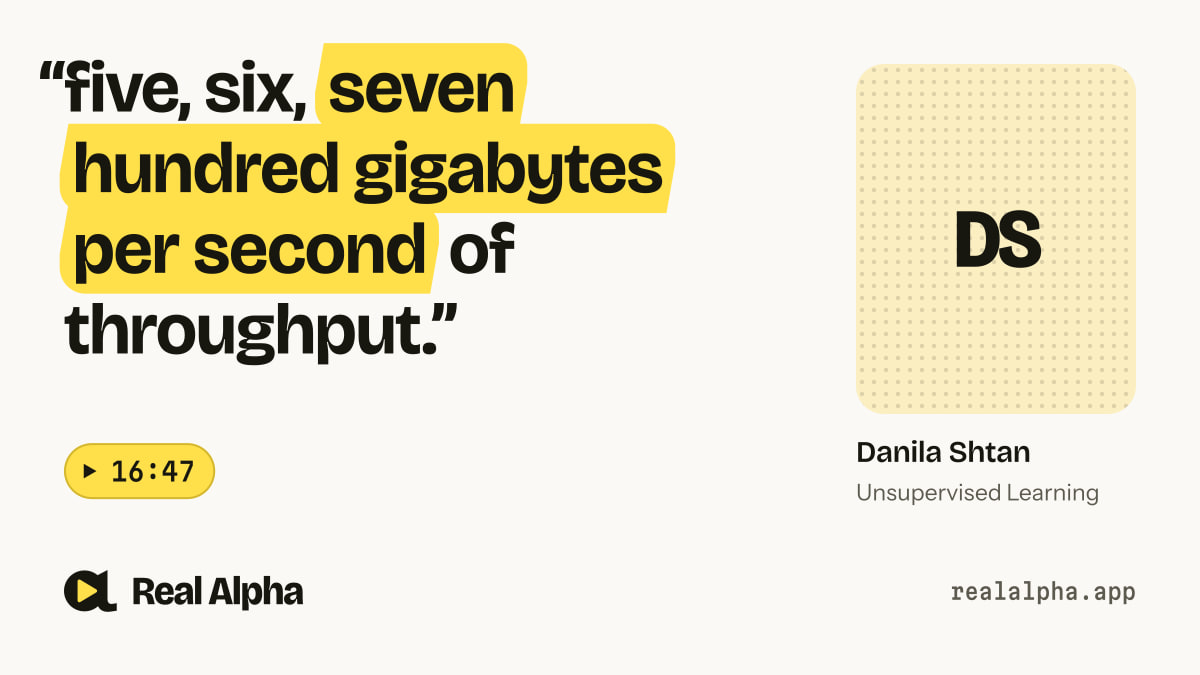
“five, six, seven hundred gigabytes per second of throughput.”
Takeaways
- Shared training volumes can reach 700 GB/s.
- AI labs prioritize GPU capacity, storage and availability.
- Enterprises add compliance, security and data-location requirements.
About this segment
Danila Shtan says GPU customers now pull up to 700 GB/s from shared storage, then contrasts AI labs with compliance-focused enterprises. Cloud providers must meet both performance and governance needs.
Danila Shtan is CTO of Nebius.

Jacob Effron, Host · AI Investor, Redpoint Ventures
Growth investor in Abridge, Ramp and Physical Intelligence; ex-Flatiron Health.
From “The Window Before AWS Wakes Up: Nebius CTO on Racing the Hyperscalers”, Nov 2, 2026. Watch the full episode
Thanks. We'll look at and fix what's off.
Transcript
Transcribed by machine (Whisper) from the episode’s audio, so a word may be off here and there.
- 15:40
oh it's not that different to be honest because like every customer is uh like its own unique flower right but at the same time workloads in principle are not that different it's either training and you kind of know how training looks like I think. Or inference. And you kind of know how inference looks like. Circling back a couple of years ago, for example, we kind of underestimated the storage component. We thought GPUs are the most important thing, and they are. But alongside the whole training angle, you see a massive demand for storage. And it's not for the amount of like HDDs or VMUs that you can provide to the customer. It's about throughput. It's about latency.
- 16:26
In my prior life, pre-AI workloads and infrastructure build-outs, I was talking about gigabytes per second if we were talking about network-attached storage, right? It was like, it's willing. Right now, we have customers routinely kind of like hitting a common share, like one volume, right, connected to a number of GPU servers with like, I don't know, five, six, seven hundred gigabytes per second of throughput.
- 16:55
this is extreme like two years ago I didn't even think about that and now this is more or less like something we expect at the same time if you are targeting these numbers for the highest demand like the most demanding customers your baseline is so high you kind of can't serve anyone right so if you hit this like use case where a customer and needs 700 gigabytes per second from three petabytes of shared file storage connected to a thousand of servers or like 8,000 GPUs, you kind of know how to serve a massive cohort.
- 17:37
So I'd say in terms of like performance or features per se, the customers are not that different. Then you meet another subset of like what the customers really want because there are definitely different customers in terms of not their scale, not their size, not their workloads, but rather how mature they are or what are their obligations for their clients, right? Because we can talk about like a Neolabs.
- 18:11
Like Neolabs routinely have seed rounds in the billions nowadays, right? So most of that budget goes into commute. So you can have like a contract for a billion dollars with the newly founded Neolab, they don't care that much about anything but GPU, storage, performance, availability. This is it. Oftentimes, they don't even care about the location of those GPUs. They don't care if that's US, Europe, France, or Iceland.
- 18:44
Why bother? Internet connection is good, storage is there, GPUs are working, and we are talking about a billion dollar contract, right? At the same time, we now see and start onboarding enterprise customers. These are companies whose contract with us will be smaller, sometimes significantly smaller, but they are more established. They have customers and they have applications for their customers. They have procedures. They need to make sure they're compliant to a number of regulations in multiple countries.
- 19:24
So now we are getting into that whole angle of being the real cloud, you know, like certifications, compliance, security posture checks. Let us look at your source code. How do you solve problem X? How do you protect your customers from attack vector Y? etc etc etc and i'd say if you are talking about differentiated customers this is the most