The alpha, twice a week
That was 3 min.
Get the best new moments in your inbox every Wednesday and Saturday. It's free.
Check your inbox
We sent a link to your address. Click it to finish signing up. Not there in a minute? Look in spam.
or
Bloomberg Surveillance · 3 min · Oct 27, 2026
AI debt and short-lived chips could compound data-center risk
 Gary Gensler
 points to AI debt approaching $600 billion, insurer exposure and off-balance-sheet guarantees.
In this episode
Full analysis- 17:52AI markets are overfunding the boom and hiding debt risks3 min
- 9:18Rising debt can undermine Treasuries as a safe haven3 min
- 41:49Nominal growth must cover a country's interest costs2 min
- 33:55Wilson says lower valuations already reflect slower earnings growth3 min
- 1:49Kaplan says the Fed should move slowly if inflation is supply-driven3 min
- 30:18Wilson sees the under-the-surface correction nearing its end2 min
- 39:00A strong dollar keeps growth concentrated in the US2 min
- 25:29AI debt and short-lived chips could compound data-center risk3 min
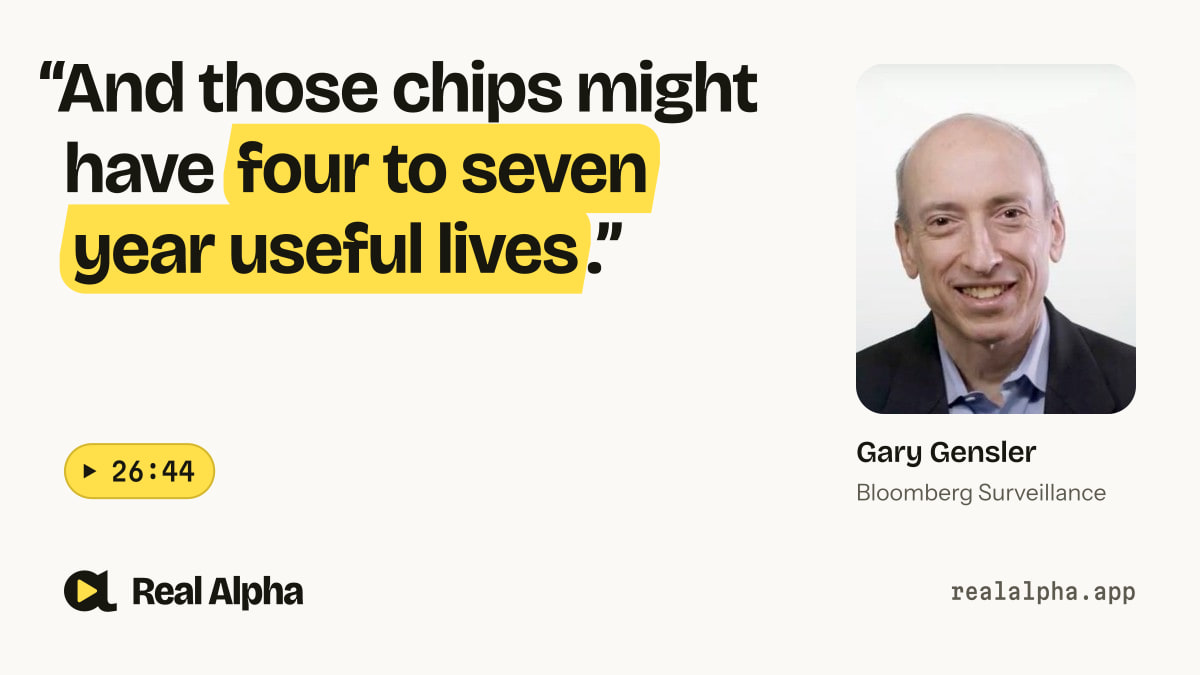
“And those chips might have four to seven year useful lives.”
 Gary Genslerat 26:44 · Bloomberg Surveillance
Takeaways
- AI-related debt is nearing $600 billion.
- Insurers hold exposure through private credit and direct holdings.
- Some funded chips may have four-to-seven-year useful lives.
About this segment
Gary Gensler points to AI debt approaching $600 billion, insurer exposure and off-balance-sheet guarantees. He says some funded chips may have four-to-seven-year useful lives, raising the stakes if the boom slows.

Professor, MIT
Led the SEC's capital-markets reform agenda and now researches artificial intelligence, finance, and public policy at MIT Sloan.
- TK
Tom Keene, Host
- PS
Paul Sweeney, Host
From “Previewing the Fed Meeting and AI IPOs | Bloomberg Surveillance”, Oct 27, 2026. Watch the full episode
Thanks. We'll look at and fix what's off.
Transcript
From the transcript Bloomberg Surveillance publishes with the episode.
- 25:32
Well, if you're asking me where is the debt in the system, that's a different question. But I do concern myself that the risk in the system is In artificial intelligence, we've raised over $ 500 billion of new debt this year. And then you add this Broadcom $ 63 billion. So we're pushing $ 600 billion. And who holds it? I think it's insurance sector I worry about that's picked up a lot of holding of debt through private credit or just directly.
- 26:05
I worry about all these guarantees that Broadcom, NVIDIA, AMD have written back into these data centers, and it's off balance sheet. They're setting up more special purpose vehicles than even Citicorp did in the day.
- 26:21
Let me get one more in here because Paul's got any questions. We're going to wait for Ethan Bronner, folks, a critical conversation from Tel Aviv. Gary Gensler, this is the critical moment then. If we have those worries... Do we understand the simple depreciation or obsolescence of all this technology? I do not have a clear picture.
- 26:41
So and a lot of the funding is funding the chips, the memory chips. And those chips might have four to seven year useful lives. Now, I get it. I get it. It's somebody in maybe another country will be using these in the future. But there's such uncertainty. Fabulous scaling, such technological advances that the chips of 2026 won't be that valuable in 2032.
- 27:10
Are you have any confidence that our friends in Washington have any idea what AI is and what AI can be and what AI risks are? Boy, I think global Wall Street's trying to just figure it out as we go through this anthropic S1. I can't imagine our friends in Washington Look, it ranges. Some part do.
- 27:33
And just like in the media business, just like financial analysts, they're grappling with it. There's real issues. That we can chat about, about AI safety and AI working on its own and.
- 27:52
Not being controlled by us humans. That's a deep thing. I worry, of course, about this overall financial stability as we decelerate from a capital expenditure boom. And then you've got a White House that just got their foot on the accelerator pedal. and wants to go as fast as possible in competition with China. And China's not going to slow down. So these are hard choices. And then the Federal Reserve has to decide, well, do we raise rates again in December? Do we raise rates again in March?
- 28:24
I think they might pause after December. What's the pixie dust? Come on. Simon Johnson finally won a Nobel Prize. His book, 13 Bankers, was brilliant on