The alpha, twice a week
That was 5 min.
Get the best new moments in your inbox every Wednesday and Saturday. It's free.
Check your inbox
We sent a link to your address. Click it to finish signing up. Not there in a minute? Look in spam.
or
The Joe Rogan Experience · 5 min · Jul 1, 2026
AI dividends won't replace the work of modernizing institutions
 Aravind Srinivas
He frames AI dividends as a share of AI profits, not a complete answer to displacement.
In this episode
Full episode- 1:08:35AI demand outpaced forecasts for compute, chips and power8 min
- 1:42:46Local AI could give users more control over information7 min
- 2:21:03Self-improving AI still faces messy real-world systems4 min
- 1:35:35America makes it possible to fund another startup after failure5 min
- 2:15:16AI dividends won't replace the work of modernizing institutions5 min
- 1:20:33Schools can teach students to ask questions AI cannot answer5 min
- 1:53:23Engagement-based feeds bury controls that would end sessions3 min
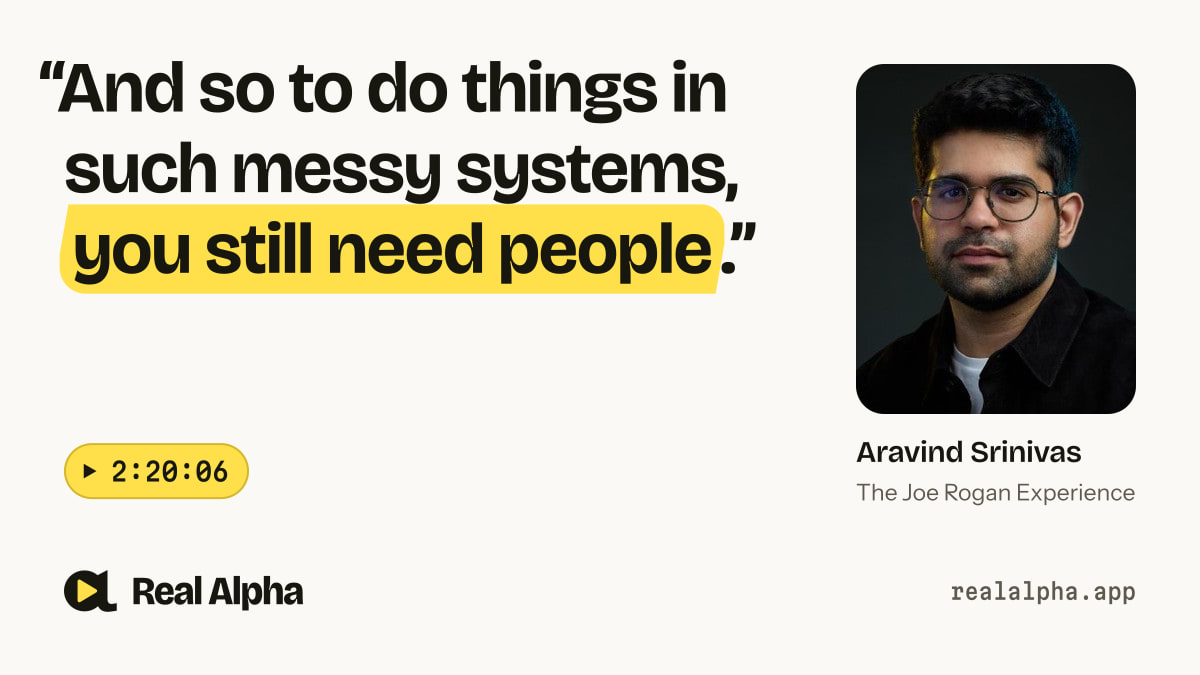
“And so to do things in such messy systems, you still need people.”
 Aravind Srinivasat 2:20:06 · The Joe Rogan Experience
Takeaways
- AI dividends could share profits but should not be the only support.
- He says modernizing government could take five to ten years.
- Legacy contracts, software and training slow adoption.
About this segment
He frames AI dividends as a share of AI profits, not a complete answer to displacement. Legacy contracts, software and training make institutional adoption a human implementation job.

Aravind Srinivas is cofounder and CEO of Perplexity AI.
Held research roles at OpenAI and Google DeepMind before co-founding the AI search engine Perplexity in 2022.

Joe Rogan, Host · Host, The Joe Rogan Experience
From “Joe Rogan Experience #2521 - Aravind Srinivas”, Jul 1, 2026. Watch the full episode
Answers “Which jobs will AI replace, and which are safe?” See all 121 answers
Thanks. We'll look at and fix what's off.
Transcript
Transcribed by machine (Whisper) from the episode’s audio, so a word may be off here and there.
- 2:15:20
What do you think about this idea that universal basic income is going to be required? Some form of it is good. It's like a dividend. I almost think of it as a dividend. If a lot of spend that most companies are currently doing today on payroll, which is paying a knowledge worker for a certain task, think of knowledge work as basically taking information and transforming it into an artifact, right?
- 2:15:47
And it's messy and complicated. Let's assume that's being done by AIs. So obviously companies will start spending more on compute instead of payroll. It's just a reallocation of like spend, a budget. Similar to like what happened in advertising industries where most of your advertising budgets went to like television and like billboards and then now it's starting to go to Google and Instagram and YouTube and all that.
- 2:16:12
So when that happens, obviously, like, the AI companies are going to make a lot of money. And people who helped be part of creating it or either directly or indirectly would want to have some role to play in that ecosystem. And a good way to involve them is through giving them some ownership in the company. So as shareholders, if you get dividends from the profits generated by the AIs, it's not a bad thing.
- 2:16:41
But that shouldn't be the only thing. Right. So this is similar to, like, people that live in Alaska. They get a check. Correct. Alaska does this, and it's not a bad thing. As long as they are doing some other things alongside. It could lessen the burden. Correct. Yeah. Yeah. And if people are interested in still being part of the AI industries. They go do things that AIs are not able to do today.
- 2:17:06
And that's been the case before. Like when Industrial Revolution started, the United Kingdom actually started like projects around building railroads. And that gave a lot of people who are in the cottage industries new jobs. So there are going to be a lot of new projects to just, okay, like what if we want to reimagine the government itself where the government runs largely on AI? Yeah, that was my next question.
- 2:17:31
yeah so then we need people for that yeah because this is a legacy industry it's not it's not about the capabilities not being there it's about working through the legacy and bureaucracy to like actually deploy and implement this inside the most like like largest institutions in the country and that's going to need a new set of skilled workers to go do that so some people who might be working at microsoft or something today might actually end up working for the united states government because uh microsoft may not need them especially for like you know internally deploying ai or selling ai to their customers but the government needs them and and if the government can pay them well and it's a fulfilling job to find some meaning for like doing something good for the country it's not a bad thing so i i think like just like in the industrial revolution where
- 2:18:21
we had new projects because the demand for ai was so big we're going to start seeing some new projects being created in ai as well when the capabilities advance enough that they can replace knowledge workers that's the rosy scenario it's not as rosy like a real world is messy a lot of things are still done through trusting other human beings nobody's like blindly trusting ai's ai still make a lot of mistakes i know a lot of people are hesitant to the idea of ai running government and i get it but also look at what the people are doing look at how much corruption there is how much fraud and waste imagine if all fraud waste and corruption was instantaneously eliminated yeah i mean that was what elon tried to do with doge right and and then i think the bottleneck there was just discovering how slow it is to do things it's not he's not used
- 2:19:14
to running that slow yeah and uh also how much resistance yeah because there's so much grift Correct. Yeah. So honestly, like more than AI, the government is running a lot of legacy software stack because a lot of these legacy enterprise companies just have created these multi-decade or like year contracts that are hard to get out of. And the way they do that is to sell it at a much larger discount. And, you know, like if you're on like a specific OS, you're not allowed to change this for like 10 years.
- 2:19:46
You have to use the same sort of software. All the people you hired only know to use that tool. So it takes time to actually change and implement new things, leave alone AI. If you just wanted to move everybody from Windows machines to Mac machines, good luck with that. It's going to take a lot of time. That's the state of the system. And so that has nothing to do with technology. And so to do things in such messy systems, you still need people.
- 2:20:16
still need people to navigate all these changes it's not about the capability of technology it's more about how the system is structured and that's why i still feel there will be new jobs