The alpha, twice a week
That was 5 min.
Get the best new moments in your inbox every Wednesday and Saturday. It's free.
Check your inbox
We sent a link to your address. Click it to finish signing up. Not there in a minute? Look in spam.
or
All-In · 5 min · Jul 10, 2026
AI infrastructure is being built against booked demand
 Andrew Feldman
 describes city-scale data centers and a $25 billion Cerebras backlog.
The episode’s best minutes
Full analysis- 1:36AI infrastructure is being built against booked demandPro pick 5 min
- 15:59Open models give companies more control over AIPro pick 5 min
- 46:21AI helps directors turn imagined scenes into visual references4 min
- 4 more moments in the full episode
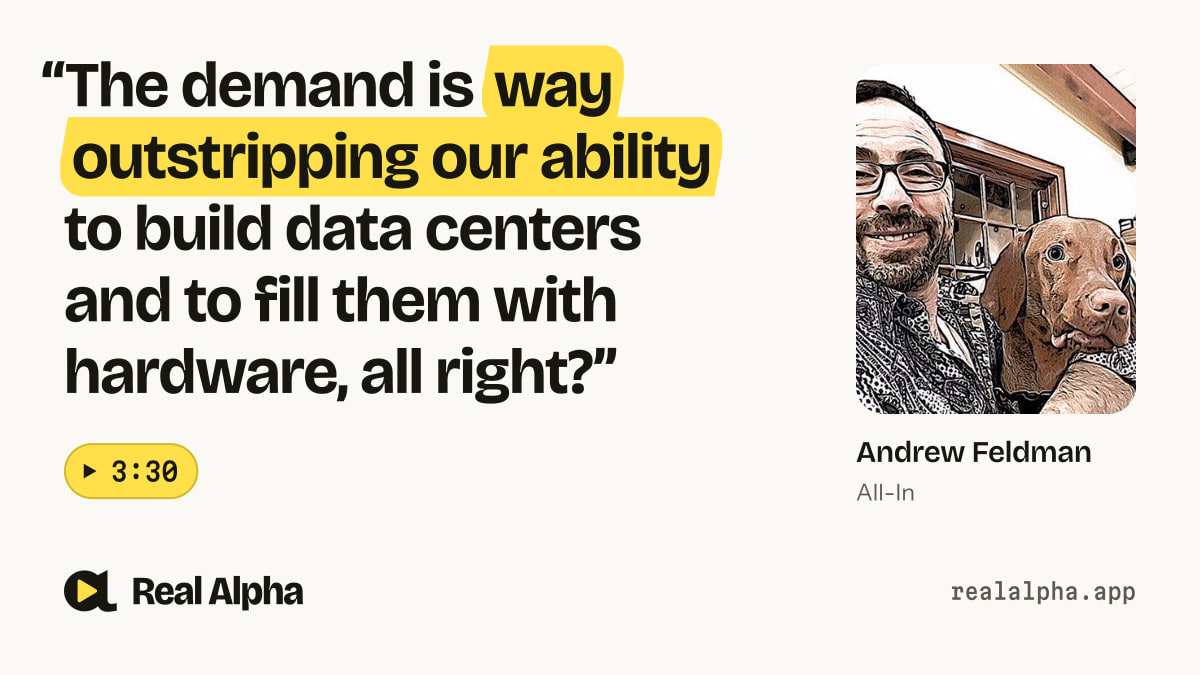
“The demand is way outstripping our ability to build data centers and to fill them with hardware, all right?”
 Andrew Feldmanat 3:30 · All-In
Takeaways Pro pick
- Data center demand is outstripping the ability to build and fill them.
- Cerebras had a $25 billion backlog.
- Companies are shifting from unlimited experimentation to using models selectively.
One of Pro's picks, open to you here. Try Pro free for 7 days
One of Pro's picks. The rest of the summary and the 3 takeaways are in Real Alpha Pro; the video, the quote and the transcript stay free.
Read it with Pro, 7 days freeAbout this segment
Andrew Feldman describes city-scale data centers and a $25 billion Cerebras backlog. He says early AI spending includes waste, but companies are learning to manage it like a business.

CEO, Cerebras
Co-founded and leads Cerebras Systems, whose wafer-scale engine is the largest processor in computing history.

Chamath Palihapitiya, Host · Founder & CEO, Social Capital
Led Facebook's growth team; his firm backed Slack and AI chipmaker Groq.

Jason Calacanis, Host · Founder & CEO, LAUNCH
Early Uber angel; sold Weblogs Inc. to AOL; hosts This Week in Startups.

David Sacks, Host · Co-founder & partner, Craft Ventures
PayPal's first COO, founded Yammer; White House AI & crypto czar 2025–26.

David Friedberg, Host · CEO, Ohalo
Founded The Climate Corporation, sold to Monsanto for about $1.1B in 2013.
From “Open Source Wins, AGI Is Here, and Scorsese’s AI Toolkit with CEOs of Cerebras & Black Forest Labs”, Jul 10, 2026. Watch the full episode
Answers “Is AI a bubble?” See all 99 answers
Answers “Is there still a GPU shortage?” See all 95 answers
Thanks. We'll look at and fix what's off.
Transcript
Transcribed by machine (Whisper) from the episode’s audio, so a word may be off here and there.
- 1:49
Maybe you could just enlighten us in 2026. What is Cerebras doing? And what is happening with this build out out in Texas? These are some gigantic, gigantic efforts. The size and scope of what is being built, the physical size and scope, usually when we talk about software or we talk about hardware, we're talking about chips or boxes and they don't have the same sort of physical enormity. Right. Right.
- 2:16
And what we're talking about now are data centers that are in the next several years going to use more power than the previous 50 years on earth took. Wow. Right. We're talking about individual buildings the size of football fields that have more power coming into them than mid-sized cities. And they're being built across the U.S. They're being built in Canada. They're being built throughout the Nordics.
- 2:43
They're being built here in Paris and throughout France and Europe, in the Middle East, in nations that sort of weren't front and center in anybody's mind previously. You know, Kazakhstan, Tajikistan are building out Georgia, you're building out data centers of size, Armenia. Everybody's sort of focused, huge data centers. Every country and every state, obviously, in America feels they need to participate in this.
- 3:07
And the people who are buying the capacity, the OpenAI's, Anthropics, SpaceXAI, the Googles, they are insatiable right now. And they're building, how many years out, when you talk to them, they were ordering chips from Cerebras before you were finished with the chips. They're putting orders in ahead of time. The irony is, unlike many sort of exciting times in technology, they're trying to capture yesterday's demand, right? The demand is way outstripping our ability to build data centers and to fill them with hardware, all right?
- 3:49
Right. And so, you know, we have a $25 billion backlog, $25 billion backlog, and we are not alone in that. AI, Anthropic, you go through this list of Google wants more data centers, Microsoft wants more data centers, AWS wants more data centers, right? All of these players are not chasing sort of if you build it, they will come. They're chasing the demand is booked. Right. How do we keep them from leaving? Right. And that's extremely unusual. It's very unusual. And now we have people who are, you know we have a term for a token maxing yeah and there's a great debate is this actually creating value i'm curious where you stand you know is it even possible that this much demand could be created if value did not exist there is clearly massive value happening yeah but there's also massive experimentation oh for sure you know i you know what i i liken this to when we first
- 4:55
started with AWS. And it was so good to get around your own IT organization. Right. That you told every engineer, yeah, go ahead, put on your credit card, sign up. Yeah. Right. And a lot of it was really useful. And some of it was like, God, I wish we didn't do that. Yeah. And so for sure, there's experimentation. But it doesn't mean that the net value isn't enormous. It means some of it is going to go nowhere. And it was the same, I remember when Costco opened up in the Palo Alto area in 1988, and people used to shop Costco like they shop Safeway. They'd go down every aisle.
- 5:34
Yes. And that's a horrible way to shop Costco, because you end up with four things you didn't need, and each was $22, right? And as people got more sort of accustomed to it, you'd go to the back, you'd get the chicken, 18 cupcakes for the kid's birthday party, bang, you were out. And it's exactly the same. I think at first people opened up and said, everybody, as much tokens as you want. And in enterprises, there's no open loop. We don't give sort of any resource unconstrained to people. And now we're jumping on and saying, whoa, all right, these guys should have as much as they need. They're enormously productive. Over here, we can use maybe an open source model, maybe a cheaper model over here. And now we're sort of running it like a business.
- 6:18
And we're really seeing a certain type of person emerge who knows how to deploy this technology.