The alpha, twice a week
That was 5 min.
Get the best new moments in your inbox every Wednesday and Saturday. It's free.
Check your inbox
We sent a link to your address. Click it to finish signing up. Not there in a minute? Look in spam.
or
All-In · 5 min · Jul 10, 2026
Open models give companies more control over AI
 Andrew Feldman
 says open models can handle routine work, while frontier models remain useful for hard problems.
The episode’s best minutes
Full analysis- 1:36AI infrastructure is being built against booked demandPro pick 5 min
- 15:59Open models give companies more control over AIPro pick 5 min
- 46:21AI helps directors turn imagined scenes into visual references4 min
- 4 more moments in the full episode
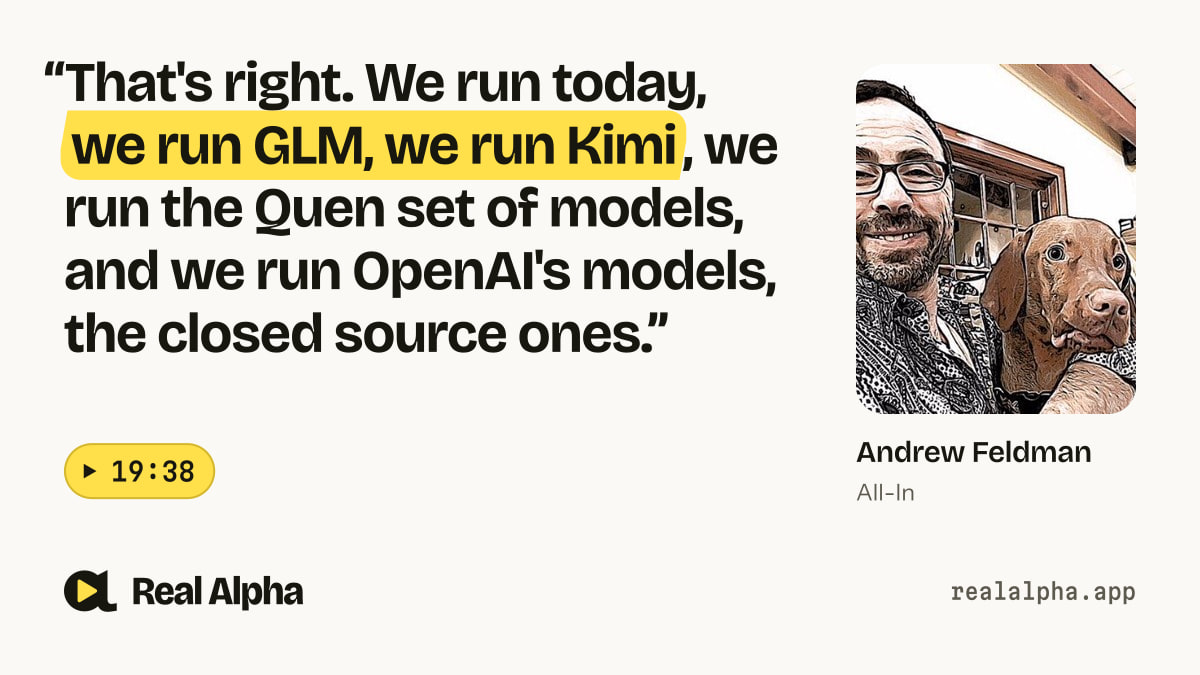
“That's right. We run today, we run GLM, we run Kimi, we run the Quen set of models, and we run OpenAI's models, the closed source ones.”
 Andrew Feldmanat 19:38 · All-In
Takeaways Pro pick
- Routine company work may not need a frontier model.
- Regulated firms want on-prem options and more control over data.
- Cerebras runs open, closed, and customer-developed models.
One of Pro's picks, open to you here. Try Pro free for 7 days
One of Pro's picks. The rest of the summary and the 3 takeaways are in Real Alpha Pro; the video, the quote and the transcript stay free.
Read it with Pro, 7 days freeAbout this segment
Andrew Feldman says open models can handle routine work, while frontier models remain useful for hard problems. He describes demand for on-prem systems and a mix of open, closed, and customer-built models.

CEO, Cerebras
Co-founded and leads Cerebras Systems, whose wafer-scale engine is the largest processor in computing history.

Chamath Palihapitiya, Host · Founder & CEO, Social Capital
Led Facebook's growth team; his firm backed Slack and AI chipmaker Groq.

Jason Calacanis, Host · Founder & CEO, LAUNCH
Early Uber angel; sold Weblogs Inc. to AOL; hosts This Week in Startups.

David Sacks, Host · Co-founder & partner, Craft Ventures
PayPal's first COO, founded Yammer; White House AI & crypto czar 2025–26.

David Friedberg, Host · CEO, Ohalo
Founded The Climate Corporation, sold to Monsanto for about $1.1B in 2013.
From “Open Source Wins, AGI Is Here, and Scorsese’s AI Toolkit with CEOs of Cerebras & Black Forest Labs”, Jul 10, 2026. Watch the full episode
Answers “Is open-source AI catching up?” See all 25 answers
Thanks. We'll look at and fix what's off.
Transcript
Transcribed by machine (Whisper) from the episode’s audio, so a word may be off here and there.
- 16:11
I'm not sure if you caught the episodes over the last two weeks, but we've been talking over the last year about open source. I've been championing that a lot just because I was early into OpenClaw and quickly started using Kimmy and was like, wait a second. and I'm blowing out my claw tokens, but this Kimmy, I can't tell the difference. And then we started smart routing it. And suddenly this open source started to figure out reasoning and the gap has suddenly closed this year.
- 16:59
Well, you don't want to take your Ferrari to the grocery store, right? There are times you want to drive your fun car, right? And there are times you want to throw the kids in and don't worry if they're Cheerios on the floor. Minivan time. Right, there's minivan time. And I think that as the sort of sophistication of the user grows, right, you're going to have hard problems and those are going to be frontier model problems.
- 17:26
They're going to be OpenAI problems. They're going to be anthropic problems. They're going to be Gemini problems. And behind that, they're going to be a lot of ordinary problems, right? I mean, if you think about a company, you know how much time is spent cutting things out of work day and getting it in a different cell for yeah all right think about the cutting and pasting economy is real that's right and this doesn't need right gold medal math no what this needs is sort of rock solid open source capabilities yeah and if you think about what i mean well we've been thinking a lot about it in gna but a huge amount of GNA, all right, is not invention, right? And you may not need sort of the most sophisticated agents for this. And another card that's turned over recently is some folks maybe have concerns with the ambition of the frontier models and maybe sharing their data,
- 18:24
data leakage and sovereignty of intelligence and they're saying hey our company is going to choose maybe we're in a regulated industry finance health care HIPAA you know FINRA all kinds of different regulations we need to have this on prem and we want to have domestically and we'd like in an open source version where we have a little bit more control yeah and I think are you seeing that now? We are seeing that for sure. And I think OpenAI made a good call releasing OSS 120B some months back. That was a good open source model. But I think in the US, we need more domestic open source models. We need to give the world a choice, right? If they want to run open source right now, it's OSS 120B or Chinese models. NVIDIA has some. NVIDIA has seen the same opportunity to push open source models. I think giving them more power might be
- 19:22
sort of well i was about to that was you cut me off at the past like my understanding was jensen was like hey we we don't even want to talk about these open source models we have because our customers right we're now going to be competing with sam dario ilan uh sergey like do we want to be in that position right so but we do need some more champions here and it's open source so people book and fork it. But that puts you in a more neutral position.
- 19:51
That's right. We run today, we run GLM, we run Kimi, we run the Quen set of models, and we run OpenAI's models, the closed source ones. We run models for, say, GlaxoSmithKline, which they wrote and developed. We run models for our partner in the UAE, G42 and MBZ UAI, that are there. models that they designed. So we have a wide variety. So sovereignty is a trend. So sovereignty is a trend. And I think the government's actions with regard to Fable