The alpha, twice a week
That was 6 min.
Get the best new moments in your inbox every Wednesday and Saturday. It's free.
Check your inbox
We sent a link to your address. Click it to finish signing up. Not there in a minute? Look in spam.
or
Unsupervised Learning · 6 min · Jun 17, 2025
AI infrastructure must handle hardware diversity and rapid change
 Ion Stoica
 sees opportunity in optimizing across heterogeneous accelerators and networks.
The episode’s best minutes
Full analysis- 13:43LLM judges have biases that need to be measured4 min
- 18:52China's open-source advantage comes from collaboration5 min
- 30:00AI infrastructure must handle hardware diversity and rapid changePro pick 6 min
- 4 more moments in the full episode
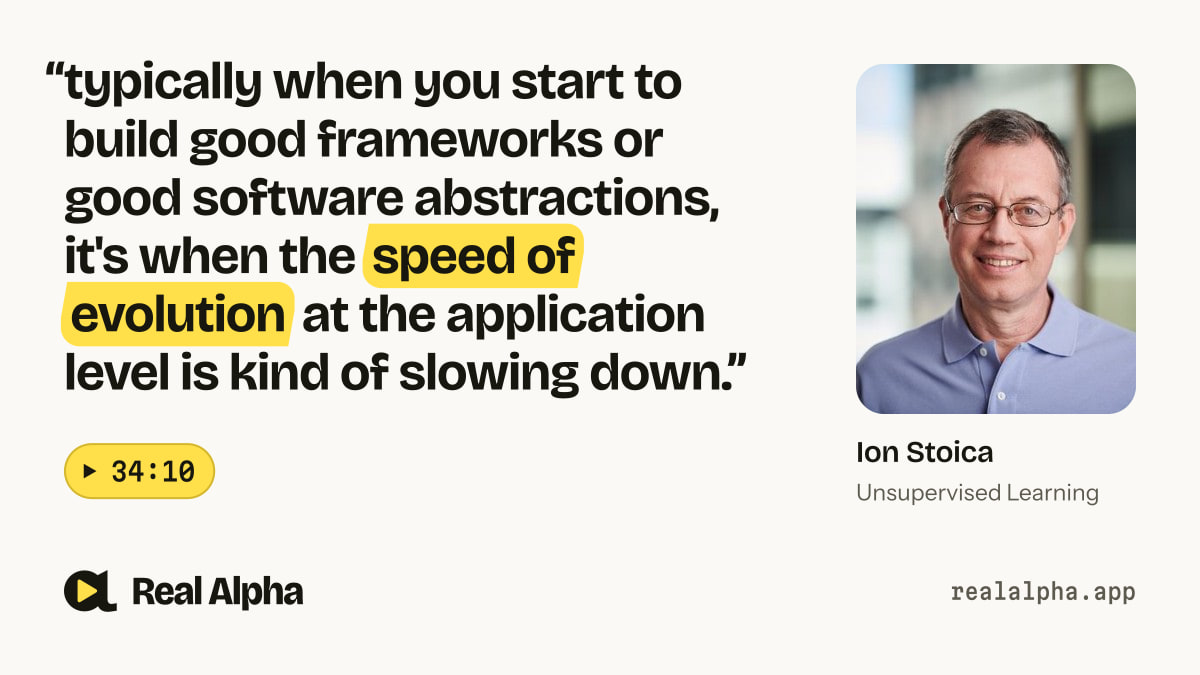
“typically when you start to build good frameworks or good software abstractions, it's when the speed of evolution at the application level is kind of slowing down.”
 Ion Stoicaat 34:10 · Unsupervised Learning
Takeaways Pro pick
- AI infrastructure spans many accelerators and network layers.
- Automated optimization could make diverse hardware easier to use.
- Frameworks stabilize when application-level change slows down.
One of Pro's picks, open to you here. Try Pro free for 7 days
One of Pro's picks. The rest of the summary and the 3 takeaways are in Real Alpha Pro; the video, the quote and the transcript stay free.
Read it with Pro, 7 days freeAbout this segment
Ion Stoica sees opportunity in optimizing across heterogeneous accelerators and networks. He says stable agent frameworks are difficult while application needs keep changing.

Ion Stoica is cofounder of Databricks and Anyscale; LMArena founder and Berkeley professor.
Built Apache Spark and Ray, co-founded Databricks and Anyscale, and helped launch Chatbot Arena for evaluating language models.

Jacob Effron, Host · Managing director, Redpoint Ventures
Growth investor in Abridge, Ramp and Physical Intelligence; ex-Flatiron Health.
From “Databricks Co-Founder: Eval Limitations, Why China is Winning Open Source and Future of AI Infra”, Jun 17, 2025. Watch the full episode
Thanks. We'll look at and fix what's off.
Transcript
Transcribed by machine (Whisper) from the episode’s audio, so a word may be off here and there.
- 30:05
And aside from the evaluations topic, which obviously you guys are focusing on with the new company, what do you think the biggest opportunities and the most important unsolved issues are at the infrastructure layer for AI right now? Again, you look at the trends and clearly right now what we see and every lab is doing, we are seeing a lot of the infrastructure evolving towards being very, you know, vertical integrated, you know, co-design across all the layers, all the way from the application to the hardware.
- 30:45
And I think that you are going to see more and more on that. That's one. I'm going to say, again, based on the trends, I think there are some opportunities. Clearly, what we are seeing here, right, it's like one thing it's about, you have this kind of distributed heterogeneous infrastructures, right? And if anything, you know, you have at the accelerator level, you have GPUs, NVIDIA and AMD, and you have many other accelerators like TPU, Trainium, and others.
- 31:18
Then you have the networking, right? You have Ethernet, you have InfiniBand, and then a little bit higher level RDMA. So you have a lot of this. And then collective communication like nickel, recall, and so forth. So huge heterogeneity. So you need to master that. and the one thing I would say that and there is quite a bit of work I'm hopeful it's about automatically optimizing and generating optimized all-level code kernels for these accelerators I think that's hopefully it will happen so that will help us support much easier news and optimize for a large variety of hardware and networking.
- 32:09
I think that it's going to see a lot of more optimization at the intersection between networking and compute, fine-grained, overlapping the communication with computation and so forth. Obviously load balancing is going to be very important. So that's one, and when you look about, in order to optimize this kind of models and workloads, it's so complicated, right, it's like if you have, if you look at this kind of parallelism, like for model, model serving and training, you have, the last time I was looking at us like seven, you know, model data parallelism, model parallelism, or tensor parallelism, pipeline parallelism, context parallelism, and the token parallelism, and expert parallelism, sequence parallelism, I forgot, so I think these are seven. So it's like you need to do this in an automated way, right? Because there are too many, and then
- 33:18
is a very fine grain, again, between communication and computation because you want to overlap the computation with communication to increase utilization of GPUs. Obviously, we'll see what happens at the agentic level. What do you think the infrastructure needs will end up being for agents? I feel like there's been some early attempts at broad frameworks, at other sorts of areas. It feels like the model companies themselves are building lots of things.
- 33:46
It's hard because when you have a field which moves so fast, it's very hard to come with good frameworks which are going to be stable over time, right? Because it's just, the needs change every month, every week, every day, right? So that kind of makes it difficult. So I think this will be, typically when you start to build good frameworks or good software abstractions, it's when the speed of evolution at the application level is kind of slowing down.
- 34:30
Is that ever going to happen, given model progress? Well, you know, it's like, look, the different layers, it does happen. I mean, it's like now everyone is using transformers. Everyone is using a kind of PyTorch, right? Almost. There are things like we are using right now, you know, when you talk about inference, we are using OpenAI API, more or less. So, yeah, I think you are seeing that. You're kind of the standardization at the low level.
- 35:04
If you look about, for instance, There's a lot of new post-training frameworks. Every day you get another one, but most of them are built on Ray, VLLM, and maybe HGLang also. Yeah, so I think you see at different points some kind of standardization, but still, it's pretty disperse.