The alpha, twice a week
That was 5 min.
Get the best new moments in your inbox every Wednesday and Saturday. It's free.
Check your inbox
We sent a link to your address. Click it to finish signing up. Not there in a minute? Look in spam.
or
Unsupervised Learning · 5 min · Jun 17, 2025
China's open-source advantage comes from collaboration
 Ion Stoica
 argues that China has more open collaboration between academia and industry, while U.S. research is siloed.
The episode’s best minutes
Full analysis- 13:43LLM judges have biases that need to be measured4 min
- 18:52China's open-source advantage comes from collaboration5 min
- 30:00AI infrastructure must handle hardware diversity and rapid changePro pick 6 min
- 4 more moments in the full episode
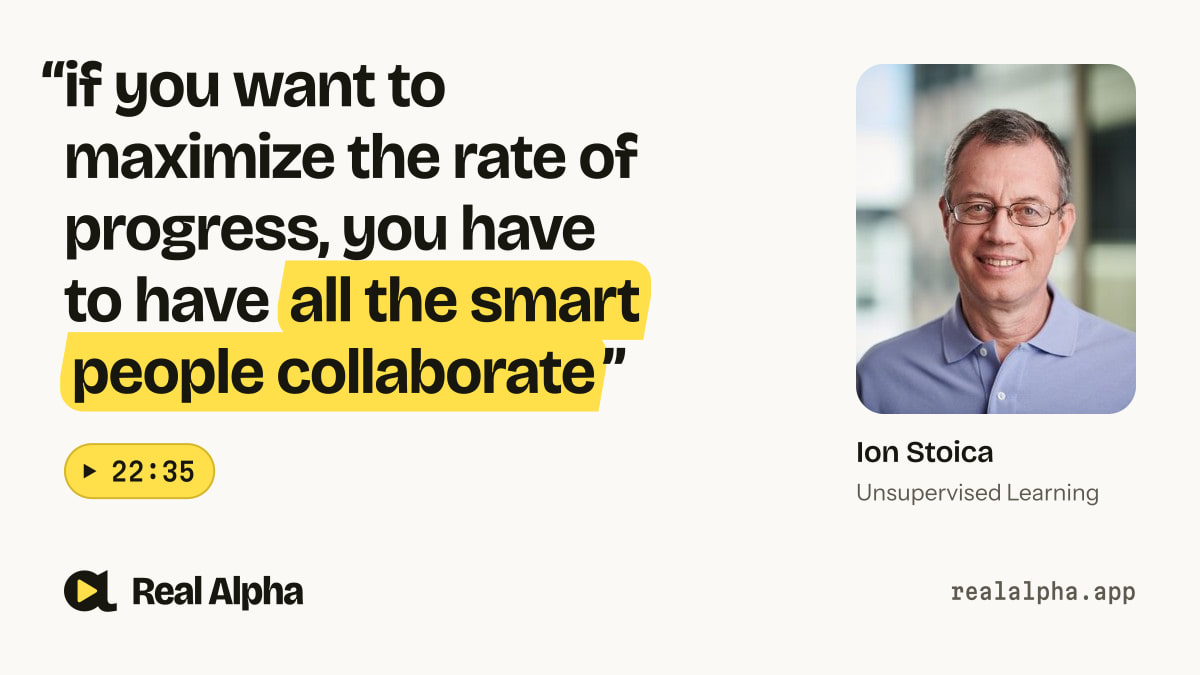
“if you want to maximize the rate of progress, you have to have all the smart people collaborate”
 Ion Stoicaat 22:35 · Unsupervised Learning
Takeaways
- Model development needs experts, data and infrastructure.
- U.S. frontier labs often work in silos.
- Shared artifacts and infrastructure help research diffuse.
About this segment
Ion Stoica argues that China has more open collaboration between academia and industry, while U.S. research is siloed. Shared models and infrastructure help researchers build on one another's work.

Ion Stoica is cofounder of Databricks and Anyscale; LMArena founder and Berkeley professor.
Built Apache Spark and Ray, co-founded Databricks and Anyscale, and helped launch Chatbot Arena for evaluating language models.

Jacob Effron, Host · Managing director, Redpoint Ventures
Growth investor in Abridge, Ramp and Physical Intelligence; ex-Flatiron Health.
From “Databricks Co-Founder: Eval Limitations, Why China is Winning Open Source and Future of AI Infra”, Jun 17, 2025. Watch the full episode
Thanks. We'll look at and fix what's off.
Transcript
Transcribed by machine (Whisper) from the episode’s audio, so a word may be off here and there.
- 18:57
most state-of-the-art closed-source models. Yeah. I think, really, if you think about But right now, the trend, obviously, and that was the open source model caught up the progress of quite impressive over the past year. Of course, it was not of course, but maybe surprising and also a surprising thing is that these models are not necessarily from U.S. or from China. but definitely at this point if you're talking about the open source models, the best car coming from China and if you look at the trends, you know the open source should be able to catch up with proprietary models within one year or so and now the question where these open source models are going to come from and what I can say is that But – In China, it's a lot of, right now, a lot of momentum, and for, I think, for structural reasons, and, you know, how the ecosystem is, right now, grew in China versus U.S.
- 20:19
So, I think that we in U.S. are a little bit of a disadvantage, you know. Say more about that? Why is that? It's structural. So first, if you think about what do you need to develop these models, right? You need three things. You need experts. You need data. You need infrastructure, right? And I think that if you look at China, they have a lot of experts. Probably in sheer number, they have more than U.S.
- 20:45
Data. They have data. They don't have as much infrastructure, but they are making progress, right? And if you look at the latest announcement from Huawei and so forth and, you know, export controls, you know, everyone guess about how effective they are going to be or they are. That's, you know, that's to debate. But the one thing there is that the open source, it's much more prevalent. Right, it's almost by default.
- 21:22
Now, if you go to the U.S., is that you have huge resources, and so forth, and you have lots of smart people. The problem is that the development, how it happens in the U.S., is siloed, right? It's, you know, this frontier lab, right? Everyone is doing the same thing, basically. That's number one. The number two is that academia, when you talk about pre-training and building the models, doesn't play a major role because lack of resources.
- 22:09
You know, there are companies like Ai2. There is a group from Stanford, Percy, Liang, trying to develop, and we at Berkeley try to develop this, you know, pre-training, post-training, full open source pipelines and so forth. But it's a challenge. And unless that changes, we are going to be a structural disadvantage because the diffusion of innovation is very limited, right? It's like you have people, so the way you can, if you want to maximize the rate of progress, you have to have all the smart people collaborate, right?
- 22:49
But if you have kind of these silos, and a big part of the research, I'm talking about academia, not being able to contribute in a meaningful way to developing these models, then it's a significant disadvantage. The main division of innovation here in the US is that through people who leave one company and go to another or start new companies. But if you look, for instance, in China, there is a much stronger collaboration between academia and industry, you know, like Bydance or Alibaba and obviously Leipzig.
- 23:34
And that really helps them. What is the reason academia is so much more effectively involved in China? How does that come about? Because it's much closer collaboration to the industry. Here it's very hard to collaborate with the Frontier Lab because everything is secret. If you really want to maximize the rate of progress, again, you have to have all your researchers or your experts collaborating.
- 23:56
The only way they can collaborate is by share artifacts. Which means, as a software side, open source models, and they need also to have a shared infrastructure. Yeah. Right?