The alpha, twice a week
That was 5 min.
Get the best new moments in your inbox every Wednesday and Saturday. It's free.
Check your inbox
We sent a link to your address. Click it to finish signing up. Not there in a minute? Look in spam.
or
TBPN · 5 min · Oct 21, 2026
AI is making complex legal work accessible to smaller firms
 Max Junestrand
 explains why legal AI adoption is more cautious than coding: errors are harder to verify.
The episode’s best minutes
Full analysis- 35:53AI is compressing the window to patch major vulnerabilitiesPro pick 5 min
- 23:14Compute scarcity could keep raising the value of each wattPro pick 6 min
- 1:16:58AI is making complex legal work accessible to smaller firms5 min
- 4 more moments in the full episode
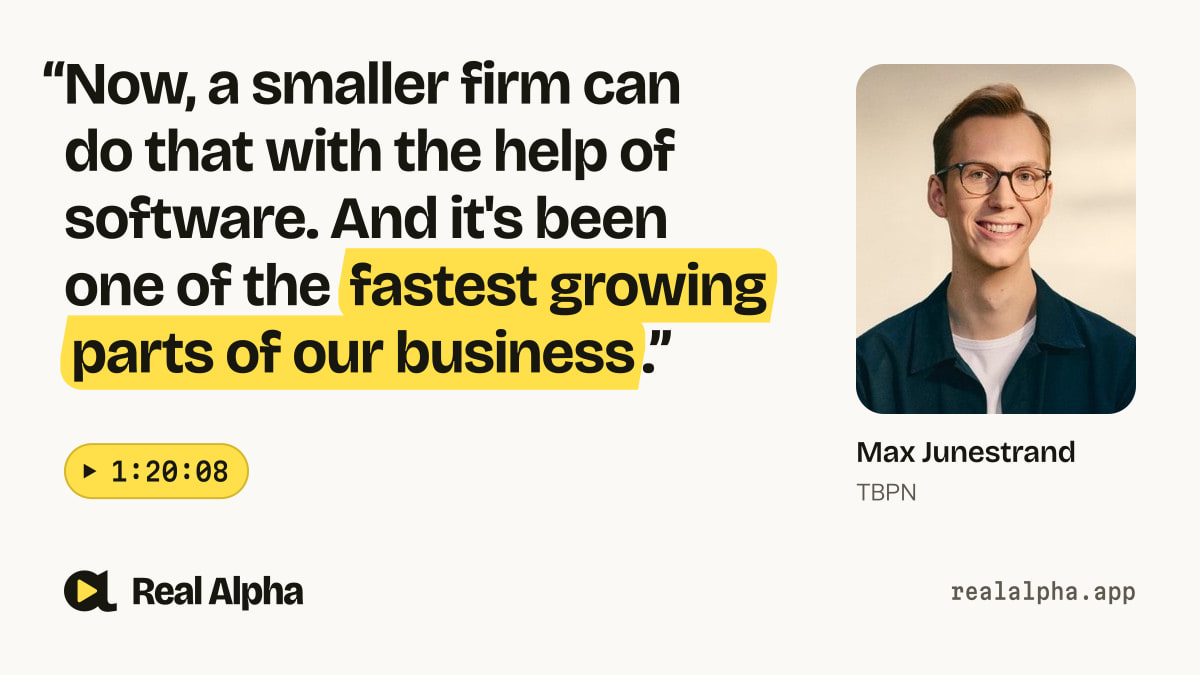
“Now, a smaller firm can do that with the help of software. And it's been one of the fastest growing parts of our business.”
 Max Junestrandat 1:20:08 · TBPN
Takeaways
- Legal work needs stronger verification than many coding tasks.
- Smaller firms can use software to take on major litigation.
- AI gives smaller practitioners access to tools once behind paywalls.
About this segment
Max Junestrand explains why legal AI adoption is more cautious than coding: errors are harder to verify. He says the tools are helping smaller firms handle complex work once reserved for large teams.

Co-founder & CEO, Legora
Co-founded and leads Legora, an AI workspace for lawyers, after stints at McKinsey and Ericsson.

John Coogan, Host · Co-host, TBPN
Co-founded Soylent and Lucy; OpenAI bought his show TBPN in April 2026.

Jordi Hays, Host · Co-host, TBPN
Founded Branded Native; co-founded fintech Capital, which Rho bought.
From “The Internet Is Finished, Nobody Expects The Number 4, Early iPhone Duo Reviews, SpaceXSITesla”, Oct 21, 2026. Watch the full episode
Thanks. We'll look at and fix what's off.
Transcript
From the transcript TBPN publishes with the episode.
- 1:17:10
How is how is the legal AI market different than the coding market? Because I think everyone watching Yeah. And everyone in tech is well aware of like how companies adopt these tools, how they, you know, how they deploy them across organizations, to use a I bunch of different
- 1:17:30
was an engineer. I like to say... I think I was the worst engineer, that's why they made me CEO out of our founding trio. But but but we look to software engineering a lot for for our inspiration. Right? And I think the main difference is that in engineering, the the individual practitioner is like just always trying new things. And and and and they're sort of like leaned in to an extent where it doesn't matter if it's wrong. You can vibe code it. And, you know, the the the products get better over time and that's okay. In law, you're not allowed to vibe draft.
- 1:18:06
You can't vibe research. It has to be correct. And the verifiability of the product is very different. You can compile the software code. You can write the tests. And if it passes all the tests, we're good. In law, it doesn't really work that way because you don't know that you're wrong until you're very wrong or unless a senior person in the organization can take a view on that work. And so the degree of adoption is accelerating exponentially, but it's doing so at a more, you know, careful rate and and and and sort of the the degree of let's totally lead this out to an agent is moving slower in legal than it's moving software. I think that's for a good reason. It it it sort of hurts us when, you know, some uncareful lawyer uses chat GBT and it hallucinates a case and it makes it into the Financial Times.
- 1:19:05
Like, that's that's not good for what we are doing either. And so I do think that the the change management is just larger in in this practice than it's been with software engineers.
- 1:19:15
How are small law firms or or single person operations adapting AI differently than than some of the bigger firms? Because it feels like the big firms are like, alright, we have these amazing businesses, we have tons of associates, we maybe have, you know, it's constantly trying to find that balance between having enough people, but not having too many. Yep. But but generally, like, have outpaced inflation and it's been a great time to be a lawyer. Whereas...
- 1:19:44
And and so when they adopt AI, they're like, well, we need to show that we're forward thinking and that we really care about innovation and all these things. But that's quite a bit different than like an independent lawyer who's just like
- 1:19:58
Well, it's helping it's helping the small firms and small in house teams take on substantially more work and and and and do substantially more complex work than they were able to before. Take a big litigation as an example. If you have a big litigation matter, typically you would need an army of associates to help you come through all of that documentation and actually take on that case. Now, a smaller firm can do that with the help of software. And it's been one of the fastest growing parts of our business.
- 1:20:28
In this next quarter, more than half of our incoming business is also from enterprise. So from legal departments like Salesforce and BMW. And what's exciting about that is those internal legal teams wanna do more. And they're seeing more claims, they're seeing more litigation, they're seeing more m and a activity, and now there's an opportunity to review every type of contract. And so what's been fun for me is it's like everybody gets to come in on the fun.
- 1:20:57
Like like the Lugora party tent is very large, and we can fit everybody under it. And those maybe smaller practitioners now have access to the same tools that the bigger guys do. And so it's really a a battle of your intellect and of your experience and your expertise and all the other trades that make up a great practitioner rather than do you have access to an, you know, an army or or, you know, tools that are otherwise locked behind very large paywalls.