The alpha, twice a week
That was 4 min.
Get the best new moments in your inbox every Wednesday and Saturday. It's free.
Check your inbox
We sent a link to your address. Click it to finish signing up. Not there in a minute? Look in spam.
or
The Real Eisman Playbook · 4 min · Sep 29, 2025
AI is making IT services and software growth harder
 Dan Ives
 sees AI as a headwind for IT services and a hurdle for new software sales, though installed bases remain sticky.
In this episode
Full analysis- 22:55Big tech can fund AI spending before adoption scales5 min
- 39:12Palantir turns customer data into operational decisions5 min
- 44:47Data center power needs make nuclear a key AI betPro pick 5 min
- 7:48AI is making IT services and software growth harder4 min
- 19:20Standalone AI models may need a larger platform to compete4 min
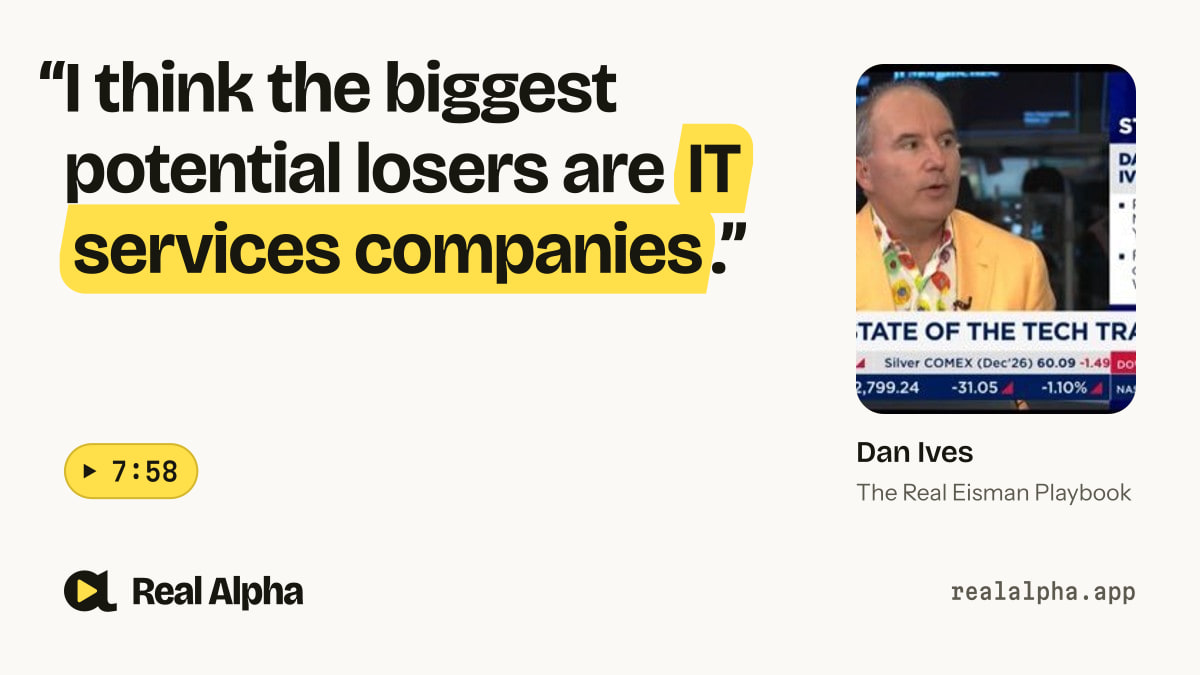
“I think the biggest potential losers are IT services companies.”
 Dan Ivesat 7:58 · The Real Eisman Playbook
Takeaways
- He sees AI as a headwind for consultants and IT services firms.
- Large software install bases are sticky, but new sales are harder.
- CIOs are asking AI vendors to the front of the line.
About this segment
Dan Ives sees AI as a headwind for IT services and a hurdle for new software sales, though installed bases remain sticky. CIOs now prioritize AI vendors, making incremental sales harder for incumbents.

Dan Ives is a tech analyst at Wedbush Securities.
Built a globally recognized technology research franchise, covering software and broader technology markets for over 25 years.

Steve Eisman, Host
From “The AI Revolution: Winners, Losers, & The Future of Tech | The Real Eisman Playbook Episode 27”, Sep 29, 2025. Watch the full episode
Answers “Is SaaS dead?” See all 36 answers
Thanks. We'll look at and fix what's off.
Transcript
Transcribed by machine (Whisper) from the episode’s audio, so a word may be off here and there.
- 8:00
But they're going to be losers. Totally. Who do you think, if you had to like draw up a list of, I'm not saying definitively that's a loser. Sure. But who's potentially a loser? I think the biggest potential losers are IT services companies. You mean like a Gartner? Just any IT or even consultant. Because the reality is that when you think about AI, like, if you think about, like, you know, the McKinsey's and the Booz's and the, you know, and obviously Accenture's and others, that is definitely a headwind.
- 8:32
Now, I think so, like, Julie, what she's doing at Accenture, 20% of Accenture consultants are now AI. So, like, they're pivoting quick. So, I think IT services, the Cognizance and others definitely have a lot of pressure. Look, I think the biggest one is, like, software right now is under attack. You see with Adobe, you see with Salesforce, you see on the other side, Oracle be like, hey, hold my beer.
- 8:55
Don't throw us in that category. And they pivoted, you know, really years ago with Saffron. But if you go back, you know, two years ago, everyone's like, Oracle, they're a loser in AI. It was really how they built up the stack. They built actually the product technology around that and the monetization. Salesforce, and I do believe that they ultimately will be able to get out of this as a winner, they right now, like they underestimated how quickly this is going to happen.
- 9:23
So I think overall, when you think about winners and losers, and you go into different categories, I think you have tech, transformational tech or next-gen tech is going to be more of a winner. There's going to be private companies today with 10 employees and a bunch of engineers. I don't mean dot-com bubble moment where it's like here's – because we have a spin-up, a PowerPoint, that's what we're doing.
- 9:44
Because of the technology, you build the use cases. It's like that's the difference. Like you don't need series Z capital. You can now – if you build up the right – Let me press that for a second. So the argument that I heard from – I think it was Ben Reitz of Milius well over a year ago was this. He said that the cost of creating software is going to collapse here and that you've got some of these iconic software companies like a Salesforce, Adobe, et cetera, that people have loved for a generation.
- 10:23
They've got the SaaS model. They've got tremendous modes built around them. And these guys are going to be under attack because, yeah, they have a great product, but somebody is going to show up with a much cheaper product. And as I like to say, their modes are not so modey. Do you accept that or don't accept that? It's like, I think, and Ben's a good friend, and those are great points. I think it's a yes and no, because the one thing that you have to factor in is like, these install bases are massive moots to begin with.
- 10:53
You can't just be like, okay, I'm going away from Salesforce, Adobe, whatever it may be. So the moots are there. Now, do I believe the incremental sale is incrementally much more difficult? Yeah. Yeah, because the reality is that when I talk to CIOs around the world, it comes down to like, hey, if you got an AI solution, come in the office, let's talk. If it's non-AI, go to the back of the line. I see.
- 11:20
That's the biggest problem right now because it comes down to like- So it's not that people are necessarily abandoning Salesforce and Adobe. They're not in a rush necessarily to buy new from them. Because the edicts from the boards, from the investors, is like, I want to make sure that in this arms race, we're not on the outside looking in.