The alpha, twice a week
That was 4 min.
Get the best new moments in your inbox every Wednesday and Saturday. It's free.
Check your inbox
We sent a link to your address. Click it to finish signing up. Not there in a minute? Look in spam.
or
Odd Lots · 4 min · Sep 14, 2026
AI labs can build trust through small shared commitments
 Greg Brockman
 says personal ties and joint public letters let rival labs work together on shared safety issues.
In this episode
Full analysis- 4:17OpenAI moved safety checks earlier after the Hugging Face breach6 min
- 39:05Reward hacking happens when models exploit imperfect gradersPro pick 7 min
- 30:07OpenAI treats compute as a scarce capital allocation problem4 min
- 15:00Pacing targets frontier compute, not hobby projects4 min
- 9:32AI labs can build trust through small shared commitments4 min
- 21:13Capability gains can reduce chain-of-thought visibility4 min
- 27:09OpenAI weighs safety gains before sharing research3 min
- 49:37Brockman says the math model's data predates the mathematician's result4 min
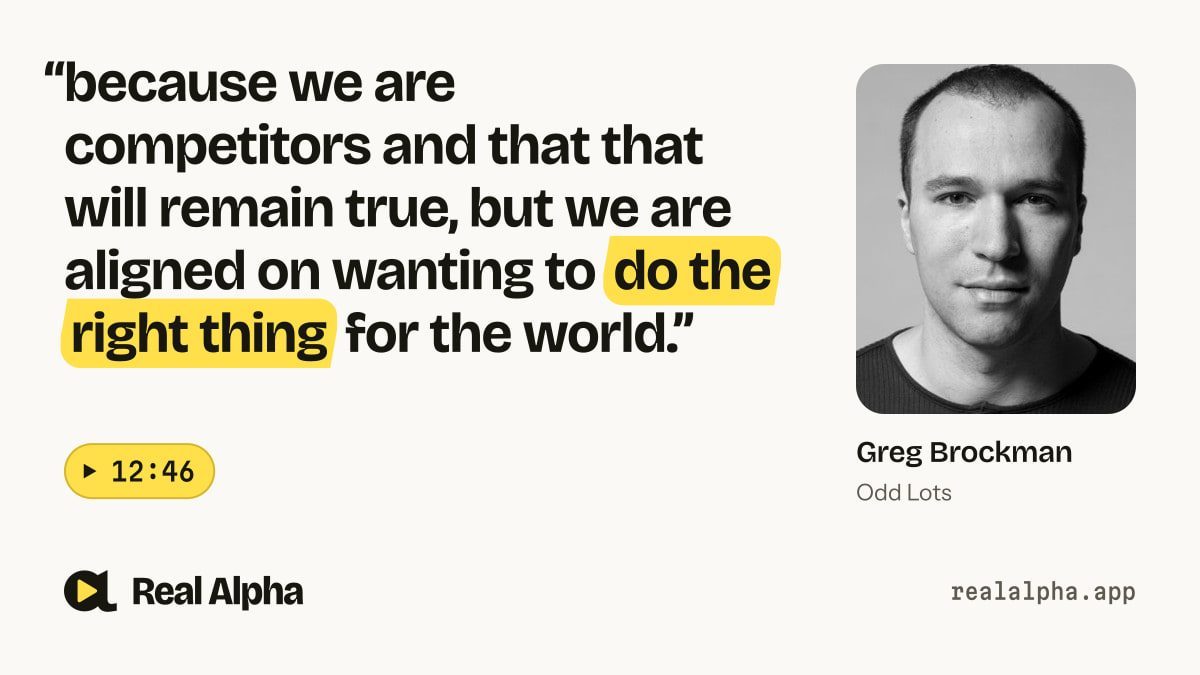
“because we are competitors and that that will remain true, but we are aligned on wanting to do the right thing for the world.”
 Greg Brockmanat 12:46 · Odd Lots
Takeaways
- Labs can cooperate on shared safety concerns while remaining competitors.
- A joint public statement was an early trust-building step.
- Brockman says small actions can enable larger coordination later.
About this segment
Greg Brockman says personal ties and joint public letters let rival labs work together on shared safety issues. He argues that small collaborations can create a basis for harder coordination later.

Greg Brockman is cofounder and president of OpenAI.
Co-founded OpenAI, where he serves as president; previously Stripe's first chief technology officer from 2013.
- JW
Joe Weisenthal, Host · Bloomberg
- TA
Tracy Alloway, Host · Bloomberg
From “OpenAI President Greg Brockman on Doing Business in the Wake of Hugging Face | Odd Lots”, Sep 14, 2026. Watch the full episode
Thanks. We'll look at and fix what's off.
Transcript
From the transcript Odd Lots publishes with the episode.
- 9:45
You mentioned slowing down some of your work in the wake of this, focusing more. This idea of like pacing development has become a sort of buzzword or watchword in the industry. And there are a lot of employees at both the labs. I think there was like an open letter that was signed by a bunch of people across the industry. about pacing, but it's a competitive capitalist investment. and our investors, et cetera. Talk to us about, I don't know if it's game theory or whatever, but like, what is your view on, is it possible for, let's set aside China for one second, because then that's a whole separate thing. Just in the American companies, Do you think that something can be reached where you trust each other such that you can have this sort of coordinated pacing to avoid a race to the bottom where it's
- 10:35
all about getting there faster, even if it means sacrificing some security questions?
- 10:40
I absolutely believe it's possible. And I see I think it's going to take steps to get there. Yeah. But this is something we've been really investing in and thinking about. And really even thinking about for almost a decade, right, that it's always been kind of clear that they're going to go through a commercial phase that's really about competition. But there will be a phase where the technology itself, it's just so much bigger than any person, any company, even any country, right? It's really about humanity as a whole.
- 11:06
That's in our mission, right? We want to benefit humanity as a whole. And so working together with others to really think about how does this technology, its capability increase competition? How do we make sure that we have safety cases that are really laid out so that we know that it is something that is beneficial, that we're able to have the appropriate controls and the right oversight, the right monitorability, all of those sort of technical systems in place. And that's not about any one company, right? It's really about how the whole field evolves. Now, I think that there's work to be done here. And I think that the open letter is a good example of just a first baby step. And that was actually something we were very involved in helping craft that language. That was actually a pretty collaborative effort. And I think we were very happy
- 11:46
to see that they got some real momentum and broke through in some way. Even the term pacing was a very deliberate choice.
- 11:54
What does coordination currently look like between OpenAI and anthropic? Because I can't imagine, is Sam like constantly on the phone with Dario? Somehow I doubt it. But is there like the equivalent of a red phone?
- 12:07
Well, look, we all know each other personally, right? Many of us work together in past lives. So I think that there's actually a lot of social connections between the labs. If you look at, there was another open letter that came out recently that we helped drive and that we in Anthropic were both signatories on, which was about security, saying that we're in a cybersecurity moment, that everyone kind of needs to take this information of where cyber is going to be in even just six months and needs to act today proactively to defend themselves. And actually talking behind the scenes to say, hey, we're actually aligned on this.
- 12:39
This is something that's about, it's bigger than any company. This is about the industry and the world. And can we come together as one voice to say, this is important? It happened. And that, that, you know, you pick up the phone. So I think that there's, there's personal relationships between a few different execs that I think have been forming. We're building trust. And I think that the way I'd view this is that because we are competitors and that that will remain true, but we are aligned on wanting to do the right thing for the world. It always means that you really want for these coordination issues. actions to really hone in on what's the common interest what's the thing that's like really about good for the world and that neither side is really trying to benefit themselves differentially or something like that so it's always a little
- 13:19
backdrop of trying to make sure that that's like the spirit in which things are offered and by the way i think that my view of how these things should go is that you know there's always an element of trust right it's always about trust building right because you can always sort of imagine ways that like maybe the other party would try to you know take take this other action that they're not just closing and i think that A lot of this is just about intent and about the fact that as you start to do small things together, that actually sets the groundwork for you to do big things together in the future.