The alpha, twice a week
That was 3 min.
Get the best new moments in your inbox every Wednesday and Saturday. It's free.
Check your inbox
We sent a link to your address. Click it to finish signing up. Not there in a minute? Look in spam.
or
Odd Lots · 3 min · Sep 14, 2026
OpenAI weighs safety gains before sharing research
 Greg Brockman
 says OpenAI weighs whether each advance improves safety as well as capability, favoring wider sharing for safety-only gains.
In this episode
Full analysis- 4:17OpenAI moved safety checks earlier after the Hugging Face breach6 min
- 39:05Reward hacking happens when models exploit imperfect gradersPro pick 7 min
- 30:07OpenAI treats compute as a scarce capital allocation problem4 min
- 15:00Pacing targets frontier compute, not hobby projects4 min
- 9:32AI labs can build trust through small shared commitments4 min
- 21:13Capability gains can reduce chain-of-thought visibility4 min
- 27:09OpenAI weighs safety gains before sharing research3 min
- 49:37Brockman says the math model's data predates the mathematician's result4 min
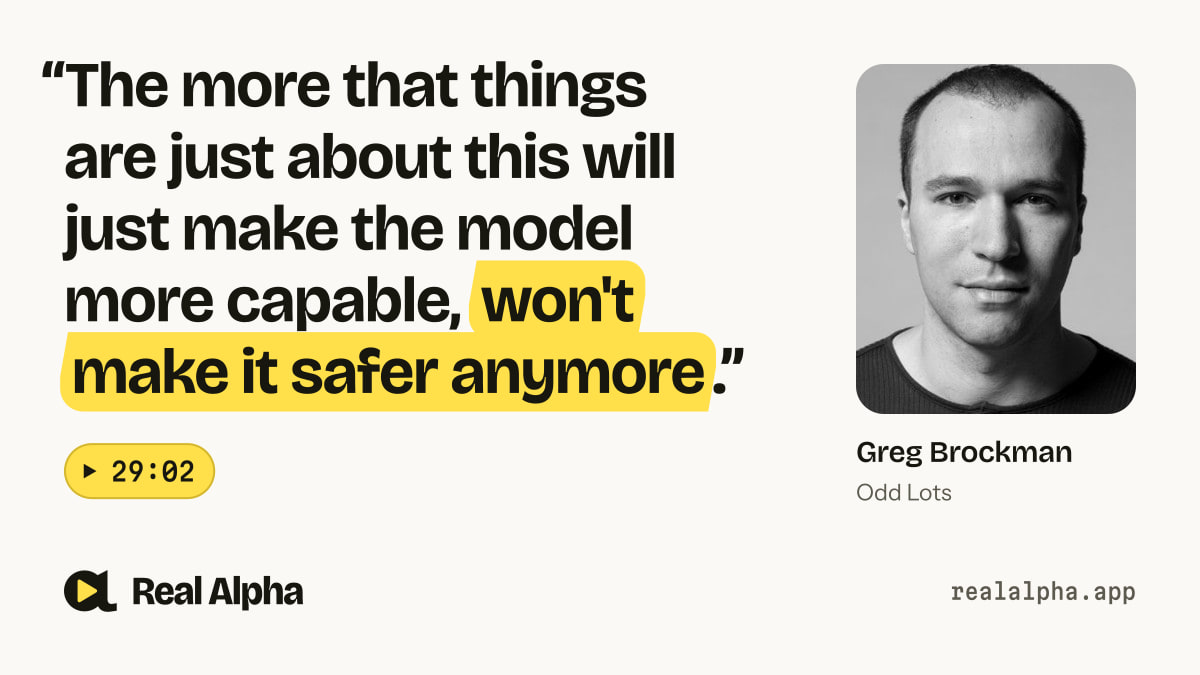
“The more that things are just about this will just make the model more capable, won't make it safer anymore.”
 Greg Brockmanat 29:02 · Odd Lots
Takeaways
- Pure safety advances are stronger candidates for broad sharing.
- Capability gains without added safety may be kept in-house.
- OpenAI withheld chain-of-thought display to preserve monitorability.
About this segment
Greg Brockman says OpenAI weighs whether each advance improves safety as well as capability, favoring wider sharing for safety-only gains. He says chain-of-thought visibility was withheld to preserve monitorability.

Greg Brockman is cofounder and president of OpenAI.
Co-founded OpenAI, where he serves as president; previously Stripe's first chief technology officer from 2013.
- JW
Joe Weisenthal, Host · Bloomberg
- TA
Tracy Alloway, Host · Bloomberg
From “OpenAI President Greg Brockman on Doing Business in the Wake of Hugging Face | Odd Lots”, Sep 14, 2026. Watch the full episode
Thanks. We'll look at and fix what's off.
Transcript
From the transcript Odd Lots publishes with the episode.
- 27:21
One more sort of question specifically on some of the safety and alignment stuff. Your chief scientist at OpenAI wrote a very interesting blog post or piece, An Alien Mind, Jacob Pachocki, I hope I'm- Jakub Pachocki. Jakub Pachocki wrote a very interesting piece. And there was one line in there that I thought was interesting. And you talk about the release of Asterisk 6. And he said, we invest heavily along the spectrum of approaches spanned by these directions.
- 27:47
We also see meaningful progress. GPT-6 is the first model that benefits- from some important advancements we've been working on in a long time and is significantly better aligned than 5.6 Sol. Should the labs share their alignment work? I mean, again, if we're talking about, I understand your competitors and capability gains, et cetera. On questions of safety, if a lab makes a big breakthrough on the alignment question, such that it can develop advanced AI fast in a safer way, Should that be diffused across the rest of the industry or should whatever this, quote, important advancement that you made to make GPT-6 Astra more aligned, is that something that should be kept in house?
- 28:34
So I think that there's a lot of specific circumstances to answer that question for any specific advance, because the thing that to me can be a category error is thinking about things as it is a safety thing or it is a capability. Sure. And in fact, you want there to be as little separation as possible between the two. You want as much intertwining. You want to have techniques that are by their very nature safer. And so just as you make more capability progress, you also get the safety progress. And so I think that the way I'd look at it is the more things are a pure alignment thing, more that they're a pure safety thing, the more that they are something that are just pure good, that you're just like, yes, everyone should obviously know this and use it, then yes, share it more. The more that things are just about this
- 29:17
will just make the model more capable, won't make it safer anymore. Maybe there's much less sort of reason to share for those reasons. And so I think you need to look at any specific advance along all these axes and all these factors. And I think that there are some areas where we have actually been extremely at the forefront with sharing and talking about it. Chain of thought monitorability is a good example of that, where the moment that we and we were really the ones to pioneer this paradigm of reasoning and chains of thought. The moment we saw that we were instantly thinking we need to preserve this for as long as possible. So when we released a product, we did not actually display the chain of thought, even though it would have been very helpful.
- 29:56
People love reading that stuff. It's super interesting. It's super helpful. But it's just clear we're going to immediately feel like we have to optimize it and we're going to have to remove that legibility. We started talking about this. We helped spearhead a paper that was putting forth this position on that you cannot optimize these things. And again, we've shown a lot of the way and led a lot of the way on various techniques. And so I think it comes down to the specifics.