The alpha, twice a week
That was 3 min.
Get the best new moments in your inbox every Wednesday and Saturday. It's free.
Check your inbox
We sent a link to your address. Click it to finish signing up. Not there in a minute? Look in spam.
or
How I Invest · 3 min · Nov 6, 2026
AI makes seed-stage investing more attractive than later rounds
 Joseph Coyne
 says AI lets technical founders reach product maturity faster and with less cash.
The episode’s best minutes
Full analysis- 6:26Proprietary enterprise data can create durable AI advantagesPro pick 7 min
- 27:21AI makes seed-stage investing more attractive than later roundsPro pick 3 min
- 34:53Underwrite Anthropic by its market share and future competition4 min
- 4 more moments in the full episode
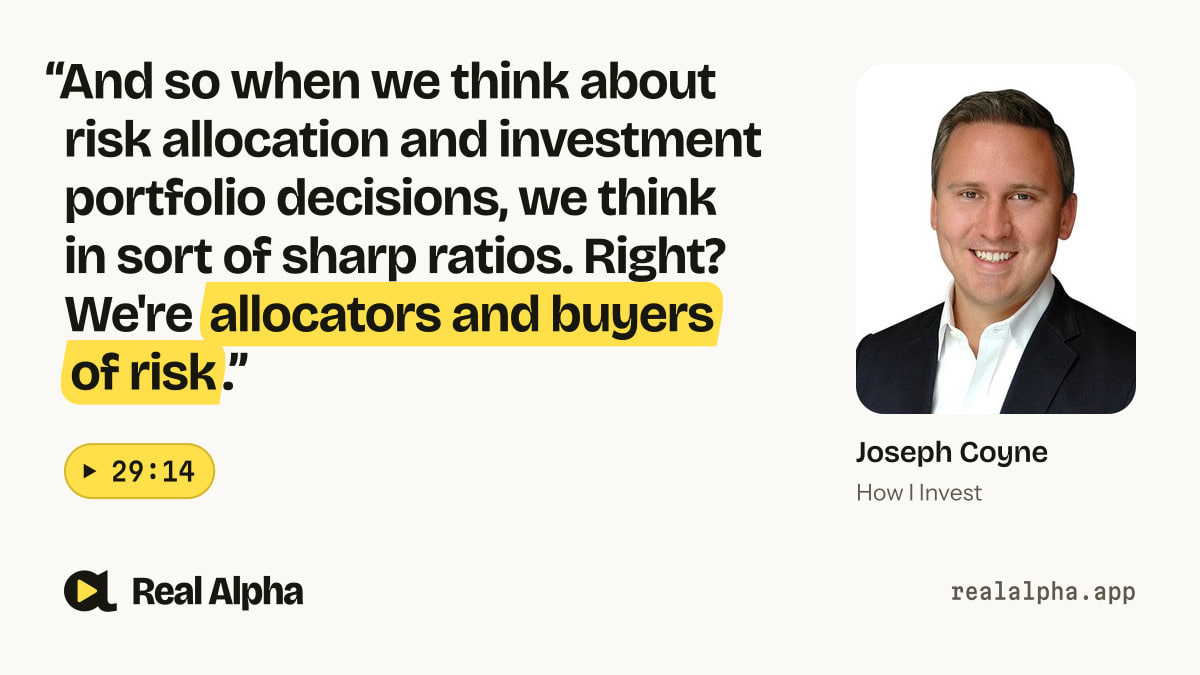
“And so when we think about risk allocation and investment portfolio decisions, we think in sort of sharp ratios. Right? We're allocators and buyers of risk.”
 Joseph Coyneat 29:14 · How I Invest
Takeaways Pro pick
- Agentic coding is driving major efficiency gains for technical founders.
- Faster product progress can shrink the seed-to-Series A timeline.
- Coyne sees more alpha before companies become obvious and highly priced.
One of Pro's picks, open to you here. Try Pro free for 7 days
One of Pro's picks. The rest of the summary and the 3 takeaways are in Real Alpha Pro; the video, the quote and the transcript stay free.
Read it with Pro, 7 days freeAbout this segment
Joseph Coyne says AI lets technical founders reach product maturity faster and with less cash. He prefers seed-stage risk before rapid progress and high valuations make companies more obvious and expensive.

Joseph Coyne is cofounder and managing partner of Studio VC.
Invested in and advised startups at Samsung Next and Bain Capital Ventures before co-founding Studio VC.

David Weisburd, Host
From “Why 95% of AI Projects Fail, Anthropic still at $2T?, and Why AI Is Still in the First Inning”, Nov 6, 2026. Watch the full episode
Thanks. We'll look at and fix what's off.
Transcript
From the transcript How I Invest publishes with the episode.
- 27:34
And and I think, like, when you think about funding startups, you know, we always enter at seed. I think you need to create some realistic benchmarking and understanding that that will happen. And that leads to things like, you know, how much cash flow do you need to achieve a particular thing... A particular outcome. So what does it take to reach a series a, series b? I think on one hand, from a product standpoint, you can reach product maturity faster than ever.
- 28:01
So, like, the dollars that we're putting into companies are being used with an efficiency that has been never seen before. Double click on that. Why why are companies able to scale so much quicker with so much less capital? I mean, I think it starts when you're thinking about product and code. I think agentic coding has been massively impactful, especially to people who know how to wield it. So early stage founders that are technical, that have engineering backgrounds themselves, are the people that we've seen in sort of the data research we've done that are benefiting the most.
- 28:28
The most efficiency right now is being accrued to the engineers. You know, I think next on the list is something like customer service, which is just a great dataset, great use case that you can augment quickly. It's digestible. But when you think about, like, the biggest delta in efficiency, it's at engineering. And so talking to large enterprises, you know, we have a number of advisors, technical advisors on our team that work at places like Meta, Amazon, Oscar Health.
- 28:53
And when we talk to them, we say, what does your job look like now as an engineering or AI manager? And they say, I can accomplish four times as much in half the time. So when we do improvement. Yeah. And so when you when you hear that, you start to think about... And we see this just in practice. Right? It's like the founders that we're backing are being way more cash efficient to get to product maturity in a shorter period of time.
- 29:15
And so that's part of reason why we spend our time at seed. I think the delta, the alpha creation opportunity from seed to a is... That delta is greater than ever right now. And so when we think about risk allocation and investment portfolio decisions, we think in sort of sharp ratios. Right? We're allocators and buyers of risk. And for every unit of risk, we need to pay the appropriate price. As things go from non obvious, pre product, to post product and obvious, meaning some product market fit, customer references, revenue, during that curve, that curve is happening shorter and faster than it's ever happened.
- 29:53
And as a result, you see series a's and series b's being priced where series d's and e's were prior. And so I wouldn't like to play that game as much as I'd like to capture the alpha going from non obvious seed to relatively mature product in a matter of year, short short number of years. I don't think I've heard a single intelligent investor take the counter on AI.