The alpha, twice a week
That was 4 min.
Get the best new moments in your inbox every Wednesday and Saturday. It's free.
Check your inbox
We sent a link to your address. Click it to finish signing up. Not there in a minute? Look in spam.
or
How I Invest · 4 min · Nov 6, 2026
Underwrite Anthropic by its market share and future competition
 Joseph Coyne
 frames Anthropic's valuation around its share of a growing market, while weighing new entrants, switching costs and pricing pressure.
The episode’s best minutes
Full analysis- 6:26Proprietary enterprise data can create durable AI advantagesPro pick 7 min
- 27:21AI makes seed-stage investing more attractive than later roundsPro pick 3 min
- 34:53Underwrite Anthropic by its market share and future competition4 min
- 4 more moments in the full episode
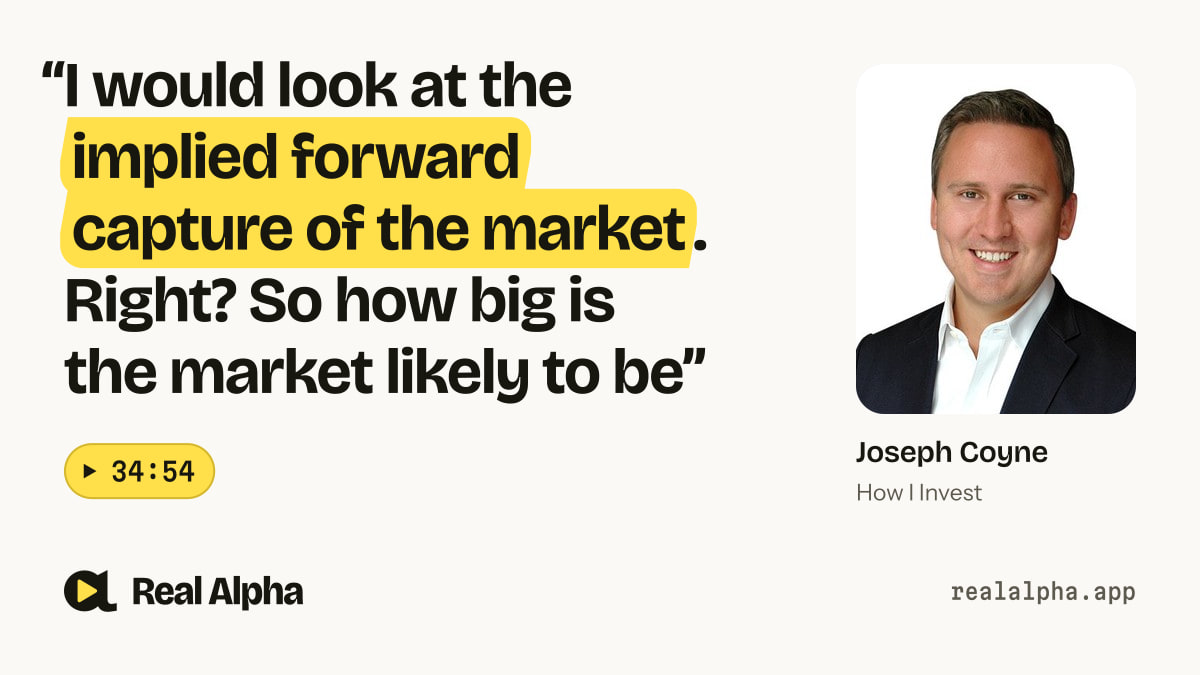
“I would look at the implied forward capture of the market. Right? So how big is the market likely to be”
 Joseph Coyneat 34:54 · How I Invest
Takeaways
- Estimate the market size and Anthropic's likely share of it.
- More competitors and cheaper models could pressure pricing.
- Enterprise revenue may be more valuable than consumer revenue.
About this segment
Joseph Coyne frames Anthropic's valuation around its share of a growing market, while weighing new entrants, switching costs and pricing pressure. Enterprise exposure may make its revenue more valuable than consumer revenue.

Joseph Coyne is cofounder and managing partner of Studio VC.
Invested in and advised startups at Samsung Next and Bain Capital Ventures before co-founding Studio VC.

David Weisburd, Host
From “Why 95% of AI Projects Fail, Anthropic still at $2T?, and Why AI Is Still in the First Inning”, Nov 6, 2026. Watch the full episode
Thanks. We'll look at and fix what's off.
Transcript
From the transcript How I Invest publishes with the episode.
- 35:06
Well, I think I would look at the implied forward capture of the market. Right? So how big is the market likely to be, then what percentage are you expecting to capture as anthropic vis a vis or relative to OpenAI and some unknown entrant or entrants? So I think that's hard to handicap on the who's coming next, right, conversation. But It's unknown unknown. Who's gonna have the idea or the resources?
- 35:29
The unknown unknown. But you have other folks that are devoting a lot of resources to the space that have billions of dollars and reasons to be highly defensive. The Googles, the Metas, the Amazons, etcetera. Right? And they they may take a different approach or a similar approach to building very very robust models, but that will only up the ante in terms of competitiveness over time. And then if you look at or make an assumption around whether they'll just be two players in the future, I think it's very unlikely that there'll be two dominant players in the LLM world.
- 36:01
So if you start to model, and you can sort of stress test this, right, a few more entrants, and then you look at the market size, of course, it's gonna continue continue to grow. What do you... What's the implied capture rate of that future revenue in three, five years that Anthropic would have to have to justify their current valuation? I think right now, it is converging to a rational sort of pre IPO price, so you're probably in a in a good spot, but that's absent my assumption around increased competition and lower cost players.
- 36:29
Now I think the other angle or lens is what is their... Who are the customers of all these LLMs? OpenAI tends to be slightly more consumer. Anthropic tends, especially with Cloud Code, tends to be slightly more enterprise. So for that reason, I would value every dollar revenue differently across those two. And so I give a little boost to Anthropic in that regard, and you can see that's probably why they've eclipsed OpenAI in terms of their growth rate.
- 36:49
I'll tell you the bold case. Virtue of Lucas Swisher, he runs growth for Co two, previous podcast guest, and he talked about the three s curves of adoption. So the first s curve, the early adopters in terms of LMs from a revenue standpoint have been developers. What's crazy about that is that there's only only 50,000,000 developers in the world out of 8,000,000,000 people. And on top of that, only a small percentage of developers have actually implemented, if you look at worldwide kind of engineers.
- 37:20
So we're still at really the small end of a small market. Now, sure, enterprises have adopted it, but to your point, 95% of them have failed. There's not that mass adoption. Not... There... There's not many enterprises that are super users today. So we're still seem to be... And then, obviously, there's all of enterprise. First, have engineers, then you have all of enterprises, then you have consumers.
- 37:41
And then you could argue a fourth s curve, which is agents. Mhmm. So some smart people would argue that your TAM is not actually 8,000,000,000. It's 8,000,000,000 people and their agents talk to each other. So in terms of the adoption curve, you... We started this conversation talking about we're in the first inning of AI. Well, I think you just made my point a little bit there too. I I think there's an argument there.
- 38:03
Side, there's room to run. Right? There's definitely room to run. So because you established that, you know, this market is growing and the TAM is expanding even from a very large base, it's extremely attractive. And I think that will also attract new entrants, new players, whether it's, you know, the FANG players or some player we haven't even started talking about. But that could erode, you know, pricing power.
- 38:24
Right? So it could erode in two ways, which is over time, you just see switching costs and you see the markets divided among more players. You can see the entrance of sort of where we invest, which is bespoke enterprise software meets AI for specific industries that has foundational Verticalization. Yeah. That has more foundational, you know, subject matter expertise baked into it, which then leads to trust within specific verticals, like airlines, banking, insurance, etcetera.
- 38:51
And then over time, I think you also have a pricing compression, which is like enterprises are gonna be willing to pay more, but how much more will they be willing to pay? In order for... To to really capture the the lion's share of the wallet, you need to have much higher r... Higher ROI than we're seeing right now in the in the first inning. So it's sort of multifactor.