The alpha, twice a week
That was 6 min.
Get the best new moments in your inbox every Wednesday and Saturday. It's free.
Check your inbox
We sent a link to your address. Click it to finish signing up. Not there in a minute? Look in spam.
or
No Priors · 6 min · Nov 5, 2026
AI math needs to put discovery tools in people’s hands
 Vlad Tenev
 sees AI speeding up math, but argues that discoveries made inside closed AI labs risk concentrating scientific power.
The episode’s best minutes
Full analysis- 12:23AI math needs to put discovery tools in people’s handsPro pick 6 min
- 19:03Tokenized assets can give global users access to U.S. markets7 min
- 28:50Robinhood is bringing algorithmic trading tools to individualsPro pick 5 min
- 5 more moments in the full episode
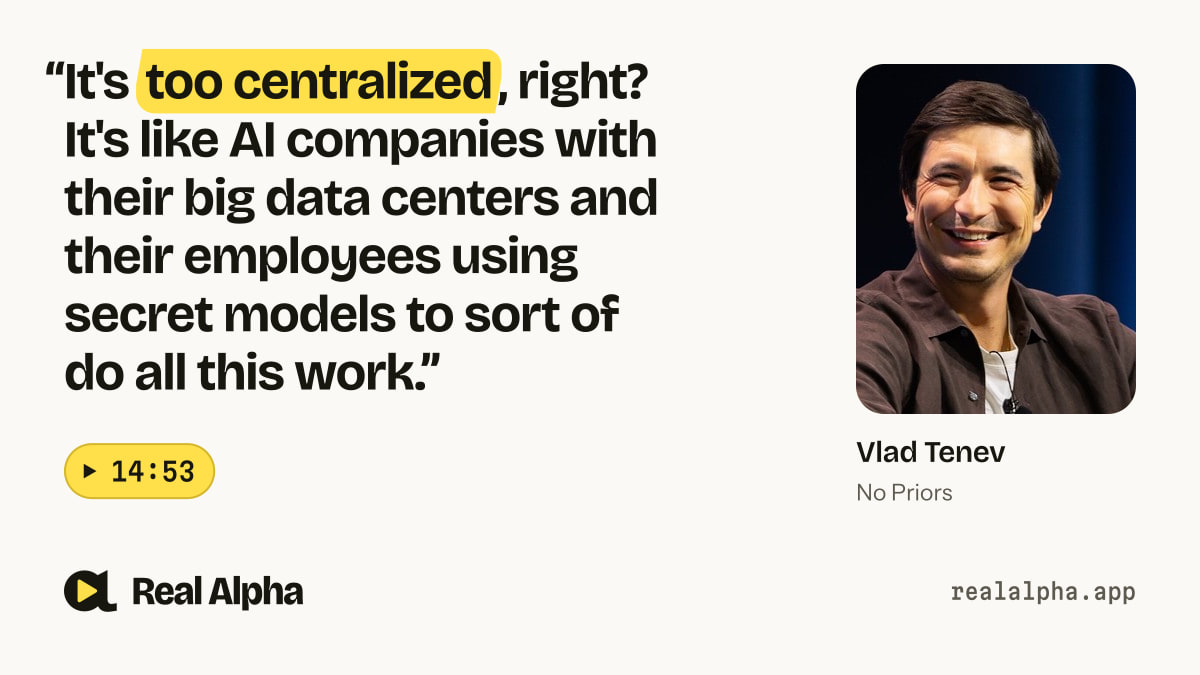
“It's too centralized, right? It's like AI companies with their big data centers and their employees using secret models to sort of do all this work.”
 Vlad Tenevat 14:53 · No Priors
Takeaways Pro pick
- AI tools are automating more of the math pipeline.
- Tenev worries about discoveries owned by AI labs.
- He expects public access to tools to broaden participation.
One of Pro's picks, open to you here. Try Pro free for 7 days
One of Pro's picks. The rest of the summary and the 3 takeaways are in Real Alpha Pro; the video, the quote and the transcript stay free.
Read it with Pro, 7 days freeAbout this segment
Vlad Tenev sees AI speeding up math, but argues that discoveries made inside closed AI labs risk concentrating scientific power. He believes broader participation makes both the work and its outcomes more acceptable.

Vlad Tenev is cofounder and CEO of Robinhood; cofounder of Harmonic.
Co-founded Robinhood in 2013, then steered it from a $500M loss in 2023 to a $1.1B profit.

Sarah Guo, Host · Founder, Conviction
Ex-Greylock partner; early investor in Cognition, Harvey and Mistral.
From “Tokenization, Agentic Trading, Harmonic: Robinhood's Mission to Expand Ownership with CEO Vlad Tenev”, Nov 5, 2026. Watch the full episode
Thanks. We'll look at and fix what's off.
Transcript
Transcribed by machine (Whisper) from the episode’s audio, so a word may be off here and there.
- 12:30
as an effort. What is your reaction to the revolution in math that's happening with AI today? I think on the one hand, it's very exciting and sort of predictable because the rise of AI models and the ability to verify the outputs put together has led to kind of automation of the math pipeline. And I think it's really, really exciting, right? I think that the power and the tools, I mean, math is changing so quickly.
- 13:07
And, you know, math as a field hasn't changed very rapidly at all in thousands of years. I mean, when I was in grad school, most of the work was still being done in person with like chalk and a chalkboard. It's like there was no collaboration. People weren't even using computers. So now math has kind of converged with coding. mathematicians are using the same tools. They're using version control. They're using like Lean for verification. And the field is accelerating very rapidly. About a year ago, so Harmonic, which is a startup that I co-founded a couple of years ago with the goal of building mathematical superintelligence. So last year, we created a model called Aristotle that was one of three that got a gold medal on the International Math Olympiad. And then subsequently to that, we rolled it out to the public. And we had people using Aristotle to tackle unsolved math problems.
- 14:13
And so it was used to solve these Erdos problems. There were these other mathematicians that were using it for new results and so forth. And so then I started thinking a lot about, okay, what's the future of math? How should these tools be used? And I think for me, it was very important for the tools that I build, not just Harmonic, but also Robinhood, to be empowering to individuals, to people. And so the one thing I don't love about like this latest wave of AI models solving math problems is that.
- 15:00
It's too centralized, right? It's like AI companies with their big data centers and their employees using secret models to sort of do all this work. And I think what's more attractive and what would ultimately win out in the end as a model is rolling these things out and actually putting them in the hands of people and having the users make interesting discoveries and inventions. So I am probably like a pretty fundamental believer in decentralization as a philosophical premise. And I would love to believe that's true. I think that there are a lot of people who work at large centralized AI companies who would say, like, if I may push back a little bit, that this is cope and centaur play will just be outclassed by, you know, more compute in an agent loop? Do you believe that's true or what will be the human input here that is
- 16:02
productive in math? Well, I think it's sort of like two separate things, right? One is what's the role of the individual mathematician? And the other is, is this going to be like a product that people use or are the AI labs going to be producing the products? I mean, I have thoughts on both of them, but on the second one, it's much more interesting. I think that a world where you have the AI labs on a proprietary basis, making all the discoveries and you have like the OpenAI or anthropic data centers that are just running code, you know, managed by the employees of those companies. And, you know, they're vertically integrating and, you know, producing all the drugs and selling the drugs to people, making all the mathematical and physical discoveries and publishing all the papers. If all of that is happening and it's owned by the AI labs themselves,
- 17:10
I think that's a bit of like a dystopian outcome and unlikely to happen for a couple of reasons. Not not just like technological and market, but I think also like if if that happens to a significant degree, people will lose their license to operate. I think it's much more I think you could have the same outcome of Navier-Stokes being proven or, you know, the light, the partial Riemann hypothesis or any any one of these things.
- 17:46
And it will be much more accepted if it was like a random layperson using it might be celebrated. Yeah, I think for sure. And I think that's how it's going to happen. that's the likely scenario one year from now. I think you also have the confounding factor of a lot of the people that are going into these AI labs are former researchers. And so they're like excited by doing research. And I think they're confused as to why this is being poorly received.
- 18:20
From their perspective, it's like, oh, I'm a researcher. I was brought into a research organization to do research. And now all these academics are are mad at me. But yeah, I think that and I've said this to folks that work at the companies, I think it would have been much better if they found some mathematicians and kind of collaborated with them to not make it seem like, you know, there's this dark data center dystopian future where, you know, one company is going to