The alpha, twice a week
That was 7 min.
Get the best new moments in your inbox every Wednesday and Saturday. It's free.
Check your inbox
We sent a link to your address. Click it to finish signing up. Not there in a minute? Look in spam.
or
No Priors · 7 min · Nov 5, 2026
Tokenized assets can give global users access to U.S. markets
 Vlad Tenev
 explains how tokenized stocks can trade and compose on blockchains, and how Robinhood Chain aims to bring those assets to people in underserved markets.
The episode’s best minutes
Full analysis- 12:23AI math needs to put discovery tools in people’s handsPro pick 6 min
- 19:03Tokenized assets can give global users access to U.S. markets7 min
- 28:50Robinhood is bringing algorithmic trading tools to individualsPro pick 5 min
- 5 more moments in the full episode
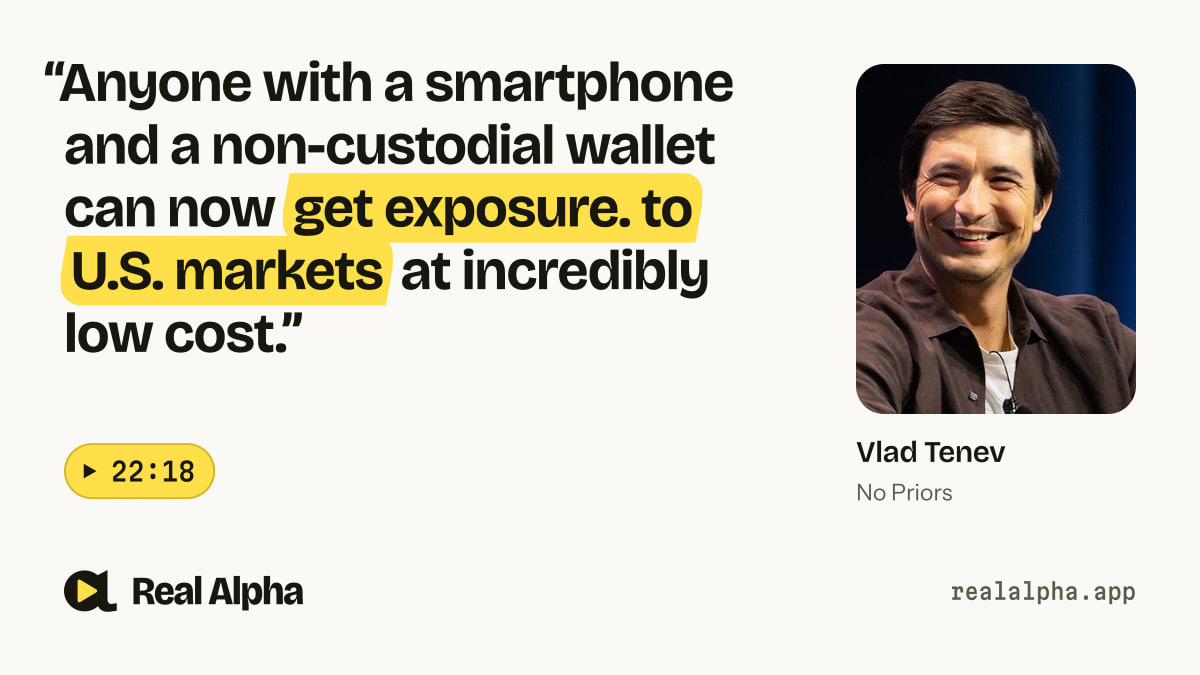
“Anyone with a smartphone and a non-custodial wallet can now get exposure. to U.S. markets at incredibly low cost.”
 Vlad Tenevat 22:18 · No Priors
Takeaways
- Tokens can make traditional assets tradable on blockchains.
- Robinhood Chain is designed for real-world assets.
- Developers can combine tokens into new financial products.
About this segment
Vlad Tenev explains how tokenized stocks can trade and compose on blockchains, and how Robinhood Chain aims to bring those assets to people in underserved markets. The model could open new ways for developers to build financial products.

Vlad Tenev is cofounder and CEO of Robinhood; cofounder of Harmonic.
Co-founded Robinhood in 2013, then steered it from a $500M loss in 2023 to a $1.1B profit.

Sarah Guo, Host · Founder, Conviction
Ex-Greylock partner; early investor in Cognition, Harvey and Mistral.
From “Tokenization, Agentic Trading, Harmonic: Robinhood's Mission to Expand Ownership with CEO Vlad Tenev”, Nov 5, 2026. Watch the full episode
Thanks. We'll look at and fix what's off.
Transcript
Transcribed by machine (Whisper) from the episode’s audio, so a word may be off here and there.
- 19:09
And the idea is almost similar to stablecoin. So the way a stablecoin works is you take some dollars or treasuries, put them in a wrapper, put them in a box, and then you mint and burn tokens against the box and the traditional assets stay custodied at a traditional institution like a like a bank. And then the tokens can trade freely on DeFi so they can move anywhere around the world. They can trade in fractional amounts. They can be swapped in different protocols or lending pools. And that opens up just a ton of possibilities. They have software characteristics.
- 19:50
Yeah. So you can kind of extend that concept to any real world asset. So we've done it with stocks. You can put stocks in a box and min and burn tokens against them and they can trade all over the internet on blockchains like software. You can do it with private companies, you know, instead of a stock, it's like a SPV with private company shares behaves the same with some slight differences around redeeming and things, things of that nature.
- 20:23
You could do it with art, collectibles, real estate. Right. So what we launched and we've been playing around with tokenization and experimenting with it for many years. So last year we had an event in the south of France where we launched stock tokens, which are tokenized versions of U.S. stocks. And we did it in Europe, but it wasn't fully DeFi enabled. So if you're a European customer using Robinhood, you could trade them and they felt very much like real stocks.
- 20:55
But you couldn't actually, you know, send them out on Ethereum or on the blockchain and put them in pools or compose them with other smart contracts. Now, this year, we took it one step further. We relaunched stock tokens with fully DeFi enabled characteristics. And we launched it in conjunction with Robinhood Chain, which is our new blockchain built for real world assets. And Robinhood chain has become one of the fastest growing, I think, the fastest growing across a lot of metrics, blockchains in history.
- 21:26
And what we've seen is just an explosion of developer activity. I think we announced recently it's the number one chain in developer activity, too. and you know developers have taken stock tokens which have become kind of like legos and have started building all sorts of interesting smart contracts nfts pooled assets where you'll take for example a meme coin and link it with a stock token and you know this is just sort of month one and month two type of activity.
- 22:01
Yeah, I think these financial primitives as the foundation of a developer platform will become really, really big. And I think what's more exciting to me than this is Robinhood Chain is a way to enable the long tail of countries. So people in countries that don't have highly functioning capital markets or financial systems, like places in South America or Africa, Anyone with a smartphone and a non-custodial wallet can now get exposure.
- 22:30
to U.S. markets at incredibly low cost. So in the same way that I think stablecoin became the default way for people in these countries to get access to dollars, stock tokens and products like that will be the default way to get access to U.S. equities for all of these people. May they have access to not just copper pots, but wealth creation. Exactly. And private companies. And really the vision for Robinhood chain and tokenization is let's just take all the things that work on Robinhood and put them on chain and make them available to people in all these countries. And I think one thing I've learned is a lot of people, so we're new to operating a blockchain, we're new to operating these on-chain smart contract products. And a lot of the criticisms that Robinhood has received, like we've been called
- 23:25
a corpo chain, right? Like the best blockchains are. So they told me that they said the best blockchains are managed by these like organizations and consortiums and everything's decentralized. And, you know, you guys are a corporation managing a chain. How is that going to be as good? Well, maybe you sacrifice a little bit of like organizational decentralization purity. But what you get is just focused leadership and someone, you know, or some group of people with very, very clear direction pushing things forward. And the other thing is also, I think it is good to have Robinhood backed products on the chain, too. A lot of chains take the approach of, you know, let a thousand flowers bloom, let the developers just build all this stuff. And we love the developers as well. But I think having primitives like stock tokens that
- 24:17
have our backing that people can trust, we've seen that that just creates more interest to build on them. Because, you know, to some degree, people know, okay, Robinhood's backing them. They're legit. Like, that's a trusted brand. We know they're not going to go away. So that gives them much more confidence to build than, you know, if it was just a team of, you know, two or three engineers somewhere that are offering these primitives. Is there an example of a composition that you think should exist on stock tokens or has already come from the ecosystem that you're excited about? I mean, one of the things that I'm thinking about is, yeah, it's like how How can we take some of these derivative products like options?
- 25:04
Can you make like really nice smart contract native options contracts? You know, there's been a tremendous amount of innovation in the traditional markets that's to some degree like stymied by how hard it is to just move off of mainframes onto more modern things and take all the counterparties that are that rely on the system being predictable and slow moving. So I think a big part of it is just let's provide the primitives and let the developers kind of put them together in new ways.
- 25:41
And I don't want to I don't want to, you know, presuppose what developers come up with because I wouldn't have been able to tell you that, you know, stock linked stock token linked NFTs or stock token mean pairs would would become a thing like I just had no way to no way to foresee how quickly those things would grow and become become real.