The alpha, twice a week
That was 4 min.
Get the best new moments in your inbox every Wednesday and Saturday. It's free.
Check your inbox
We sent a link to your address. Click it to finish signing up. Not there in a minute? Look in spam.
or
80,000 Hours Podcast · 4 min · Jul 21, 2026
AI populist coalitions can crowd out frontier safety priorities
Jasmine Sun sees alliances with populist groups as a way to reach voters, but their priorities may not match frontier-safety concerns.
In this episode
Full analysis- 2:19AI insiders expect job losses but feel the race is unavoidable5 min
- 14:04A few personal beliefs can set the direction of major technologiesPro pick 5 min
- 32:47Public backlash grows when workers lack a way to bargain over AIPro pick 8 min
- 6:58Fear of losing leverage is drawing talent into AI labs7 min
- 44:02AI companies need visible benefits to regain public trust8 min
- 22:09Safety work has different status inside and outside AI labs6 min
- 52:49China's AI adoption reflects pragmatism more than optimism6 min
- 40:16AI populist coalitions can crowd out frontier safety priorities4 min
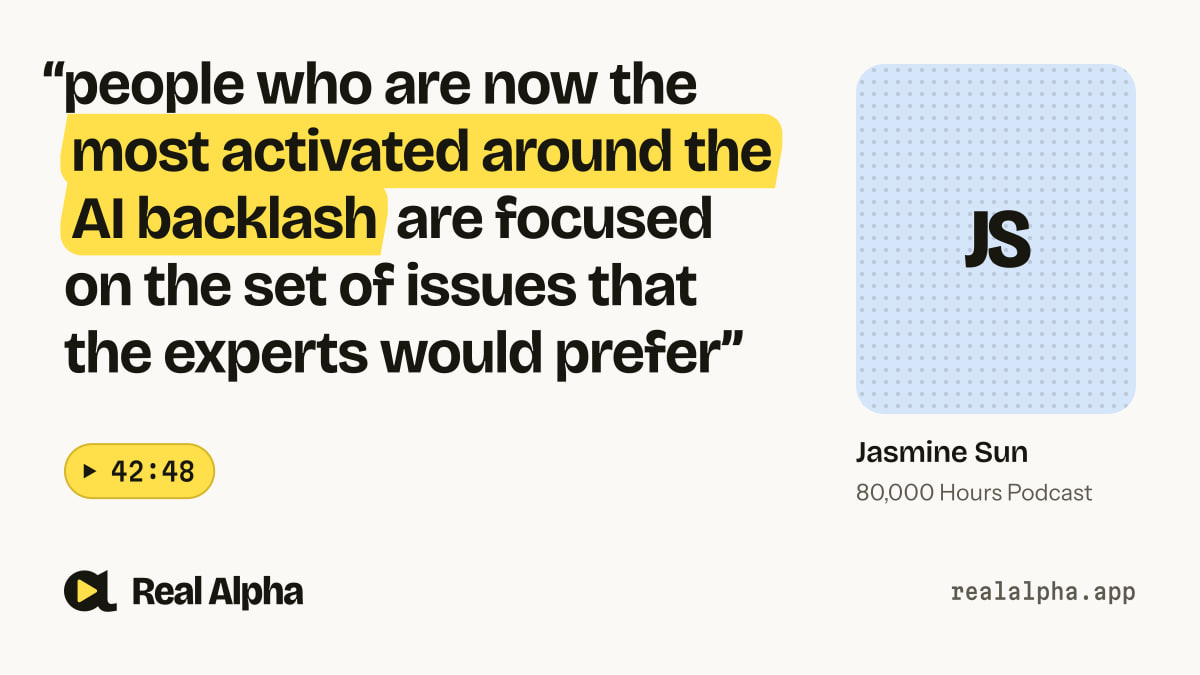
“people who are now the most activated around the AI backlash are focused on the set of issues that the experts would prefer”
Takeaways
- Populist coalitions can give safety advocates access to existing networks.
- Broad AI politics may elevate issues outside frontier safety.
- Water-use debates could absorb legislative attention, Sun warns.
About this segment
Jasmine Sun sees alliances with populist groups as a way to reach voters, but their priorities may not match frontier-safety concerns. Water-use debates could absorb scarce legislative attention.
Jasmine Sun is a writer and journalist covering AI.
Documents the cultures and beliefs shaping frontier AI through her “anthropology of disruption” reporting.
- ZQ
Zershaaneh Qureshi, Host
From “What AI insiders say off the record | Jasmine Sun”, Jul 21, 2026. Watch the full episode
Thanks. We'll look at and fix what's off.
Transcript
Transcribed by machine (Whisper) from the episode’s audio, so a word may be off here and there.
- 40:19
I guess like a reflection that I have, I mean, besides AI populism contributing to like scary, violent things in the near term, it also seems like potentially longer term, it might kind of be bad overall for AI safety, I guess in a couple of senses. Like one thing that you've mentioned, one effect that you've mentioned, right, is that because AI has kind of become the new, like because China, like politicians kind of using it to push whatever thing they were already trying to push for.
- 40:57
Another thing is just like this misguided focus on things like banning data centers, which, you know, I can understand the sort of the fact that that's kind of coming from feeling kind of powerless about what else you can do. And then you also have this like very deep lack of belief and trust in the AI company leaders who are saying that the technology is going to be a really big deal and pose like like potentially pose like kind of like life altering transformative effects.
- 41:28
Um, I feel like all of these things, um, seem like bad news for the safety, like, like getting, getting like good safety policies in place, um, and making sure things go well. Um, what do you make of that? It seems to me that like the safety community is somewhat divided on this question. Um, I've, I've talked to, yeah, like I've talked to folks on both sides. I'm not quite as much of a policy expert here compared to a lot of folks are. But there are clearly some folks from Future of Life, et cetera, who have actually really leaned into the idea that you can build coalitions and build bridges with some of these AI populists because they have existing networks, they have existing relationships with policymakers, they have bases who they can activate around the issue of AI, where a lot of people were probably never going to quite grok a lot of frontier safety
- 42:21
issues, but maybe they could be sort of brought on board through some of these other issues like kid safety or the environment that they otherwise cared about. And so there are clearly some folks who think it's a good idea to forge these alliances. I'm also, however, like, I think what you're saying is very compelling. Like, I do think that by making AI a much more mainstream political conversation, and because AI is such a broad-reaching technology with all these different axes of potential policymaking. It's a real question as to whether the people who are now the most activated around the AI backlash are focused on the set of issues that the experts would prefer, like you said. I think that the fact that the AI water use issue is still as salient in conversations as it is, that is something that's an extremely widespread belief among,
- 43:11
say, college students, is pretty crazy because I think it would be a total misallocation of legislative energy for us to focus on legislating data center water use, right? And it is true that I think a lot of folks are going to be distracted in an ecosystem where there's limited political capital and limited attention by sort of marginal issues if one believed that some of these frontier safety risks are actually the ones that need to be worked on most. I will say that it's possible that the politics of the issue and the broad politics of the issue can coexist with more precise and technocratic policymaking at the legislative level, especially now that mythos and the Pentagon fiasco have sort of gotten a lot of the...
- 44:00
policy and expert community much more worried about the existential risk side of things.