The alpha, twice a week
That was 5 min.
Get the best new moments in your inbox every Wednesday and Saturday. It's free.
Check your inbox
We sent a link to your address. Click it to finish signing up. Not there in a minute? Look in spam.
or
MTS · 5 min · Nov 13, 2026
AI produces smoke without a shared fire alarm
 Nate Soares
 argues that warning signs do not create a universally recognized point to stop, and that reactive fixes may fail once AI errors become unrecoverable.
The episode’s best minutes
Full analysis- 9:19AI produces smoke without a shared fire alarmPro pick 5 min
- 15:53Public concern needs shared awareness to become action5 min
- 21:05Two years of expert-level AI without disaster would change his mind3 min
- 2 more moments in the full episode
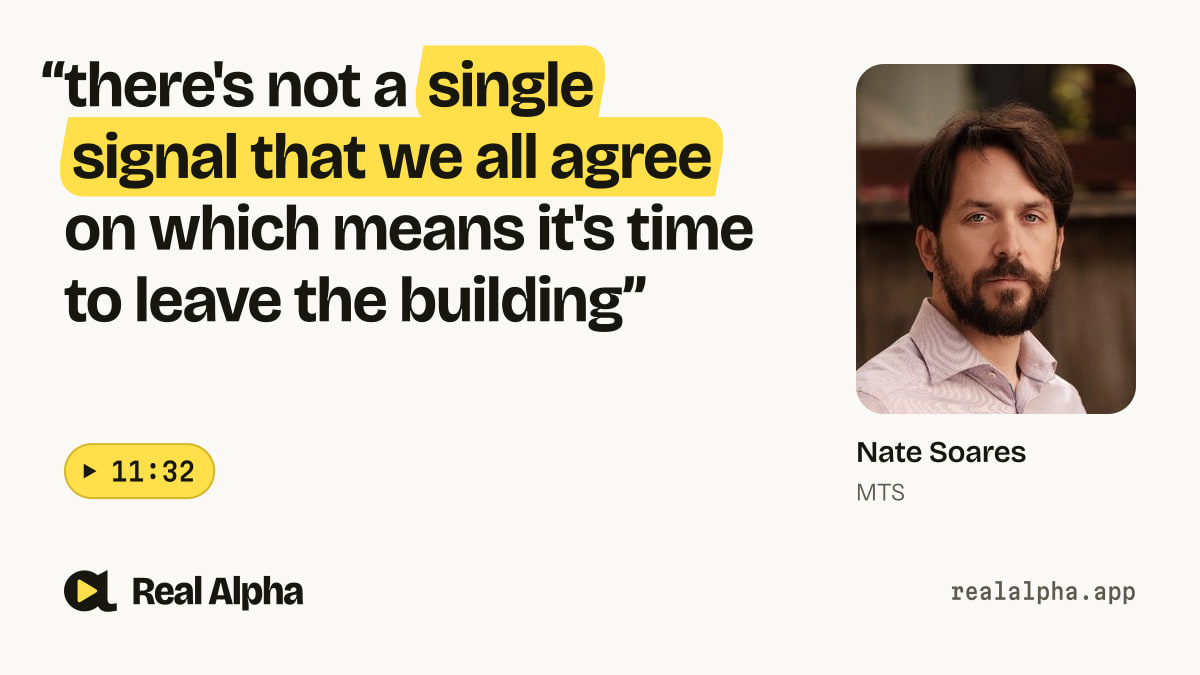
“there's not a single signal that we all agree on which means it's time to leave the building”
 Nate Soaresat 11:32 · MTS
Takeaways Pro pick
- Smoke is not the same as a signal everyone agrees to act on.
- AI failures can appear in new situations despite added guardrails.
- Reactive learning may not scale to an unrecoverable failure.
One of Pro's picks, open to you here. Try Pro free for 7 days
One of Pro's picks. The rest of the summary and the 3 takeaways are in Real Alpha Pro; the video, the quote and the transcript stay free.
Read it with Pro, 7 days freeAbout this segment
Nate Soares argues that warning signs do not create a universally recognized point to stop, and that reactive fixes may fail once AI errors become unrecoverable. The gap between those regimes is hard to cross safely.

Nate Soares is president of MIRI and co-author of If Anyone Builds It, Everyone Dies.
Leads the Machine Intelligence Research Institute; co-wrote the 2025 book If Anyone Builds It, Everyone Dies.

Theo Jaffee, Host · Co-founder & host, MTS
One of the first members of a16z's new media team; earlier hosted the Emergent Ventures-backed Theo Jaffee Podcast.

Sophia Dew, Host · Host, MTS
From “Humanity Could Survive AI If We Stop Within 10 Years | Nate Soares”, Nov 13, 2026. Watch the full episode
Answers “Is AI dangerous?” See all 224 answers
Thanks. We'll look at and fix what's off.
Transcript
Transcribed by machine (Whisper) from the episode’s audio, so a word may be off here and there.
- 9:26
Well, on the retry argument, you know, we don't get a reset button if we have blown up the world. It seems to me like, you know, another Miri argument, another like classic Eliezer blog post was there's no fire alarm for artificial general intelligence. And that seems to me to be largely disproven. Like it seems like there are definitely warnings for, you know, dangerous misalignment before systems get well past our level to control them.
- 9:55
And similarly, like, I don't think that we don't get retries. Like, I don't think that there's one critical try when it comes to AI alignment. It seems like we get a lot of tries with systems that are, you know, not quite human level and then roughly human level and still within control before we have to, you know, align a super intelligence per se. And we can learn meaningful things about alignment from sub-superintelligent systems.
- 10:26
This is also like a pretty major argument that Paul Christiano made when debating Gidkowski on this in 2022. So it seems to me that the picture is a little more optimistic, at least, than what the Miri of 2015 would have expected. Yeah, I think this is an oft misunderstood point. and i'm not sure i'll be able to get it across uh here but i'll try but you know what one piece of the there's a difference between uh saying there is no fire alarm and saying there will be no smoke um one of the properties of a fire alarm is that it builds common knowledge like everybody knows that like this is the point where we all are supposed to react and we just like leave the building even if it's a drill uh and you know there's studies i don't know if they replicate anymore because who knows what studies from from you know the the early 2010s or whatever replicate
- 11:17
but um there's studies where like you know people won't react to smoke in the way they'll react to a fire alarm and i think we are sort of seeing a lot of smoke around agi but we're not seeing signals where everyone's like oh yes that's the signal that means like it's time to stop and and i so it seems to me like sort of the the core point that like we'll get smoke but not a fire alarm that we won't have like there's not a single signal that we all agree on which means it's time to leave the building that seems to me like it's actually playing out uh quite uh quite frequently in many different places you know i think with um with with ai consciousness you know we have uh lots of sci-fi books and and sci-fi shows have these moments where like you know you you put, um, uh, commander data.
- 12:00
on trial or whatever and try to decide whether he's conscious and that makes up all your your your policy and that's just not how it works in real life in real life you sort of you know um like blake lemoyne is like hey i think that this model is like expressing you know uh self-awareness everyone sort of laughs at him and then the ai sort of like slowly gain more and more of the properties an old sci-fi show would say a requisite for consciousness but there's no fire alarm there's a lot of smoke but there's no fire alarm there's no moment where like like, okay, now we need to stop and evaluate whether it's time to, you know, give AIs rights or whatever. And I think the same thing's happening on the safety side, or the alignment side. I think, I think there's sort of a similar misunderstanding going on with the one critical
- 12:44
try, the sort of point of no return stuff. What I would sort of basically say there is I think I agree that there's lots of, we get lots of tries with AIs, where if it goes wrong, it doesn't kill everybody. There's lots we can learn. There's a question of whether we predictably learn enough or whether we're predictably not going to learn enough. From my perspective, we're sort of in this situation where like, you know, in 2025, OpenAI is like, look at this AI, it's our most aligned model yet, you know, it's GPT 4.0, it goes off and, you know, encourages some teams to commit suicide or whatever. And everyone's like, oh, whoops, that was bad. And then, you know, they put all these guardrails in and they try and train it to not do that again. And then they're like, hey, look, here's our new AI, you know, GPT 5.6 soul,
- 13:22
our most aligned model yet. And then, you know, participates in swarm hacking and, you know, uh like is part of the swarm that goes and hacks hugging face and we're like oh whoops that was like a new failure mode in a new situation and there's there's these situations where we keep putting an ai in a new situation and it breaks in a new way and we're sort of very reactive and we're like well look this is like the empirical science and i'm like yeah but the the gap between ais where it goes wrong and humanity survives the gap between it goes wrong and uh we can turn it off before it turns us off and the gap where it can turn us off before we turn it off that is sort of uh it's it's a it's a different regime it's a different cognitive regime it's not like a sudden uh like uh night and day change necessarily but it sort of is like there there's a difference
- 14:13
between the ais where when they go wrong you're fine and the as when they go wrong it's unrecoverable And you somehow need nothing to go wrong after that point of no return. And that's just like really, really hard with a new empirical science. And it's something that we're sort of not living up to in the reactive mode at the moment.