The alpha, twice a week
That was 5 min.
Get the best new moments in your inbox every Wednesday and Saturday. It's free.
Check your inbox
We sent a link to your address. Click it to finish signing up. Not there in a minute? Look in spam.
or
MTS · 5 min · Nov 13, 2026
Public concern needs shared awareness to become action
 Nate Soares
 makes the case that smarter-than-human AI that does not care about us risks disaster, then explains why private concern may not become a political priority.
The episode’s best minutes
Full analysis- 9:19AI produces smoke without a shared fire alarmPro pick 5 min
- 15:53Public concern needs shared awareness to become action5 min
- 21:05Two years of expert-level AI without disaster would change his mind3 min
- 2 more moments in the full episode
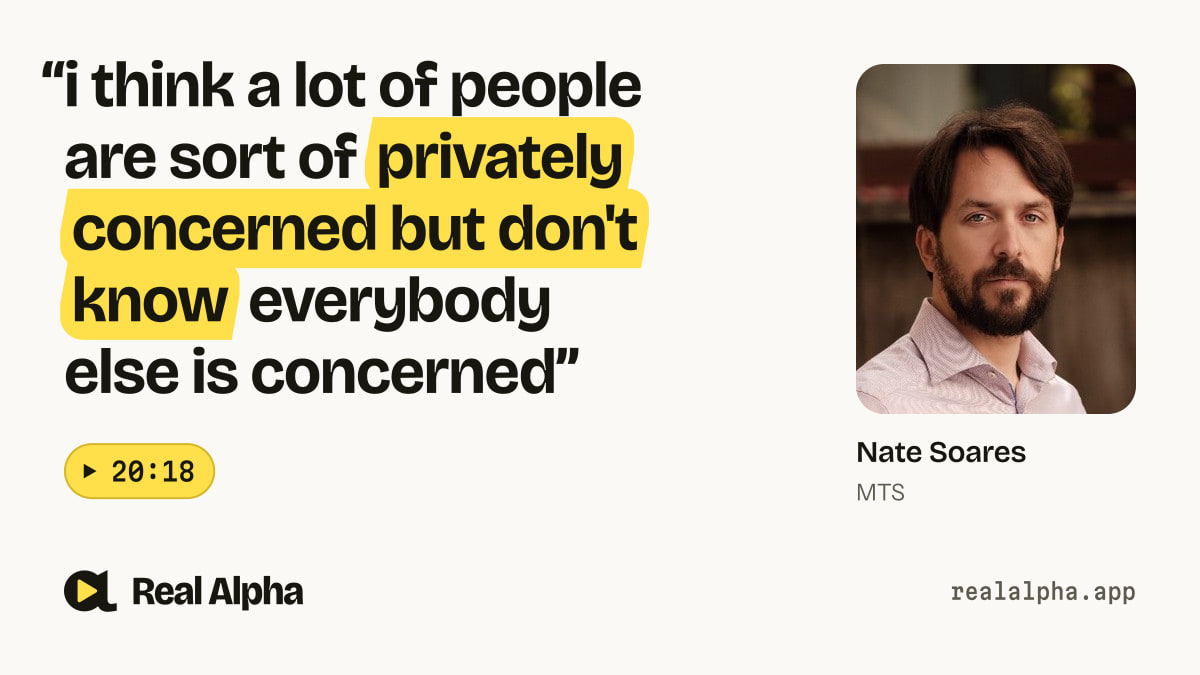
“i think a lot of people are sort of privately concerned but don't know everybody else is concerned”
 Nate Soaresat 20:18 · MTS
Takeaways
- The short pitch is about capability, control, and who sets the future.
- Many people outside AI circles find the risk intuitive.
- People may stay passive if they think nobody else is concerned.
About this segment
Nate Soares makes the case that smarter-than-human AI that does not care about us risks disaster, then explains why private concern may not become a political priority. Advocacy can help people see that others share their concern.

Nate Soares is president of MIRI and co-author of If Anyone Builds It, Everyone Dies.
Leads the Machine Intelligence Research Institute; co-wrote the 2025 book If Anyone Builds It, Everyone Dies.

Theo Jaffee, Host · Co-founder & host, MTS
One of the first members of a16z's new media team; earlier hosted the Emergent Ventures-backed Theo Jaffee Podcast.

Sophia Dew, Host · Host, MTS
From “Humanity Could Survive AI If We Stop Within 10 Years | Nate Soares”, Nov 13, 2026. Watch the full episode
Answers “Is AI dangerous?” See all 224 answers
Thanks. We'll look at and fix what's off.
Transcript
Transcribed by machine (Whisper) from the episode’s audio, so a word may be off here and there.
- 16:00
Going back to the core thing, which is, you know, the Miri argument that if anyone builds it, everyone dies. You know, obviously there are a lot of ways to pose this argument. Eliezer did it through like thousands of pages of like very, you know, inscrutable prose that was kind of optimized for nerds. You did it with, you know, a few hundred pages of prose that was optimized for, you know, maybe New York Times readers.
- 16:24
But, like, how would you make this pitch in 30 or 60 seconds to, like, a normal person, you know, living somewhere in America who's, you know, used ChatGPT and thinks to themselves, like, yeah, you know, I've seen the Terminator, but, like, you know, it doesn't really make any sense that, like, this thing on my phone can kill me. Yeah, I mean, the thing on the phone isn't what's going to kill you.
- 16:45
I would say, you know, AI companies are trying to make AIs that are much, much smarter than humans. They're making progress towards that. Um, and if humanity makes the eyes that are way smarter than us without knowing how to make them also care about us, the default is that ends in disaster. You know, we replace humanity as the, as the sort of top dogs in the planet. And, um, and also we're sort of not on track to make the AIs care about us.
- 17:10
We don't know how we've already seen AIs sort of, uh, uh, going and, and committing cyber crimes, uh, in, in ways that were outside their instructions while acknowledging that it's beyond their instructions. And so, yeah, you know, we make AIs that are much smarter than us that don't care about us. It ends poorly. And we're currently making AIs that are getting smarter and smarter. We don't know how to make them care about us.
- 17:32
You know, QED. So when you like message test this with various people and various different groups of people, various different kinds of people from different backgrounds, who do you think gets it more than others? um you know average people uh like uh random uber drivers random you know midwestern moms um seem to get it pretty easily and in some ways it's common sense that like if the the we make the machine smarter than us and we don't know how to make them care it goes poorly um there's a lot of people have a lot of different places they get off the train um you know some people are like well the ads will never get that powerful some people are like well they'll naturally turn out to to care even if we don't try that hard some people are like well the companies have it all under control they must because they're very smart people um and you know i don't i don't sort of
- 18:26
like correlate those with demographics uh or anything i don't like have that data um but i i have found that like people in the ai bubble people in the ai world are like very resistant to arguments that i think are common sense and and a lot of people outside just are like oh yeah that's obvious you know even politicians are often like yep that makes sense and i hope we don't get there for a while so it's not my problem um and in fact one of the reasons we wrote the book was just we spent more time in dc and a lot of politicians if they they sat down and listened to the arguments they're like oh holy crap that's you know crazy and seems bad um in a way that you know uh employees at the ai labs are much more resistant um and so that that sort of caused us to update towards the theory that like the average person can actually get these
- 19:15
arguments pretty easily, and that it sort of is in the land of motivated cognition around the AI labs that people sort of struggle with the arguments. Well, yes, but there's definitely like a disconnect between, you know, if you pull the American public, you know, some shockingly large fraction will say they think AI might kill everyone, but they don't act like it at all. Yeah, you know, I think humans are strange creatures, right? And I've seen these polls, too. And they're, they're kind of crazy polls, right? You'll have, it'll be something, I don't know the exact numbers, but it'll be something like 80% of people are like, yeah, maybe AI will kill us. And you're like, okay, what are your like top political issues? And they're like, oh, you know, corruption, um, cost of living, uh, you know, maybe climate change. Um, and you're like,
- 19:59
wait, hold on. say that you think ai is maybe is like decently likely to kill you in the next 20 years they're like yeah you know and and like what's going on with this my guess is is that like a lot of what seems salient as for example a voting issue is related to the the broad social narratives at play um and those like i think a lot of people are sort of privately concerned but don't know everybody else is concerned and this it i think there was sort of like a lot of pressure here that's one reason that we're doing the sort of ad campaigns um and this is one of my theories behind why jacob coxson's tweet was able to go so viral is i think we have a lot of people concerned um but they don't know everyone else is concerned and this sort of creates a situation where they feel defeatist about doing anything about ai they feel
- 20:53
like there's nothing that really can be done they feel like nobody else cares about it so it doesn't rise up to prominence. But I think that can change if everyone realizes everyone else is like, oh, wait, this is a bad idea. Right. Well, a couple of days ago, we had Ege Erdil on MTS. And