The alpha, twice a week
That was 5 min.
Get the best new moments in your inbox every Wednesday and Saturday. It's free.
Check your inbox
We sent a link to your address. Click it to finish signing up. Not there in a minute? Look in spam.
or
MTS · 5 min · Nov 22, 2026
AI raises the bar for expertise rather than removing it
 Justin Skycak
 argues that AI multiplies what experts can do, while foundational skills let people judge and direct its work.
The episode’s best minutes
Full analysis- 9:58AI raises the bar for expertise rather than removing itPro pick 5 min
- 23:13Spaced repetition can train connected math skills6 min
- 29:23Use AI to quiz you, not just give you answersPro pick 6 min
- 2 more moments in the full episode
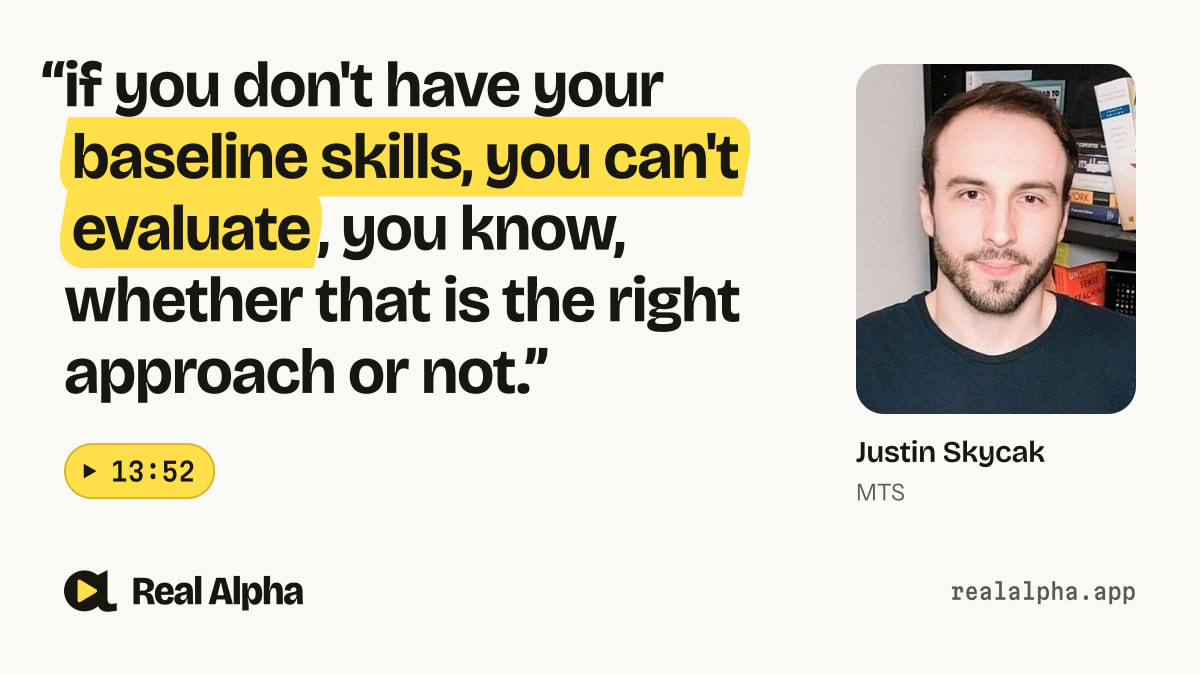
“if you don't have your baseline skills, you can't evaluate, you know, whether that is the right approach or not.”
 Justin Skycakat 13:52 · MTS
Takeaways Pro pick
- Expertise helps you spot which problems are worth solving with AI.
- AI can extend what you know, not replace knowing what you are doing.
- Foundational skills let you evaluate and direct an LLM.
One of Pro's picks, open to you here. Try Pro free for 7 days
One of Pro's picks. The rest of the summary and the 3 takeaways are in Real Alpha Pro; the video, the quote and the transcript stay free.
Read it with Pro, 7 days freeAbout this segment
Justin Skycak argues that AI multiplies what experts can do, while foundational skills let people judge and direct its work. Without those skills, users are led by the model instead.

Justin Skycak is a mathematician, teacher and programmer at Math Academy.
Built Math Academy’s AI expert system and hierarchical spaced-repetition engine for adaptive, individualized math learning.

Theo Jaffee, Host · Co-founder & host, MTS
One of the first members of a16z's new media team; earlier hosted the Emergent Ventures-backed Theo Jaffee Podcast.

Sophia Dew, Host · Host, MTS
From “Why Foundational Math Still Matters in the AI Era | Math Academy”, Nov 22, 2026. Watch the full episode
Thanks. We'll look at and fix what's off.
Transcript
Transcribed by machine (Whisper) from the episode’s audio, so a word may be off here and there.
- 10:02
and I want to talk more about that. It's a place for people learning math, but I want to ask you a question, which is, I love all your excitement. I think there are some maybe possible students of yours or people that I see that are excited to learn math or computer science, but because of these breakthroughs, like they're feeling a bit hopeless. How do you think you move them from feeling hopeless and feeling like learning isn't valuable to being excited again?
- 10:27
Yeah. So I think this is one of those, you know, it's easy to think that because a tool can do stuff for you, that it's like, oh, I like, it's taken away from me the opportunity to do things. But I think in reality, what's happened is that the tool, if you have like a lot of expertise, this tool can extend you in ways. It's a multiplier on you. And so, you know, you get used to thinking like, well, like, you know, the bar used to be here and now AI tools can basically do that. You don't, you don't just like walk into a, like developing a product by, by, you know, not the level of expertise that, that, that you need to have. It used to be a level that, that you could call it kind of use LLM tools for, but, but now it's kind of like the bar has just been raised the multiplier has been raised you want to go do something serious out in the world
- 11:40
it's like you know just just like just like previously when coding came to to math like advent of calculators and stuff it's it's it's like you you use the calculator to extend your mathematical abilities to build stuff as an engineer like having a calculator doesn't mean that you don't need to know what you're doing doing anymore. It means that when you know what you're doing, you can do more of it faster and extend it. And I think LLM is this very similar kind of setup, but just to software in general and domain expertise in general. It's like the more you know what you're doing, the more you see that surface area of all these problems to solve with LLM, what problems are worth solving and what avenues you can explore with them. So I would say it's very much a multiplier.
- 12:25
And if you have a large amount of baseline expertise and you can really, you know what you're doing, then you're going to, you know, you multiply, if your skill level used to be a 1 out of 10, and now with the AI, like, it's like, oh, I'm a 10 out of 10. Like, well, guess what? The scale's out of 100 now. If you were a 10 out of 10, you become 100. If you are, yeah, I think that's basically my take on it.
- 13:01
Yeah, I agree. And I think this leads me to what I want to talk about next, which is, you know, you work on Math Academy. I've been a student of Math Academy. I love it. And I think that, you know, you're spending your life's work on helping people learn math. Why do you still think it's valuable to learn math today, right? I think it was Jensen who was talking about in the future, will we need to know math and things like that?
- 13:23
But I want to get your pitch for why learning math is still valuable. Yeah. So if you don't know the fundamentals of what you're doing, you always got to take other people's word for it. And that's when you kind of get into this trap of just like, you know what, like, oh, so-and-so said this is the best practice or the solution. You don't think about it yourself. You just do what they do. Or like an LLM said, like, this is the right approach to that.
- 13:55
Like, if you don't have your baseline skills, you can't evaluate, you know, whether that is the right approach or not. And you can't get, like, really off manifold from the LLM, kind of extend, you know, the base training set that it's on. And in my experience, so much of the value in producing software is kind of like is equipping, taking your domain expertise, that stuff that other people typically don't know or don't understand, other models don't know, don't understand, and being able to wrangle code and math and just engineering in general to perform.
- 14:42
things that it wouldn't normally be able to do. And yeah, I just think like without the foundational skills, it's kind of like you're just, you got a very low ceiling of what you're able to, you're going to be led by the LLM instead of you leading the LLM. Yeah, absolutely. Okay, tell me more about Math Academy for someone who's listening and they've never heard about