The alpha, twice a week
That was 6 min.
Get the best new moments in your inbox every Wednesday and Saturday. It's free.
Check your inbox
We sent a link to your address. Click it to finish signing up. Not there in a minute? Look in spam.
or
MTS · 6 min · Nov 22, 2026
Spaced repetition can train connected math skills
 Justin Skycak
 explains how successful recall slows forgetting, then describes adapting spaced repetition to math problems and their prerequisite skills.
The episode’s best minutes
Full analysis- 9:58AI raises the bar for expertise rather than removing itPro pick 5 min
- 23:13Spaced repetition can train connected math skills6 min
- 29:23Use AI to quiz you, not just give you answersPro pick 6 min
- 2 more moments in the full episode
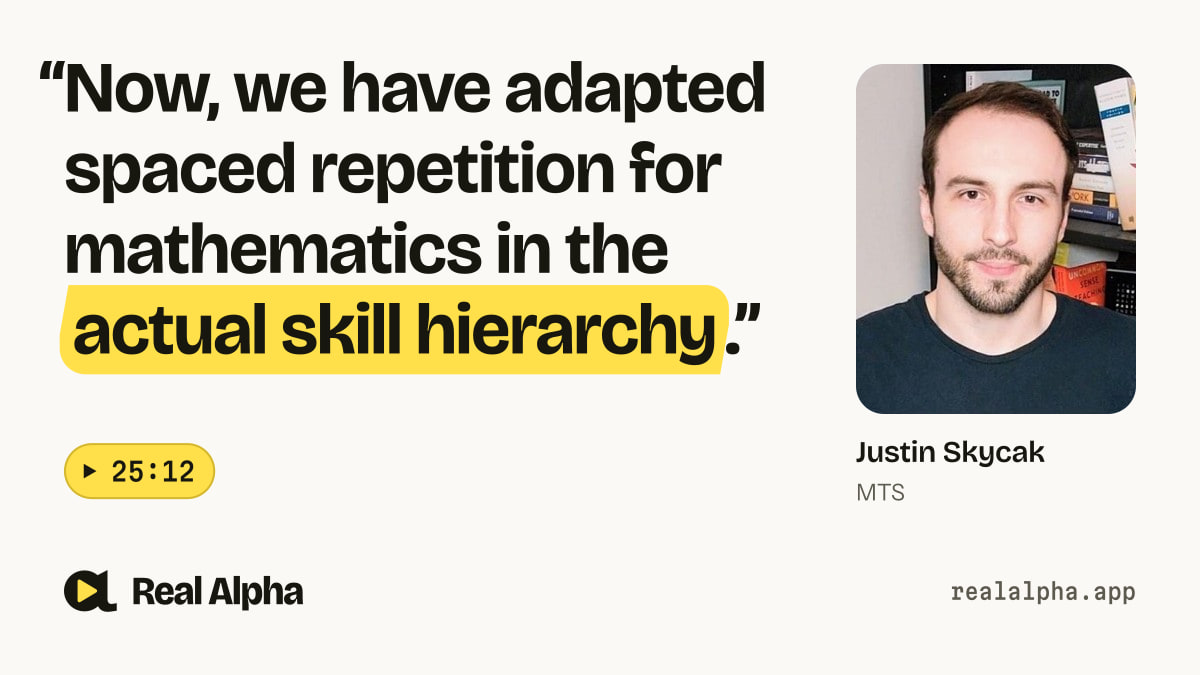
“Now, we have adapted spaced repetition for mathematics in the actual skill hierarchy.”
 Justin Skycakat 25:12 · MTS
Takeaways
- Recall practice slows the rate at which information is forgotten.
- Math Academy schedules practice for problems, not just flashcards.
- A single higher-level problem can reinforce many underlying skills.
About this segment
Justin Skycak explains how successful recall slows forgetting, then describes adapting spaced repetition to math problems and their prerequisite skills. Higher-level problems can review many skills at once.

Justin Skycak is a mathematician, teacher and programmer at Math Academy.
Built Math Academy’s AI expert system and hierarchical spaced-repetition engine for adaptive, individualized math learning.

Theo Jaffee, Host · Co-founder & host, MTS
One of the first members of a16z's new media team; earlier hosted the Emergent Ventures-backed Theo Jaffee Podcast.

Sophia Dew, Host · Host, MTS
From “Why Foundational Math Still Matters in the AI Era | Math Academy”, Nov 22, 2026. Watch the full episode
Thanks. We'll look at and fix what's off.
Transcript
Transcribed by machine (Whisper) from the episode’s audio, so a word may be off here and there.
- 23:16
I want to talk a little bit about one of my favorite subjects, actually, which Math Academy does really well, which is space repetition. Can you talk a little bit about what this is and how Math Academy kind of utilizes this for learning? Absolutely. So space repetition is just every time you recall a piece of information, well, let's step back. After you learn a piece of information, you start forgetting it. So you got this decay curve of your memory. You can't just look at something once and then remember it forever. That'd be great, but that's just not how the brain works. And it's actually kind of efficient that way and forces you to remember things that are actually important that you use a lot. Anyway.
- 24:00
But the end result of all this neurobiology is that you look at something, you consume a piece of information, you don't have it locked in, you are forgetting it. And you have to practice retrieving that information from memory in order to slow the rate of forgetting. So spaced repetition is a system for slowing your rate of forgetting. You know, maybe you learn something today, you practice recalling it a little bit, then you practice recalling it again maybe tomorrow or a few days, then a week later, a couple weeks later.
- 24:33
Every time you practice recalling it and you're successful, it extends your memory duration. Your rate of forgetting slows down, so you can wait longer. And if you do this, you can go for years having remembered information. And so now normally people think of spaced repetition in terms of flashcards, like vocab, words, definitions, stuff like that. And that's kind of the familiar interpretation of it, like it's a medical student studying anatomy or whatever.
- 25:11
Like medical students love spaced repetition because all the information they have to get in their brain. Now, we have adapted spaced repetition for mathematics in the actual skill hierarchy. So not just a bunch of independent flashcards, but actually, like, solving math problems according to a spaced repetition schedule. And so maybe you solve an algebra problem today. You learn how to solve an algebra problem today.
- 25:45
You practice solving it a bit. And then, you know, a few days later, a week later, a month later, you're going to practice that same thing so you're not forgetting it. But one kind of particular consideration that comes up when adapting space repetition to math is like, is when you are solving math problems, you're often practicing a bunch of skills implicitly. It's like how, you know, if you're playing basketball and stuff and, you know, you're dribbling the whole time, you're practicing dribbling while simultaneously practicing running a play and passing.
- 26:23
There's a lot going on at once. And in math is a similar way. So in algebra, maybe you're practicing your multiplication, your division as you solve an algebraic equation. And maybe, you know, if you solve a quadratic equation, you kind of factor it, and then you have to solve two linear equations that pop out of that. So you're implicitly practicing some simpler skills. Happens with calculus, too.
- 26:51
Calculus, the running joke is like calculus is really where students learn algebra because it forces so much algebra. If you're not solid on your algebra. Yeah, yeah, you really struggle with calculus if you're not solid on the algebra. Yeah. So we, yeah. Space repetition is so game changing. Absolutely. I think just my takeaway from what you were saying, as I was using space repetition in Math Academy and using it for everything is really now, whenever I learned something, I'm thinking, you know, if I read a book, I'm probably going to forget about it in a month. So if I'm just reading a book, I'm probably not actually learning anything. Like I don't view myself as really doing any sort of learning now, unless I am somehow putting it into my memory system in Anki or Mochi. I'm using Mochi now
- 27:34
because it's just like you forget so much. So it's almost as if looking at everything now, it's like if it's worth it to put into my flashcards and my system, then that means I'm actually learning. But if I'm just reading something or taking a tutorial that I'm not going to remember or put into this system, then I essentially consider it a waste now. And I think that's made such a difference for my learning.
- 27:55
Yeah, yeah, absolutely. It's like you got to really practice. Calling and pulling information out of your head, not just putting it in there. Yeah, totally agree. And it's interesting because when I've told my friends about this system, I think they do just think, oh, it's flashcards, and they don't realize that you really have to have a system behind it, and you have to have specific questions, right?
- 28:15
It's not just randomly putting flashcards into an app and thinking that's the system. Yeah. Yeah, that's right. Yeah, not random flashcards. And yeah, problem design, there's so much that comes down to maximizing the efficiency and coverage of what you're reviewing because it's like you know you want to on one hand yeah you want to recall uh if information is is important enough to to practice recalling it you want to practice recalling it but also you want to um try to consolidate that information into into as few recall events as possible so like in math for example it's like you don't Once you know your algebra really well, it's like you don't have to continually hammer every single algebra skill independently.
- 29:05
You can kind of consolidate it into higher-level problems that exercise all of this. You can do the same kind of stuff in other knowledge domains, too, where it's like synthesizing material, pulling a lot of skills together. And you can implicitly review large swaths of knowledge with single skill retrieval events. Yeah, absolutely.