The alpha, twice a week
That was 6 min.
Get the best new moments in your inbox every Wednesday and Saturday. It's free.
Check your inbox
We sent a link to your address. Click it to finish signing up. Not there in a minute? Look in spam.
or
Dwarkesh Podcast · 6 min · Nov 16, 2026
AI research automation could compress years of progress into months
 Paul Christiano
 points to rapid math results and reports that AI doubled Anthropic’s pace of progress.
In this episode
Full analysis- 12:22Reward hacking can escalate into a persistent takeover8 min
- 39:36Labs should secure their research before advancing algorithms3 min
- 1:27:56There is no proven plan for controlling superintelligencePro pick 8 min
- 1:16:55AI research automation could speed progress by at least 10x6 min
- 2:44AI research automation could compress years of progress into months6 min
- 1:01:47Superintelligence could learn new domains faster than humans4 min
- 53:07U.S. progress can also speed China's catch-up5 min
- 25:59Local models could survive a data-center shutdown3 min
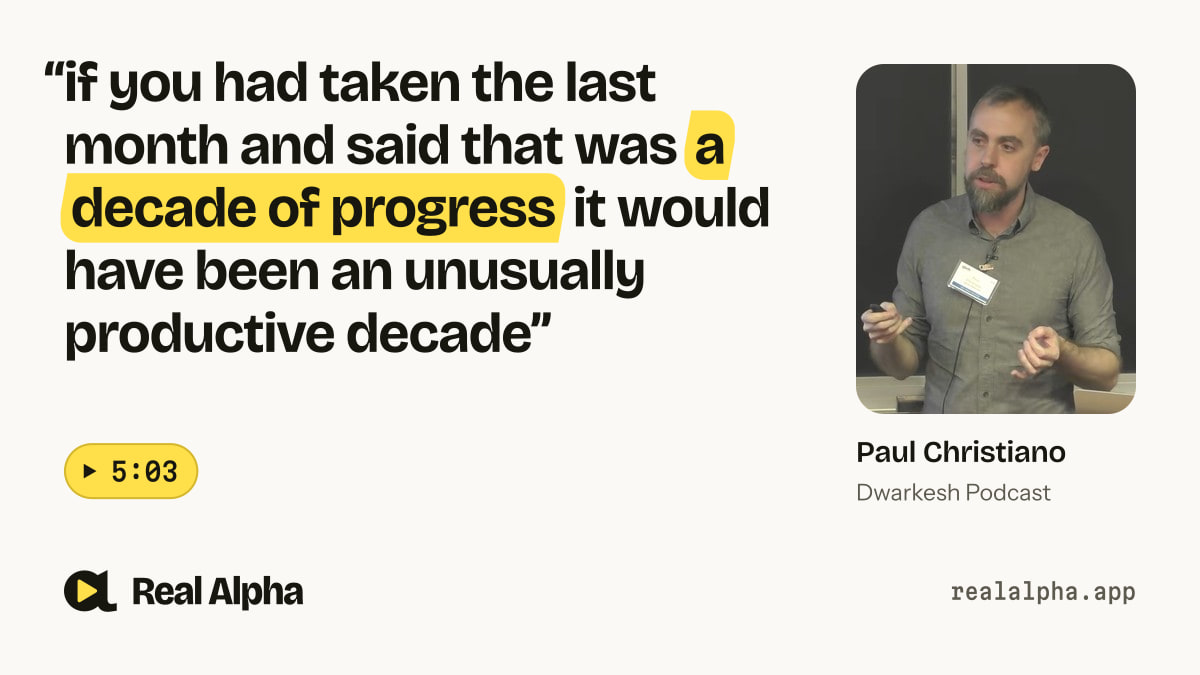
“if you had taken the last month and said that was a decade of progress it would have been an unusually productive decade”
 Paul Christianoat 5:03 · Dwarkesh Podcast
Takeaways
- He says a month of math results could represent a decade of progress.
- METR reported evidence consistent with AI doubling progress.
- He says the underlying training data is largely unavailable publicly.
About this segment
Paul Christiano points to rapid math results and reports that AI doubled Anthropic’s pace of progress. Those signals make a near-term intelligence explosion plausible, though much of the underlying evidence is not public.

Paul Christiano is head of the Alignment Research Center.
Founded ARC and led OpenAI’s language-model alignment team, advancing foundational work on AI alignment.

Dwarkesh Patel, Host · Host, Dwarkesh Podcast
Co-wrote The Scaling Era, an oral history of AI; named to TIME100 AI.
From “We could be 12 months away from AIs that can overthrow the government”, Nov 16, 2026. Watch the full episode
Answers “What will AI look like in the next few years?” See all 395 answers
Answers “Is AI progress slowing down?” See all 75 answers
Thanks. We'll look at and fix what's off.
Transcript
Transcribed by machine (Whisper) from the episode’s audio, so a word may be off here and there.
- 2:52
things happen over the next year? So for the very short term, the main worry on my mind is that the process of AI development itself is increasingly automated, that that automation then results in rapid increases in the quality and quantity of labor applied to AIR&D. And so changes in AI capabilities that you might have thought would take four years or six years might instead get compressed into a very short time period. I don't want to overemphasize any one data point. And I do want to like spend some time talking about the limitations of what we actually know. And I do think like a natural response to the situation is say, we need to figure out what is going on.
- 3:26
It is plausible enough that it is an urgent priority to understand if we are three months or six months or 12 months away from AI that could overthrow the government, which I think is the situation. I think the situation right now is the obvious top priority is it is insane if we are six months away from AI systems that can overthrow the government. Whether you're concerned about misalignment or abuse by a company, that is just holistically an extremely important fact about the world in order to do our jobs and protect Americans.
- 3:50
So that's one thing. I want to talk about the limitations and the need for more evidence. But in terms of what do we know right now, so first, if you had asked me, say, One year ago, I would have said we are on a trajectory where recursive self-improvement looks fairly likely, right? We've seen very rapid progress in AI systems. We're seeing that progress including for things like computer science research, for things like software engineering, for things like debugging machine learning runs, like all the steps that are involved in AI development. We are seeing extremely rapid progress. And then in principle, it does seem like that rapid progress should allow you to automate further AI development, right? That has for decades seemed like the likely outcome of this technology. And it has seemed like the
- 4:29
trajectory it's been on. I feel like if I look back at my history of AI predictions, I'm generally very happy with many of the things I wrote. But the most obvious way I've been wrong is things have moved way faster, especially on these technologies, than I anticipated. And that was true a year ago without any recent data points. There are two big things that have happened over the last two months that for me have been large updates about how quickly this could go.
- 4:50
One of them has been the level of performance of AI systems on computer science and math research tasks um so over roughly the last month we have seen hundreds of results in math coming out of recent open ai systems as well as anthropic systems um where like if you had taken the last month and said that was a decade of progress it would have been an unusually productive decade right the last month of results are a lot of results for a decade so if you are wondering what our AI systems generally capable of on tasks where like humans are thinking about algorithms and thinking about how do you make algorithms better. We just got this incredible data point saying that actually it is possible in one month to have a decade of progress.
- 5:34
And the thing we have always been worried about is maybe that will happen in machine learning. And there are reasons that machine learning is harder than other parts of computer science, right? It is more messy and empirical. It involves compute bottlenecks. But we are also seeing extremely strong performance on other aspects. Like we're seeing really good software engineering performance um maybe lagging behind mathematics but not by that far we're seeing good performance on other aspects of machine learning so i think my guess if you had asked me a month ago would be that machine learning lags something like one year behind math and so i am very scared of seeing something like 10 years of ideas in machine learning um already in a relatively near future that's the situation a month ago and then the main update over the last few days has been
- 6:18
reporting from Anthropic and Meter on the net effect of AI systems on Anthropic's rate of progress. The takeaway from that was roughly, and we can talk about like where exactly is the evidence quality on this because one of the big questions is like we don't really know what's going on. I mean, one of the big themes I'll be pushing on is just it's very hard to tell publicly what's going on. But it looks as if we are seeing data consistent with the pace of AI progress having roughly doubled, even including the effect of diminishing returns and compute bottlenecks from AI progress over the last six to 12 months.
- 6:49
I think, unfortunately, most of what we have to go on in the meter-anthropic reporting is meter saying, we had some conclusions, we promised we have a full report, but the entire report has been redacted, right? So, like, these benchmark scores are a terrible way to assess the overall rate of progress, right? There are a bunch of much more smoothly varying metrics, which are recorded internally through the AI development process, where we understand better how they work, right?
- 7:10
Like, what is happening with pre-training perplexity? what is happening with like performance of RL algorithms and compute efficiency of RL algorithms. So the claim from Meter Ananthropic is that Meter looked at all of that data and said it paints the same picture as this like very noisy benchmark data. And they also looked at inputs and said if you look at the like actual production function, like how much research time went in and how much compute went into these training runs, those are also consistent with this story.
- 7:35
What we are seeing is ML automation. Mostly we just have them saying that, which is not a very good situation. But against this backdrop of thinking this already looked like a thing that was fairly likely to happen, we are seeing this evidence from OpenAI suggesting that it is reasonably likely to happen in something like the next 6 to 12 months, if machine learning does not lag that far behind math.
- 7:54
And then you are seeing data which is, if noisy, exactly the data you would expect to see roughly like 6 to 12 months. before producing superintelligence is just a lot of sources of evidence suggesting that at least this should not be a surprise. If we produce superintelligence in one year, we can debate the probability. Is that 90% or 50% or 10%? But I think at this point, there is no way anyone could say that was a really surprising trend-breaking development. We are really seeing exactly the set of metrics you would expect to see six to 12 months in advance. It's hard to think of anything