The alpha, twice a week
That was 3 min.
Get the best new moments in your inbox every Wednesday and Saturday. It's free.
Check your inbox
We sent a link to your address. Click it to finish signing up. Not there in a minute? Look in spam.
or
Lightcone · 3 min · Mar 27, 2026
AI research needs to scale without a human bottleneck
 François Chollet
's criterion for new AI approaches is whether capabilities can scale without recurring human engineering.
In this episode
Full analysis- 6:08Verifiable rewards explain why coding agents work4 min
- 12:27Gradient descent struggled to discover generalizable reasoning7 min
- 35:13Chollet expects AGI to use a compact intelligence enginePro pick 5 min
- 20:41ARC-AGI 2 was saturated through a repeatable verification loop5 min
- 25:48ARC V3 measures how efficiently agents learn unknown games4 min
- 29:13ARC V3 tests games agents have never played before6 min
- 49:57AI research needs to scale without a human bottleneck3 min
- 52:08Keras grew by making the whole user experience accessible3 min
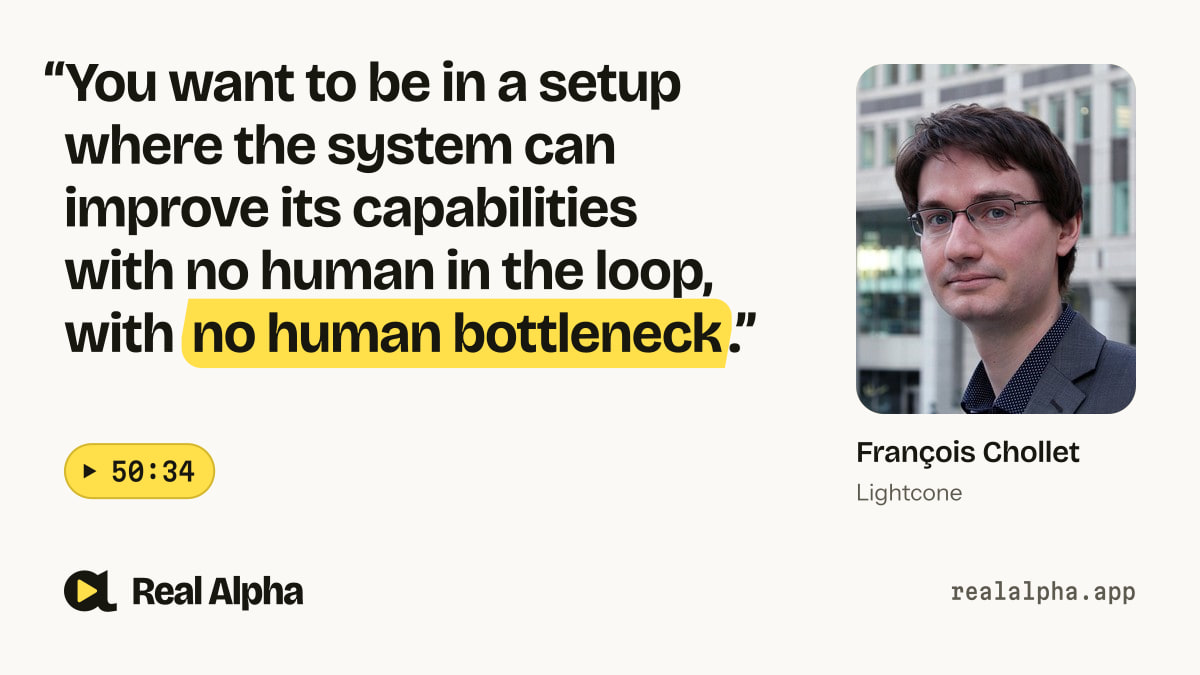
“You want to be in a setup where the system can improve its capabilities with no human in the loop, with no human bottleneck.”
 François Cholletat 50:34 · Lightcone
Takeaways
- Capability gains should not depend on ongoing human engineering.
- Scaling without a human bottleneck is not the same as recursive self-improvement.
- Interactive, verifiable environments can generate much more training data from limited human input.
About this segment
François Chollet's criterion for new AI approaches is whether capabilities can scale without recurring human engineering. He argues that removing human bottlenecks matters more than requiring recursive self-improvement.

François Chollet is founder of ARC Prize and Ndea.
Created Keras and the ARC-AGI benchmark at Google, then co-founded Ndea with Mike Knoop to pursue AGI through program synthesis.

Garry Tan, Host · President & CEO, Y Combinator
Co-founded Posterous and Initialized Capital, an early Coinbase backer.

Harj Taggar, Host · Managing partner, Y Combinator
Co-founded Auctomatic with the Collison brothers and later Triplebyte.

Diana Hu, Host · Managing partner, Y Combinator
CTO of Escher Reality; after Niantic bought it, ran AR for Pokémon GO.

Jared Friedman, Host · Managing partner, Y Combinator
Co-founded Scribd, which YC funded in 2006; has advised 20+ YC unicorns.
From “François Chollet: Why Scaling Alone Isn’t Enough for AGI”, Mar 27, 2026. Watch the full episode
Thanks. We'll look at and fix what's off.
Transcript
Transcribed by machine (Whisper) from the episode’s audio, so a word may be off here and there.
- 50:10
I mean, is it as simple as like, if there's a scaling law that could happen, then even if it's a different or is it, is that too like, you know, thinking by analogy? I think you are looking for approaches that scale. I think it's a non-starter. If you're working on something, but the only way to increase the capabilities of the system is to have human engineers and researchers spend time on it, it will not work.
- 50:38
Because even if the idea is very clever and very elegant and works really well, capabilities are going to be bounded. They're going to be bounded by human investment, right? You want to be in a setup where the system can improve its capabilities with no human in the loop, with no human bottleneck. So you would say like, don't just do it the way we did it like 10 years ago. Do it with the idea that recursive self-improvement is baked in at the beginning.
- 51:02
Yeah, not necessarily recursive self-improvement because deep learning, for instance, is not recursively self-improving, but with the idea of scaling up with no human bottlenecks. You want to remove the human from the improvement loop. The great strength of deep learning is that the models got better and better simply by adding training, training compute and training data. I mean, it's a little bit of caricature because, of course, just adding these factors requires a lot of human involvement.
- 51:30
But basically, that's the idea that you have this decoupling from the improvement curve and the amount of human effort that's needed to be injected into the system. Yes, or human effort that's already happened. Because the LMs do actually require an enormous amount of human effort. It's just it was the human effort to build the internet, and we'd already built it. Yeah. Actually, less and less now that we are doing training in interactive, verifiable environments.
- 51:54
Because then you only need a small amount of human effort to create the environment. And from that small amount of effort, you're creating exponentially more trained data. But at first, I think to sort of like prime the machine, you need this tremendous amount of human-generated abstractions and coding in text data. And if you don't start from that, you cannot get the system into this loop.