The alpha, twice a week
That was 3 min.
Get the best new moments in your inbox every Wednesday and Saturday. It's free.
Check your inbox
We sent a link to your address. Click it to finish signing up. Not there in a minute? Look in spam.
or
Bloomberg Surveillance · 3 min · Oct 30, 2026
AI spending is hard to value when its returns are unclear
Sarah Hunt says AI funding is getting harder to justify as cash flows weaken and the path to returns remains unclear.
The episode’s best minutes
Full analysis- 0:48AI spending is hard to value when its returns are unclearPro pick 3 min
- 8:13Lower-income workers are earning more by working more hoursPro pick 2 min
- 15:18High-yield bonds offer income as a way to diversify3 min
- 2 more moments in the full episode
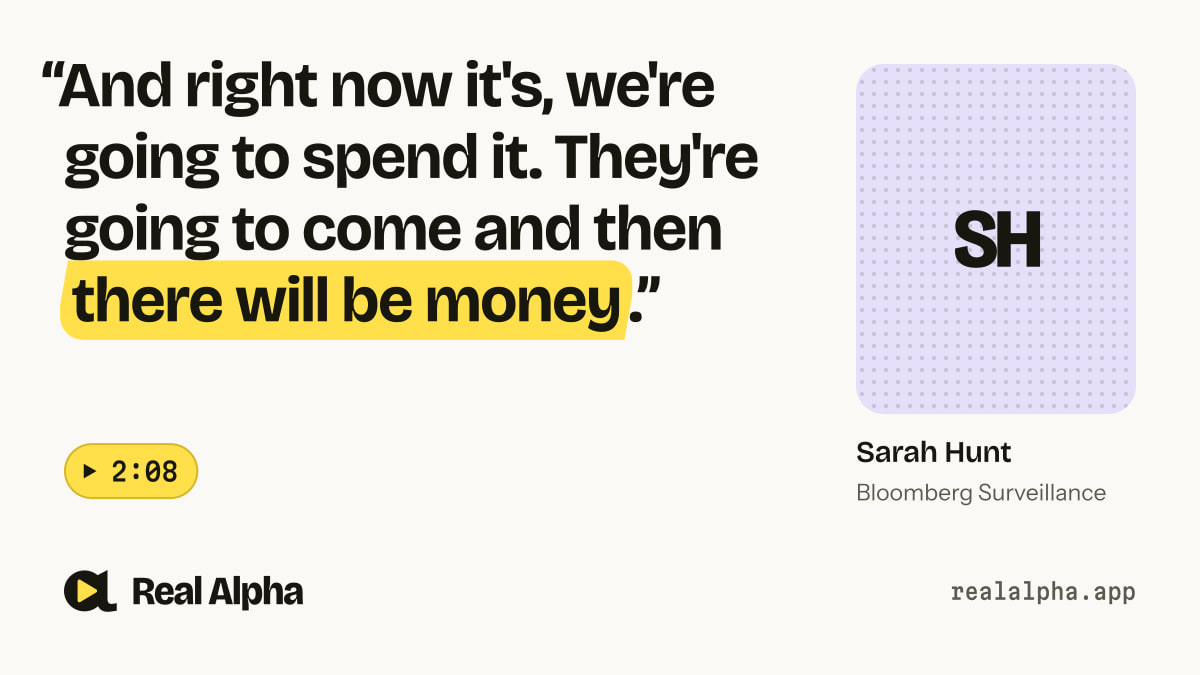
“And right now it's, we're going to spend it. They're going to come and then there will be money.”
Takeaways Pro pick
- AI capex is harder to underwrite when returns lack a clear path.
- Weakening base businesses may undermine AI funding.
- Look for resilient cash flows, not just stocks that have fallen.
One of Pro's picks, open to you here. Try Pro free for 7 days
One of Pro's picks. The rest of the summary and the 3 takeaways are in Real Alpha Pro; the video, the quote and the transcript stay free.
Read it with Pro, 7 days freeAbout this segment
Sarah Hunt says AI funding is getting harder to justify as cash flows weaken and the path to returns remains unclear. She favors balance sheets and cash flows over buying a dip indiscriminately.
Chief Market Strategist, Alpine Saxon Woods
Develops Alpine Saxon Woods’ investment strategies after 25 years managing growth, momentum and dividend portfolios.
- TK
Tom Keene, Host
- PS
Paul Sweeney, Host
- LM
Lisa Mateo, Host
- MB
Michael Barr, Host
From “Bloomberg Surveillance TV: October 30th, 2026 | Bloomberg Surveillance”, Oct 30, 2026. Watch the full episode
Thanks. We'll look at and fix what's off.
Transcript
From the transcript Bloomberg Surveillance publishes with the episode.
- 0:51
Well, you know, you had the whole lead up into this where everybody was, including ourselves, were talking about how good earnings had been and how everything was, that was carrying a lot of the, that plus the AI trade was carrying a lot of the sentiment. And now you have sort of cracks in both. And I wouldn't say that the earnings necessarily were bad, but I think that Alphabet presages an issue when your funding for AI is your base business and your base business all of a sudden is being somewhat compromised. I mean, who knows exactly what that level is, but cannibalized by AI, then how do we look at that going forward? And we're already crossing over into 2027 where those cash flows that were funding everything and you still had mild positive cash flows are flipping to negative. And I think that that's one
- 1:31
of the reasons you've seen the multiple compression that you have. So it sounds like you aren't so quick to just jump in and buy a dip. So we hear two types of thought, right? On one hand, if you actually look at the multiples, they're pretty cheap and the earnings have actually been pretty good. And on the flip side, there's something going on here where they're not answering the question of how they plan to pay this all off and continue to improve profitability.
- 1:53
At pace the way that they have. What's your take on this? Well, I think that a good chunk of that multiple compression is exactly that. It's the uncertainty of I'm spending all this cash. And in prior periods, I could explain to you if I spent a dollar, what I could think I was going to be making on that dollar and how that was going to happen. And right now it's, we're going to spend it. They're going to come and then there will be money. And there's less of an easy path. Now, there are all sorts of discussions about different kinds of compute being used for different kinds of things and how all of this is going to work.
- 2:22
But that's a lot of money to spend right now. And people don't quite understand where that return is coming from. You layer that into the fact that inflation is problematic on the oil front, that you've got component shortages. And all of a sudden, people start to get wary and wary about spending that money. And you've got to go to debt and equity markets and raise it.
- 2:37
So this diversification trade has been sort of what people are turning to increasingly today. Do you think that's the way to go? Is that the way to hedge is to just look for companies and countries that.
- 2:49
Are uncorrelated in some capacity? Does that exist? Well, I was about to say the correlation is not, I mean, it's hard to say that it's uncorrelated because if you have a problem with the story that's been driving the market, the entire market is going to suffer regardless of the companies. that are knee-deep in it versus not knee-deep in it. I mean, we're balance sheet and cash flow people, so we always have been. So there's a big emphasis.
- 3:09
On that for us. And there are plenty of places, the industrial sector's gotten hit pretty hard. Healthcare's got some, there's a lot of good things that are going on in a lot of these different markets. The rise in interest rates was tough on the industrials, and you've seen some of them that are mostly tied to AI have a little bit more problems. But there's still an enormous amount of build-out. I mean, look at GDP.
- 3:27
Like, the economy is, is doing well. And yes, AI is a big part of that, but there are other parts of the economy that are doing well, that are also doing well. So it's not only that story. The problem is that that is the theme that people have anchored to. And when that theme starts to get a little bit wobbly, you see the market do.