The alpha, twice a week
That was 2 min.
Get the best new moments in your inbox every Wednesday and Saturday. It's free.
Check your inbox
We sent a link to your address. Click it to finish signing up. Not there in a minute? Look in spam.
or
Bloomberg Surveillance · 2 min · Oct 30, 2026
Lower-income workers are earning more by working more hours
 Nela Richardson
 says lower-income workers’ base pay is roughly flat, while overtime, extra shifts and side work lift earnings.
The episode’s best minutes
Full analysis- 0:48AI spending is hard to value when its returns are unclearPro pick 3 min
- 8:13Lower-income workers are earning more by working more hoursPro pick 2 min
- 15:18High-yield bonds offer income as a way to diversify3 min
- 2 more moments in the full episode
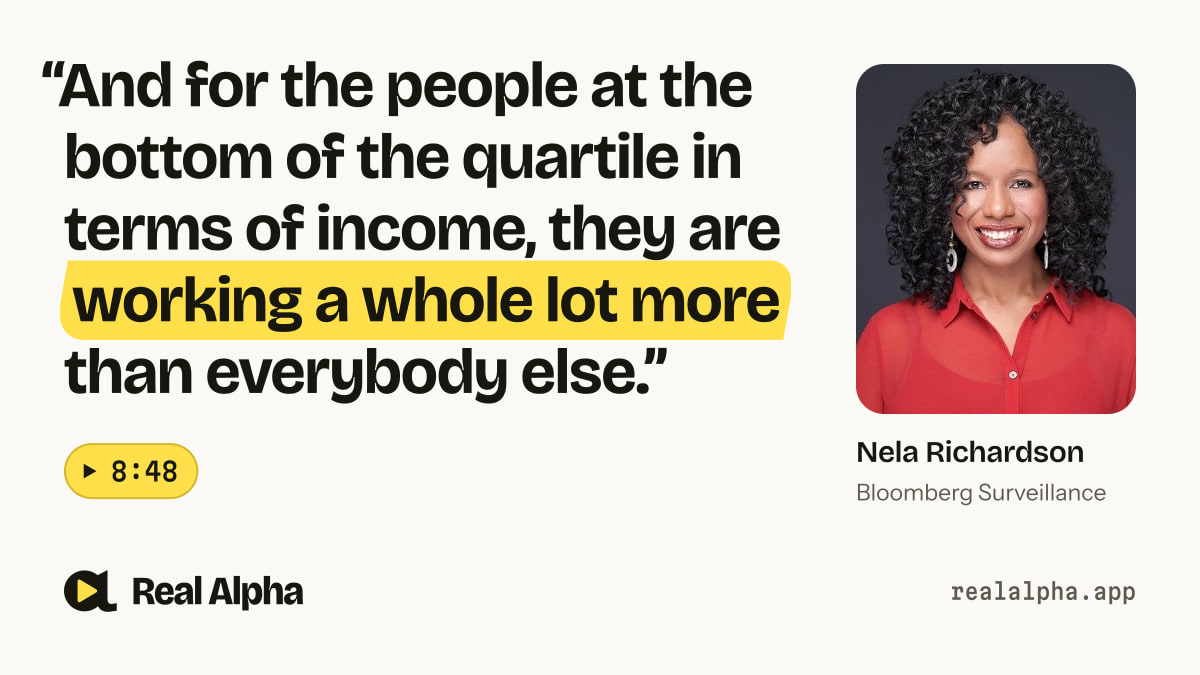
“And for the people at the bottom of the quartile in terms of income, they are working a whole lot more than everybody else.”
 Nela Richardsonat 8:48 · Bloomberg Surveillance
Takeaways Pro pick
- Base pay is up about 3% year over year.
- Lower-income workers are adding hours to keep up with prices.
- Whether they can keep working more is an open question.
One of Pro's picks, open to you here. Try Pro free for 7 days
One of Pro's picks. The rest of the summary and the 3 takeaways are in Real Alpha Pro; the video, the quote and the transcript stay free.
Read it with Pro, 7 days freeAbout this segment
Nela Richardson says lower-income workers’ base pay is roughly flat, while overtime, extra shifts and side work lift earnings. That pressure helps explain why sentiment remains weak despite continued spending.

Chief Economist & ESG Officer, ADP
Revamped ADP’s National Employment Report and launched wage-growth tracking using payroll data from nearly 10 million workers.
- TK
Tom Keene, Host
- PS
Paul Sweeney, Host
- LM
Lisa Mateo, Host
- MB
Michael Barr, Host
From “Bloomberg Surveillance TV: October 30th, 2026 | Bloomberg Surveillance”, Oct 30, 2026. Watch the full episode
Thanks. We'll look at and fix what's off.
Transcript
From the transcript Bloomberg Surveillance publishes with the episode.
- 8:15
You know, the big picture numbers are those things. It is robust. It is healthy. It is solid. It's only when you look under the hood that you actually see what's really going on and how it amplifies the case shape that we're seeing. So what are we seeing? In terms of base pay, everybody's getting about the same amount of base pay. They're getting about 3% from last year. It's kind of normalized to this really boring number. But earnings and base pay are two totally different things. Earnings is how much overtime, how many hours, what the bonuses are. That's where all the action is. And for the people at the bottom of the quartile in terms of income, they are working a whole lot more than everybody else. And that is because they have to keep up with higher prices. So base pay, about the same, but double digits in terms of earnings
- 9:07
for the bottom quarter of this income distribution, all over time, shift work, that kind of thing, driving that increase. In other words, you could see a faster pace of wage growth at the lower end of the K, but it's not because they're getting paid more in their jobs as much as the gig economy supporting their weekly paychecks. That's exactly right. And this is very different than we saw during the great resignation where many economists were really enthused by the fact that there was wage compression from the bottom to the top because the bottom half was seeing such high wage growth. That's not what's happening now. People are just working more to keep pace. and to make their dollar go further.
- 9:50
So this explains why sentiment's so poor. People don't feel good because they're working all the time. That's right. On the flip side, it does give people spending power and the ability to keep... on going out and maintaining their lifestyle even though maybe they don't feel so good.
- 10:04
And so that's a good thing, especially in the good sector where overtime is more prevalent. The question is whether it's sustainable. Can you keep doing this? Can you keep working more to outrun an inflation? And then on the flip side, for the top income earners, which are more likely to be invested in the stock market, is that wealth effect, the feeling that I can spend more because I'm making more in the markets, is that sustainable, especially with the action we're seeing today?