The alpha, twice a week
That was 7 min.
Get the best new moments in your inbox every Wednesday and Saturday. It's free.
Check your inbox
We sent a link to your address. Click it to finish signing up. Not there in a minute? Look in spam.
or
All-In · 7 min · Sep 30, 2025
AI workloads explain Nvidia’s GPU lead and Arm’s role
 Rene Haas
 explains why training favored GPUs, how Arm CPUs support accelerators, and why inference and physical AI need different chips.
The episode’s best minutes
Full analysis- 3:38AI workloads explain Nvidia’s GPU lead and Arm’s role7 min
- 11:14Intel’s missed bets compounded into a manufacturing gap5 min
- 18:18Export controls risk creating rival chip ecosystems4 min
- One more moment in the full episode
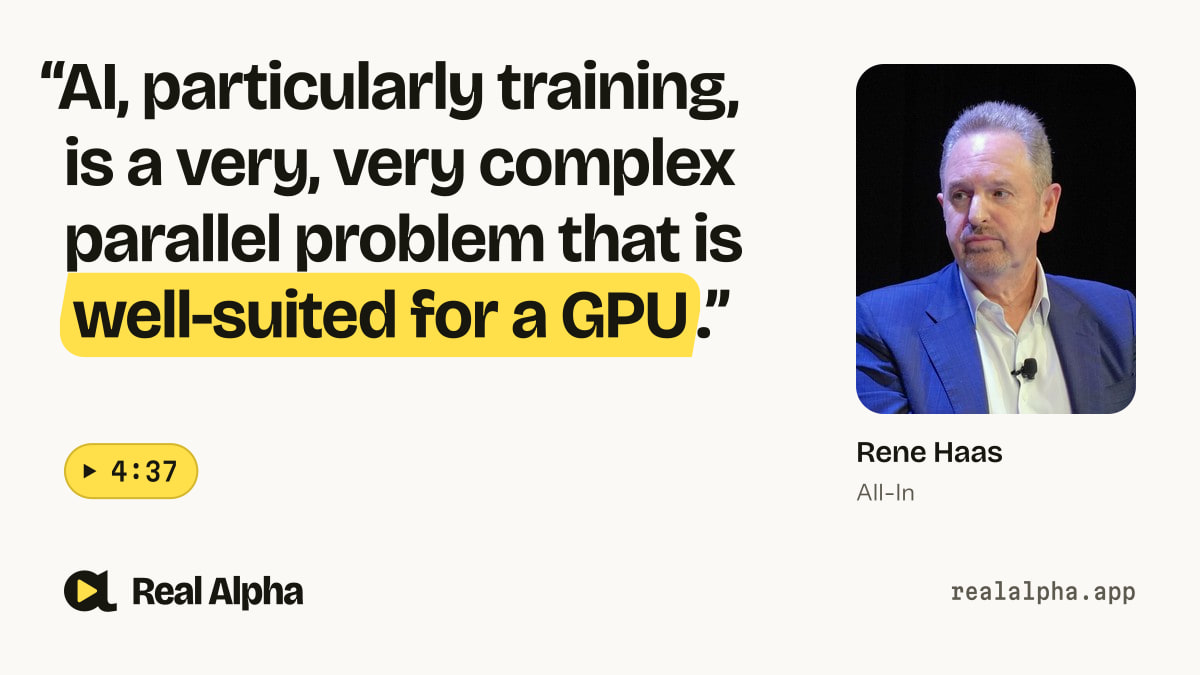
“AI, particularly training, is a very, very complex parallel problem that is well-suited for a GPU.”
 Rene Haasat 4:37 · All-In
Takeaways
- Parallel training workloads are well suited to GPUs.
- Arm CPUs connect to accelerators such as Nvidia’s Grace Blackwell.
- Robots could use tens or hundreds of chips each.
About this segment
Rene Haas explains why training favored GPUs, how Arm CPUs support accelerators, and why inference and physical AI need different chips. It’s a useful map of where chip demand may grow next.

Rene Haas is CEO of Arm.
Arm's CEO since 2022, after seven years at NVIDIA. Since April 2026 he has also led SoftBank Group International.

Chamath Palihapitiya, Host · Founder & CEO, Social Capital
Led Facebook's growth team; his firm backed Slack and AI chipmaker Groq.

Jason Calacanis, Host · Founder & CEO, LAUNCH
Early Uber angel; sold Weblogs Inc. to AOL; hosts This Week in Startups.

David Sacks, Host · Co-founder & partner, Craft Ventures
PayPal's first COO, founded Yammer; White House AI & crypto czar 2025–26.

David Friedberg, Host · CEO, Ohalo
Founded The Climate Corporation, sold to Monsanto for about $1.1B in 2013.
From “Arm CEO Rene Haas on AI: Nvidia Lessons, Intel’s Decline and the US-China Chip War”, Sep 30, 2025. Watch the full episode
Thanks. We'll look at and fix what's off.
Transcript
Transcribed by machine (Whisper) from the episode’s audio, so a word may be off here and there.
- 3:51
Just set the landscape for people that want to understand NVIDIA, the most valuable company in the world. It's a window to understanding AI. What do they make that's so powerful and why aren't there other competitive solutions at that level of scale yet? And how do you think that changes over the next five, 10 years? Oh boy, a lot there to describe. So the way to think about NVIDIA and to some extent, even though I'm the CEO of ARM, I don't want to tie it necessarily back to ARM.
- 4:23
But in our world, what really drives demand is compute workloads. At the end of the day is compute workloads. And when a new workload is essentially either identified and or invented, then it comes down to what is the best architecture processor-wise to address that workload. So let's look at AI, the lightning bolt moment of Alex Nett and the work actually that the Demison team were working on. AI, particularly training, is a very, very complex parallel problem that is well-suited for a GPU.
- 4:57
And in fact, the very first work done by the engineers on AlexNet was not with Blackwell, it was not with an AI processor, but it was with a gaming GPU, a gaming card. So NVIDIA was in a very, very good place to seize that moment relative to the DeepMind moment slash AlexNet slash the transformer slash training. And fast forward, training these complex AI models, as Demis was just talking about, this is a huge huge amount of work now what role does arm play there every one of these workloads requires a cpu to not only mean run the computer but help the accelerator run and that's where NVIDIA is a customer today their most advanced chip called grace blackwell is 72 arm cpus with a blackwell architecture and that's that's where NVIDIA plays today so back to uh where does NVIDIA fit there is competition you know demis talked about uh prior with google they do their
- 5:54
own chip called tpus uh obviously NVIDIA is the leader with general purpose but right now we're in this interesting world where people are looking at is it a general purpose chip is it a custom chip etc etc it's a fascinating time to be in this industry for sure where do you think companies like tesla you know tesla recently merged two pads and now they're working on ai5 and ai6 and some of the more emergent companies like cerebrus and there's a whole slew of companies now, Grok and others that have raised enormous amounts of money. Do you believe that the role of ARM should be, to be the, lack of a better phrase, the arms dealer to all of those folks that need that capability? Or at some point, do you think that, you know, you see enough of it, or you're like, gosh, I could just do this better? Maybe a little bit of both. I mean, today,
- 6:46
the role we play is we are now increasingly that microprocessor that connects to these accelerators, Whether it's something that's done by Cerebris or it's something that's done by NVIDIA, something done by Google, they're connected. Could we do something ourselves custom? It's possible. Could we also supply the intellectual property to somebody building a custom chip? We're doing that today. So to some extent, we're in a very unique place that not only can we provide the solution, whether it's standard or custom, But as AI moves from gigawatt data centers to running in these headsets or running in a wearable or running in something that needs to be energy efficient, you still need to run the compute workload.
- 7:28
But now you need to run the AI workload. And that is a place that I think only ARM is uniquely positioned to address. So you're going to make chips and compete with NVIDIA? I'm not going to say that today, but could we do that? I hinted in the last conference call that we're looking at going a little bit further than we do today. Could we see in the next few years, could we see a divergence in the market between training and inference?
- 7:53
Because what I've noticed is that you've got XAI and OpenAI. And, you know, Google's already doing it with TPUs. They're building their own chips for inference, which might be, I don't know, 99% of the workloads. They seem to acknowledge that NVIDIA is the best at training, and they don't seem, they haven't at least announced an effort to challenge NVIDIA for training. So is there a possibility that, you know, the market could sort of bifurcate into training chips and inference chips, and inference gets much more competitive?
- 8:24
Yes, and I also think you have a third bucket where training distills down to simpler training chips that you don't need to run a trillion parameter model. You can have a giant model that now treats and teaches smaller models, mature experts, 20 billion parameters that can be a mix of inference and training doing reinforcement learning where the chip is now helping learn trained areas. It's almost like the professor teaching a student who can also be a student teacher, right?
- 8:54
Who can do a little bit of both. and then there's inference that over time will be very dedicated and particularly as you get to endpoints that you can't have a gpu that you know runs at a kilowatt of power it's impossible right so if you have robots in the field we have 500 million robots what is the chip market going to look like for robotics how what makes it different than what we have today on the embedded side versus the data center side for ai yeah physical ai is going to be a gigantic market i I mean, today, quite candidly, they're using...
- 9:25
Bigger than data centers? Yeah, I think so. Because I think they're going to... Today, they largely use repurposed automotive chips, right? Things that have functional safety, compliance around ADAS, but they're not specific for actuators or specific for smaller parts of the joints. So physical AI, particularly AI that can learn, is, I think, going to be a giant market because the robots themselves will have tens of chips, hundreds of chips.
- 9:53
So, yeah, from a unit standpoint, it could be huge. The numbers are going to be well beyond what we see today.