The alpha, twice a week
That was 4 min.
Get the best new moments in your inbox every Wednesday and Saturday. It's free.
Check your inbox
We sent a link to your address. Click it to finish signing up. Not there in a minute? Look in spam.
or
All-In · 4 min · Sep 30, 2025
Export controls risk creating rival chip ecosystems
 Rene Haas
 argues that restricting chip supply pushes capable countries to build alternatives.
The episode’s best minutes
Full analysis- 3:38AI workloads explain Nvidia’s GPU lead and Arm’s role7 min
- 11:14Intel’s missed bets compounded into a manufacturing gap5 min
- 18:18Export controls risk creating rival chip ecosystems4 min
- One more moment in the full episode
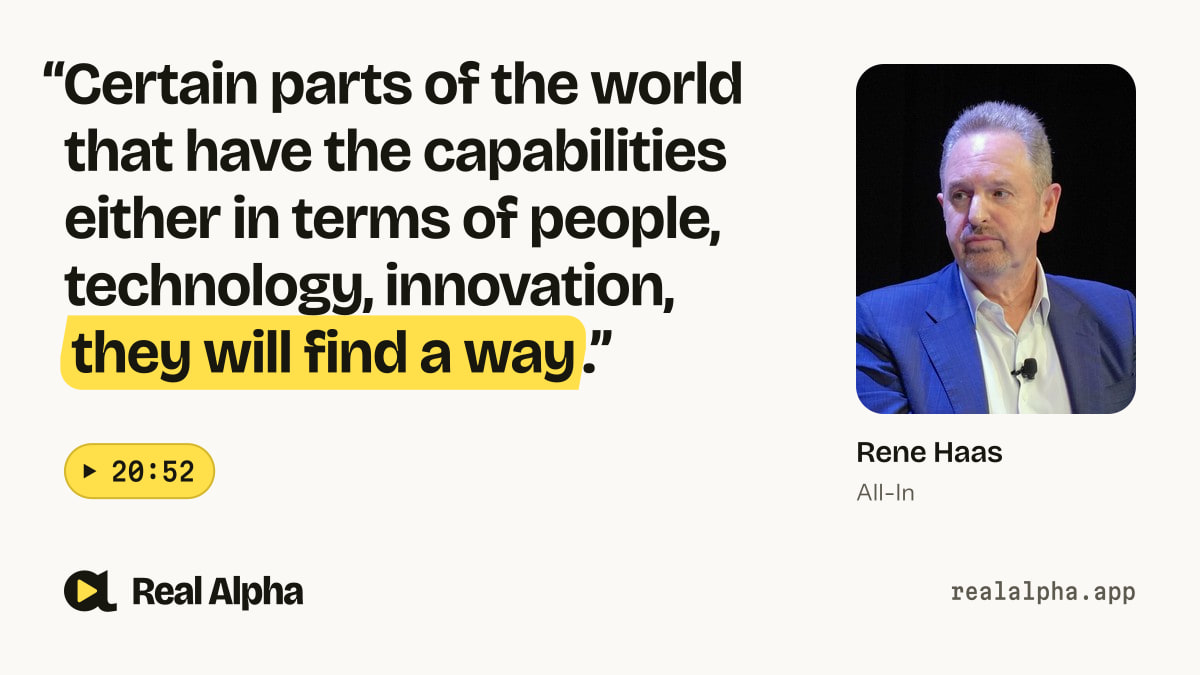
“Certain parts of the world that have the capabilities either in terms of people, technology, innovation, they will find a way.”
 Rene Haasat 20:52 · All-In
Takeaways
- Semiconductors have advanced in a relatively open global ecosystem.
- Restricted supply can spur other countries to find alternatives.
- Parallel ecosystems could make the West less competitive.
About this segment
Rene Haas argues that restricting chip supply pushes capable countries to build alternatives. That could split the global semiconductor ecosystem and put the West’s position at risk.

Rene Haas is CEO of Arm.
Arm's CEO since 2022, after seven years at NVIDIA. Since April 2026 he has also led SoftBank Group International.

Chamath Palihapitiya, Host · Founder & CEO, Social Capital
Led Facebook's growth team; his firm backed Slack and AI chipmaker Groq.

Jason Calacanis, Host · Founder & CEO, LAUNCH
Early Uber angel; sold Weblogs Inc. to AOL; hosts This Week in Startups.

David Sacks, Host · Co-founder & partner, Craft Ventures
PayPal's first COO, founded Yammer; White House AI & crypto czar 2025–26.

David Friedberg, Host · CEO, Ohalo
Founded The Climate Corporation, sold to Monsanto for about $1.1B in 2013.
From “Arm CEO Rene Haas on AI: Nvidia Lessons, Intel’s Decline and the US-China Chip War”, Sep 30, 2025. Watch the full episode
Answers “Should AI be regulated?” See all 145 answers
Thanks. We'll look at and fix what's off.
Transcript
Transcribed by machine (Whisper) from the episode’s audio, so a word may be off here and there.
- 18:30
to build up that capacity in the U.S., I think that's required. Let me go back to X-Fort controls, which Jamath mentioned. I'm not sure people here know exactly how these things work, but basically if a product like an advanced semiconductor is put on the X-Fort control list, It means that the company that's selling it or the buyer, they have to apply for a license from the Commerce Department to get their purchase order fulfilled.
- 18:56
And the Commerce Department will then process that license request and it goes through some interagency committee and five different departments will basically have to sign off on it. And best case scenario, it takes months, but there are license applications that literally have been in the hopper for two years, by which time the chip is obsolete. And believe it or not, there are a lot of people in groups in Washington right now who are calling for literally every sale of an advanced semiconductor worldwide to be a licensed sale because they think that GPUs are like plutonium or something and they're inherently scary.
- 19:30
I mean, this is seriously the discourse that's going on right now. And in fact, there was a major rule that was put forward called the Biden diffusion rule in the last five days of the Biden administration that basically did require every sale of a GPU worldwide to be licensed subject to some carve-outs we rescinded that but there is a never-ending clamor and pressure in Washington to bring back these sorts of rules and the irony is that the people who are advocating for these things call themselves China Hawks but it seems to me that the whole base So the semiconductor industry, the reason why it's moved so fast, why you get new chips every year, is it's really been left alone by the government for the most part. It hasn't been a highly regulated industry. And I'm curious, what do you think will happen to the industry and the pace
- 20:16
of innovation if the government now makes it heavily regulated in the way that I'm describing? You've brought up a great point. And I think we may even have a couple of those in the queue that hasn't been approved for a couple of years. You're right, semiconductors have not been unregulated traditionally. And because of that, if you look at the real heart of what drives semiconductor growth, compute, whether it's Intel, whether it's ARM, whether it's NVIDIA, that's the West. And why is that the West? Because that requires both innovation at the chip level and a global software ecosystem. And the world works really well when it's flat.
- 20:53
And there isn't constraints relative to who you sell to or how ecosystems get built. If you shut off supply of a computing architecture into other parts of the world, what will happen? Certain parts of the world that have the capabilities either in terms of people, technology, innovation, they will find a way. And they will find a way around the problem. And once that happens, you've now created two parallel universes.
- 21:21
And then the U.S. and the West would be at risk of that other ecosystem being an ecosystem of choice. so if you can navigate for those licenses being expedited the world works really well in semis when it's flat and a global ecosystem may the best company win