The alpha, twice a week
That was 5 min.
Get the best new moments in your inbox every Wednesday and Saturday. It's free.
Check your inbox
We sent a link to your address. Click it to finish signing up. Not there in a minute? Look in spam.
or
Latent Space · 5 min · Nov 25, 2026
AI's impact will arrive through frontier work, not one big disruption
 Thariq Shihipar
He expects AI's economic effects to arrive gradually: enterprises will use it to connect systems, while frontier fields like compute, biology and robotics open new opportunities.
In this episode
Full analysis- 6:24A human folder keeps generated game code editable5 min
- 19:44Decision models can route work without full inference5 min
- 42:00Humans should choose which AI experiments get computePro pick 6 min
- 37:28AI's impact will arrive through frontier work, not one big disruption5 min
- 31:14A rejected Dock prototype clarified the distraction he wanted to solve6 min
- 3:09More capable models can work in the tools people already use3 min
- 14:23His main constraint is finding better ways to work with AI3 min
- 48:18Games can give young people practice with real responsibility4 min
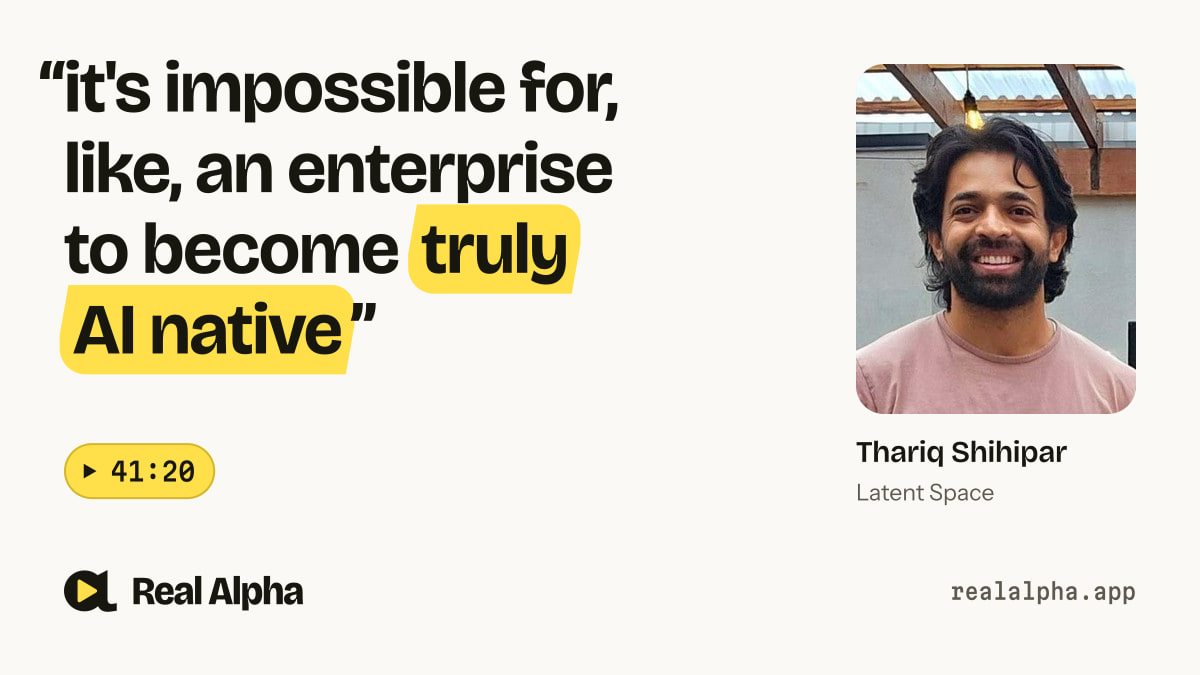
“it's impossible for, like, an enterprise to become truly AI native”
 Thariq Shihiparat 41:20 · Latent Space
Takeaways
- He expects gradual change rather than one-time labor disruption.
- Enterprises can use AI to connect systems and improve delivery.
- Frontier fields may draw ambitious people and create new opportunities.
About this segment
He expects AI's economic effects to arrive gradually: enterprises will use it to connect systems, while frontier fields like compute, biology and robotics open new opportunities. He argues frontier work is what makes an organization truly AI-native.

Thariq Shihipar is a joined OpenAI after the interview.
Builds Claude Code's interface features like AskUserQuestion and writes widely read technical essays on agent harnesses.

Shawn Wang (swyx), Host · Co-founder, AI Engineer
Wrote “The Rise of the AI Engineer” and founded Smol AI, maker of AI News.

Alessio Fanelli, Host · Founder, Kernel Labs
Partner at Decibel, backing technical founders who build developer tools.
From “The Revolution vs The Renaissance — Thariq Shihipar, OpenAI”, Nov 25, 2026. Watch the full episode
Answers “Will AI boost economic growth?” See all 37 answers
Thanks. We'll look at and fix what's off.
Transcript
From the transcript Latent Space publishes with the episode.
- 37:38
Uh, if you, like, recap your highlights of 2026, you know- Yeah... is it just, like, model releases? Is it just, like, trends? And then maybe how do, how do we turn that into insights for 2027? Yeah. Um, I mean, I, I think it's definitely just the year that, like, you know, AI sort of worked, right? And I think that, like- Agents worked. Yeah, yeah, yeah. I, I think that, like, simultaneously everything is very different and nothing is that different. You know what I mean? And I think that's, like, good.
- 38:05
Like, I, I think that, you know, everyone's writing code by hand, but it's not like, you know, we're still, like, writing software and there's still all the problems of writing software that we just talked about, right? It's like, oh, like, you know, like, what are the right decisions? What's the, like, what do you actually want? Like, what- What, what do you mean everyone's still writing code by hand? Oh, sorry.
- 38:23
It's, it's the equivalent of every-everyone writing code by hand. Uh, I, I might have just misspoke. I mean, like, everyone's writing code with agents. [laughs] You know? Yeah, yeah, yeah. Like, compared to write-writing- Yeah, yeah... like, like, you know, the adoption of the, the models have been, like, like, you know, it's insane, like, the fastest adopting thing of all time. I mean, we, we have, uh, numbers from Anthopic's public filings now- Yeah... that show the last one year has completely changed in Anthopic. Yep. Yeah.
- 38:48
[laughs] I mean, it was, like, absolutely insane to see the numbers, right? [laughs] Like, um, but at the same time, like, not that much has changed. Yeah. You know? Like, it's just, like, software- Right... is hard to do, right? Like there... It's not like we're seeing, like, 10% GDP growth or, you know, any... Or, like, yeah, even m-major effects on the labor market or anything like that. Um, and I, I think that's my overall hope is that, like, you know, with RSI that you... It'll happen, and it will also be like nothing is ever really happening. Um- That's like slow takeoff. It's not exactly slow takeoff.
- 39:22
Okay. It's like, I think the idea is, like, okay, may-maybe in five years we'll all have a robot in our house doing our chores. You know what I mean? Um, but I think that, like, in the same way that, like, you know, 10 years ago, um... Okay, more than 10 years ago, 15 years ago, like, plus, um, not everyone had phones, right? Now everyone has phones. Um, is the world dramatically different between then and now? In some ways, yes, right? But in some ways, like, no. This is- You know what I mean? Instead of- Yeah... slow takeoff, just no takeoff, right? Like, not...
- 39:51
Just, like, gradual, linear, people will adjust. I think that, yeah, it's just like human problems are human problems. You know what I mean? [laughs] Yeah. I, I mean- They're status related. They're, like- [laughs]... you know, happiness. Like, how, like- No, like your-... fulfillment and-... your nanny is late and you have a meeting and you gotta go to work and now your kid is stuck, right? Human problems are human problems.
- 40:10
Yeah, yeah, yeah. And so, like, we'll... We can both, I think, have RSI and have human problems, you know? And like, um... Yeah, and then, you know, like, things like enterprise adoption and things like that are... So my personal e-expectation kind of of how RSI will go is that the, uh, we'll sort of have these frontier capabilities, right? Like robotics, biology, compute, et cetera, that are, like, kind of obvious wins at some point. Like, like, compute is an obvious thing now, right?
- 40:38
Where you're like, "Oh," like, "If we just make a compute company, and we, like, get whatever, we make new chips or we make new data centers or something like that," it's like you just do it and you make money. Um, and then there's things that we're f- new basic research essentially that's, uh, being done with biology and robotics and stuff, where you're, like, trying to prove out that this will work, you know what I mean?
- 40:56
Like, that biology will work, um, that robots will work. And once you prove it out, then it just becomes like a let's invest as much as we can in this. And there will just be, like, this ever-increasing amount of frontier work to do, right? Like energy, robotics, biology, all this stuff, and that will be, like, how we, uh, like, you know, where we want to spend the most compute and intelligence and where the most ambitious people will go.
- 41:18
And then on the other side, there will be, you know, enterprises and things like that where, like, AI is used to, like, glue things together, to make things efficient, to make sure we deliver the work and things like that. But it w- you know, like, it's impossible for, like, an enterprise to become truly AI native, right? I-in the sense that, like, they just don't have the opportunities, and in order to ha-find the opportunity, you have to be at... Like, you have to do a frontier thing, you know what I mean? Like, you have to be solving biology or robotics or, like, things like that. And so I think we'll...
- 41:49
My hope is that, like, the economy will just sort of sort like this, right? Where it'll be like, oh, you know, w- AI's making things more efficient in enterprise and driving revenue on... And each frontier capability unbox new revenue and new possibilities and, and, um, it's not this, like, big disruption all at once. Yeah. Um, that is one f- yeah. It's...